 Sipu Jha

When The Matrix came out in the last year of the last century, it broke our minds. The perfect mix of occidental and oriental philosophy wrapped in Goth motifs with unimaginable kickass action made audiences everywhere question their reality. It became so ingrained in popular culture that when landlines started disappearing, people wondered if we were stuck in The Matrix, because that was the only way to teleport out of the simulation and back into the real world.While we might not be stuck in The Matrix, we certainly are stuck somewhere, or at least our minds are. Not in a fabricated digital illusion, but in the endless quagmire of never-ending content. René Descartes once said: “I think, therefore I am.” A more honest update for our age would be: “I scroll, therefore I am… stuck.”Anyone who has consumed short-form video (SFV) content knows the drill: you start off with a cute clip of Baby Yoda doing the magic hand thing, watch Obi-Wan Kenobi do what he must, and before you know it you’re neck-deep in fan theories about how Yoda was secretly responsible for the rise of the Empire. What feels like a momentary detour quietly becomes a mental labyrinth with no clear exit.And it turns out this isn’t just anecdotal doomscrolling. A massive new psychological review — the meta-analysis Feeds, Feelings, and Focus, spanning 71 studies across continents — has now mapped what this endless stream of short-form content is doing to our attention, our emotions and the subtle architecture of the mind. Its findings don’t scream catastrophe; they whisper something far more insidious: a civilisation drifting into a new cognitive normal without noticing the shift.
How the study was conducted
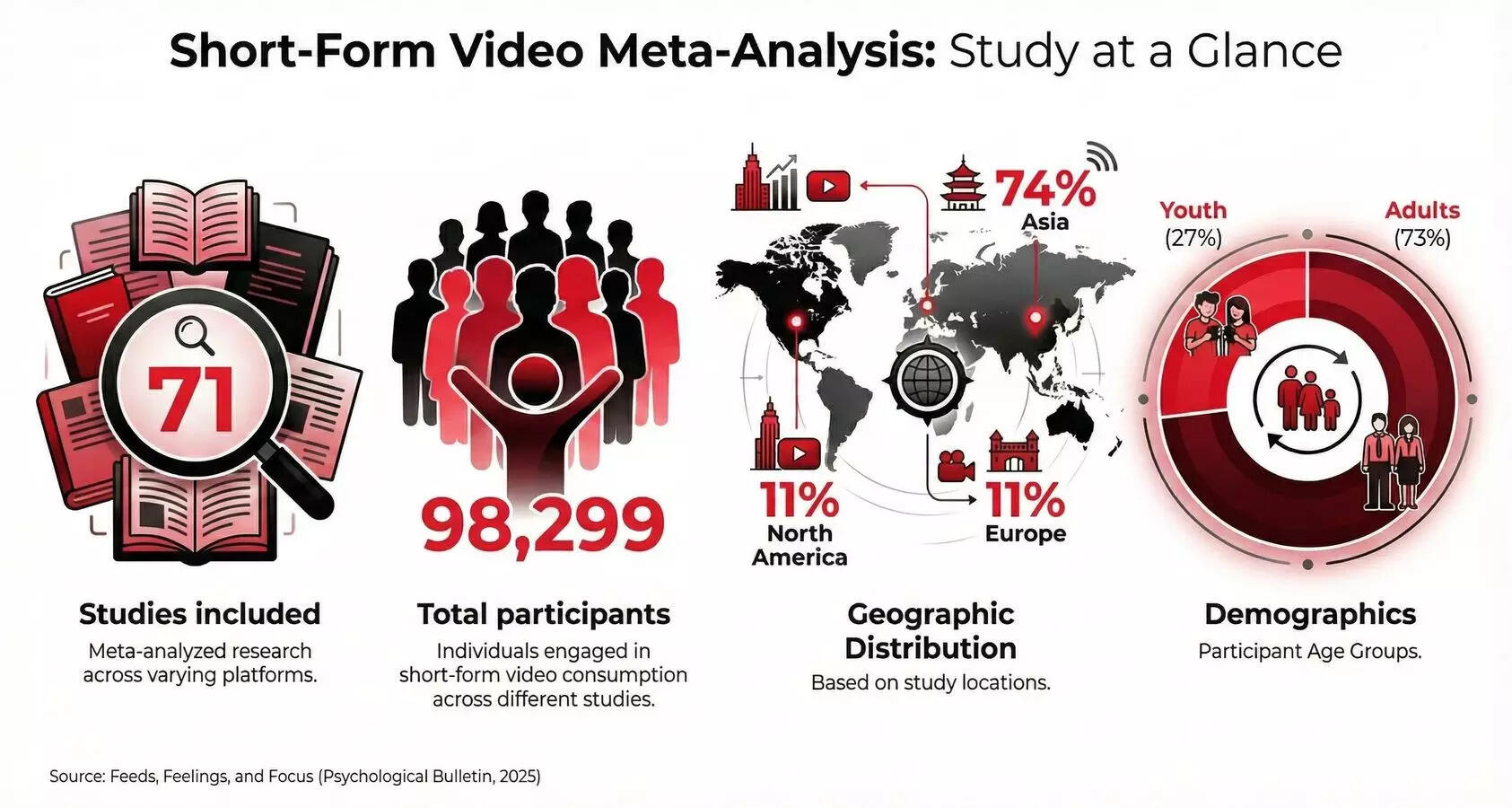
To understand what this shift in mental life really means, researchers assembled one of the most ambitious reviews of digital behaviour so far. They analysed almost 100,000 participants — schoolchildren, university students, office workers — spread across Asia, Europe and North America. The scale alone is remarkable, but what matters more is its breadth: not a single platform in isolation, but the entire ecosystem of short-form video and the rhythm it imposes.They examined simple behaviours like time spent scrolling, but also deeper patterns: whether checking the feed feels automatic, whether stopping feels oddly difficult, whether small bursts of stimulation become the default way of filling emotional or cognitive emptiness. They studied attention, memory, impulsivity, anxiety, sleep, loneliness, self-esteem and overall well-being.A consistent pattern emerged across cultures, age groups and research methods. The correlations between heavy SFV use and negative outcomes were modest — typically between –0.10 and –0.30 — but they appeared everywhere. In psychology, such consistency is a powerful signal. A single gust of wind changes little; a steady breeze reshapes the dunes.
At a Glance
At the broadest level, the study shows a mind slowly retraining itself to move at the pace of the feed. Heavy SFV users lose focus more quickly and tire faster, with attention shifting into bursts rather than stretches as the systems that once anchored concentration begin to thin. Emotion follows the same pattern: a gentle but persistent rise in stress and restlessness, captured in that –0.21 drag, as feelings arrive too quickly to be fully processed and leave the nervous system in a state of low-level tension. Age offers no refuge here. With 73 percent adults in the sample showing the same patterns as teenagers, the feed reveals itself to be an equal-opportunity disruptor, interacting with human architecture rather than life stage. What truly shapes the outcome is not how long people scroll but whether scrolling has slipped below the level of conscious choice, because the moment behaviour becomes automatic, the psychological cost deepens and autonomy begins to erode swipe by swipe. And through it all, identity sits in a strange equilibrium: the effects on self-esteem and body image are tiny and inconsistent, not because the platform is safe but because it is too chaotic to impose a single direction, amplifying whatever emotional or narrative groove the algorithm believes each user already inhabits.
What the study reveals
What it reveals is not a brain damaged by technology, but a mind slowly reorganising itself around a medium that never pauses, never concludes, and never gives the nervous system a place to rest. Short-form video does not overwhelm the mind; it reshapes its expectations. It does not destroy attention; it redefines what attention feels like. It does not replace emotion; it accelerates its rhythm.The findings fall into five broad revelations that explain how the infinite scroll reshapes the way we think, feel and inhabit our own inner world.
Revelation 1: Attention deficit
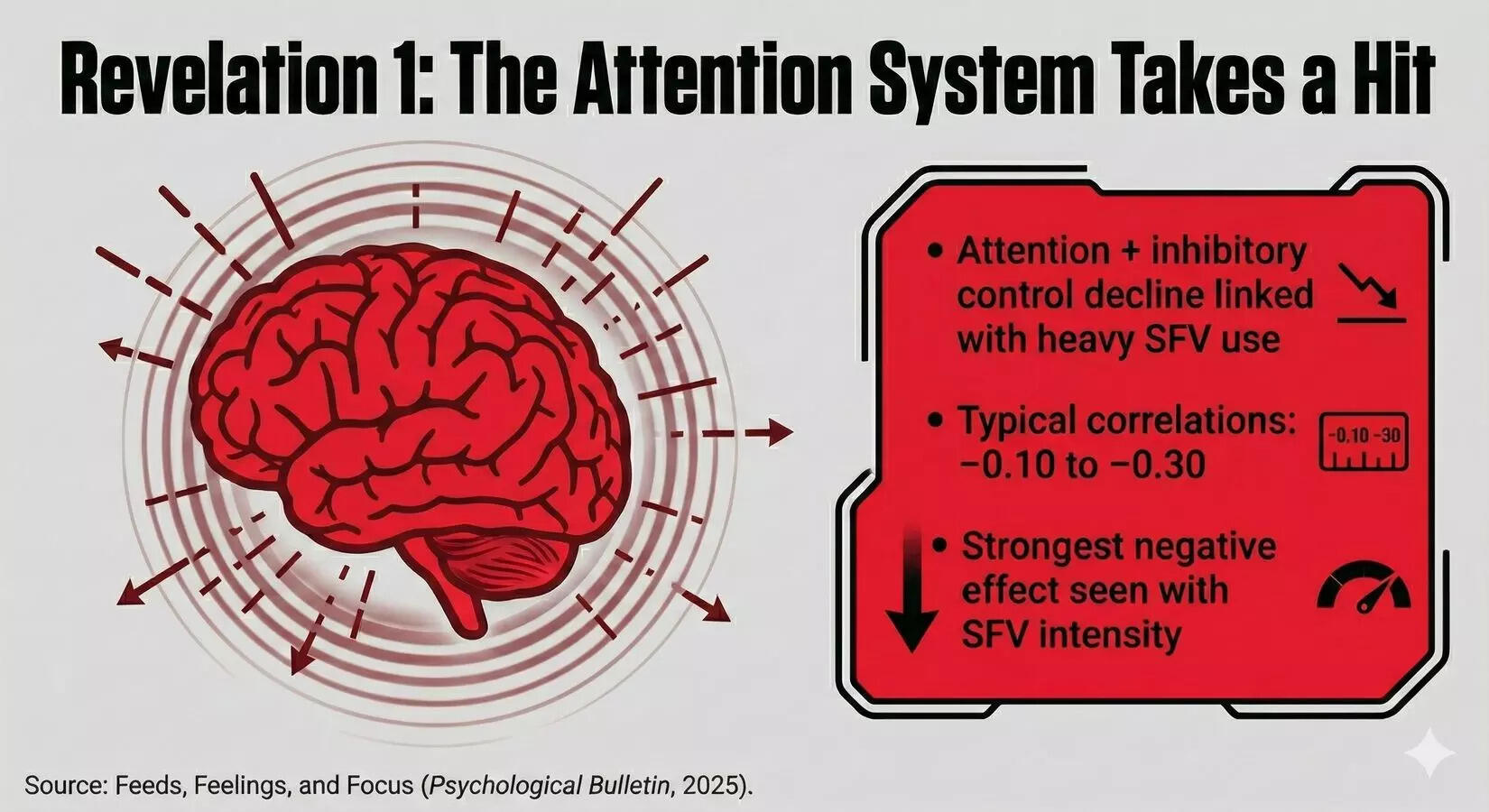
The clearest pattern in the data is a quiet thinning of sustained attention. Heavy users of short-form video are not incapable of focusing; they simply find it harder to remain with a task for long. Concentration starts to feel like holding a posture after too much fidgeting — still possible, but strangely burdensome.Across the meta-analysis, tasks requiring sustained focus and inhibitory control show negative correlations in the –0.10 to –0.30 range, signalling a mind that has adapted to the feed’s micro-rhythm. Instead of settling into stretches of thought, it learns to operate in bursts. Working memory and executive function show small but reliable declines, suggesting that the mental anchor points that once stabilised attention are loosening.A brain conditioned for rapid novelty begins to experience traditional slowness — reading a page, listening without interruption, engaging with complexity — as effortful. The mind grows accustomed to motion, and stillness begins to feel unnatural, almost suffocating, like swimming against a current designed to carry it somewhere faster and shallower.
Revelation 2: Overstimulation
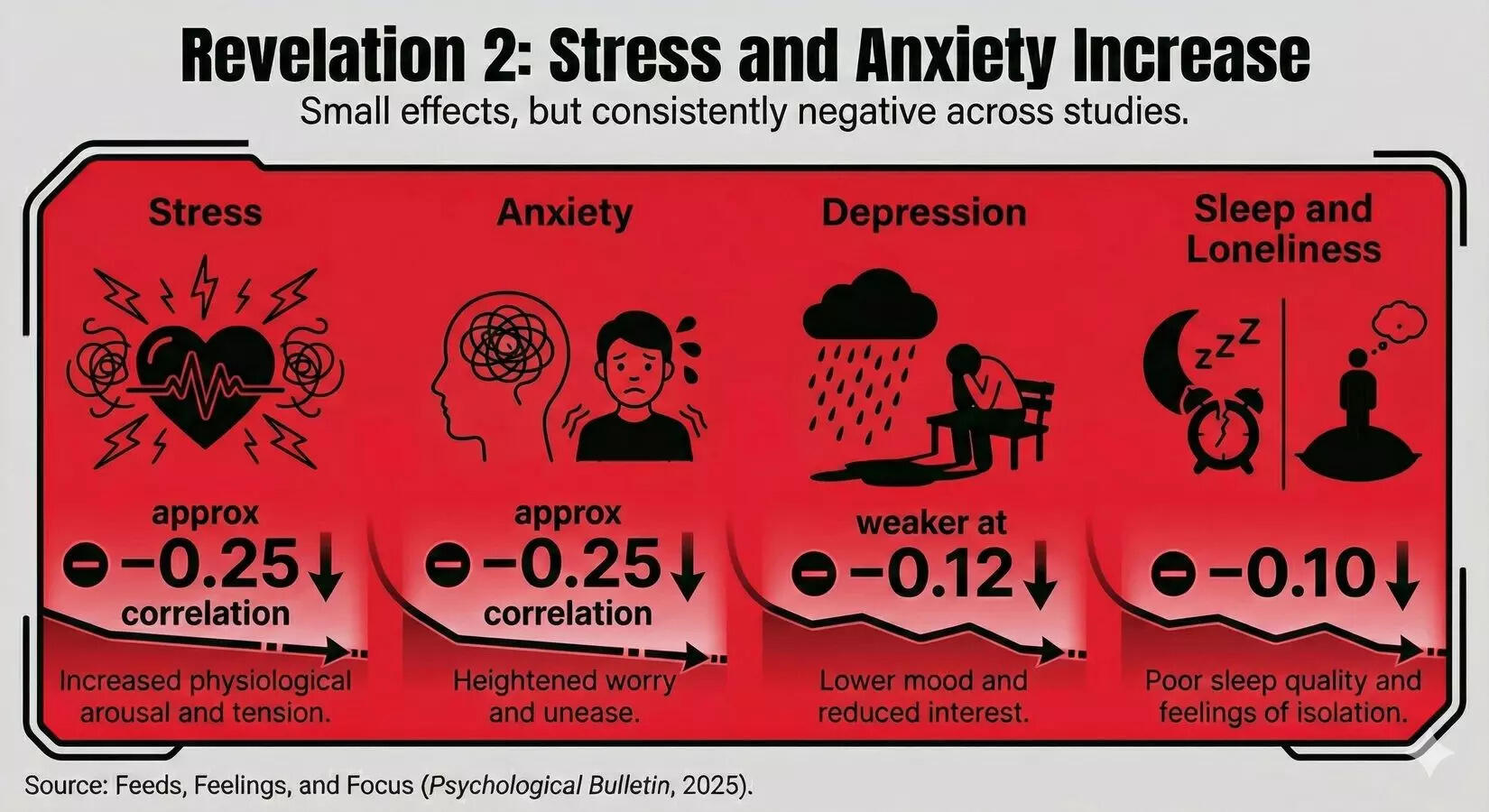
The emotional data reveals a steady rise in stress, anxiety and restlessness among heavy SFV users — not a dramatic spike, but a quiet thickening of tension across daily life. The overall correlation sits at r = –0.21, with a confidence interval from –0.25 to –0.17.This means the link between SFV use and poorer mental health isn’t overwhelming but is consistently negative across nearly 100,000 people. Numbers like –0.25 for stress and anxiety represent stronger small-to-moderate effects — the psychological equivalent of a persistent headwind. Values like –0.12 for depression and –0.10 for loneliness and sleep reflect smaller drifts in the same direction.The nervous system is pulled through emotional states faster than it can settle into any of them: delight collapses into disgust, awe flickers into irritation, sympathy dissolves into envy. Over time, the mind is left with half-finished feelings and a faint, lingering hum of tension. SFV does not drain emotion; it disrupts its rhythm.
Revelation 3: Age doesn’t matter
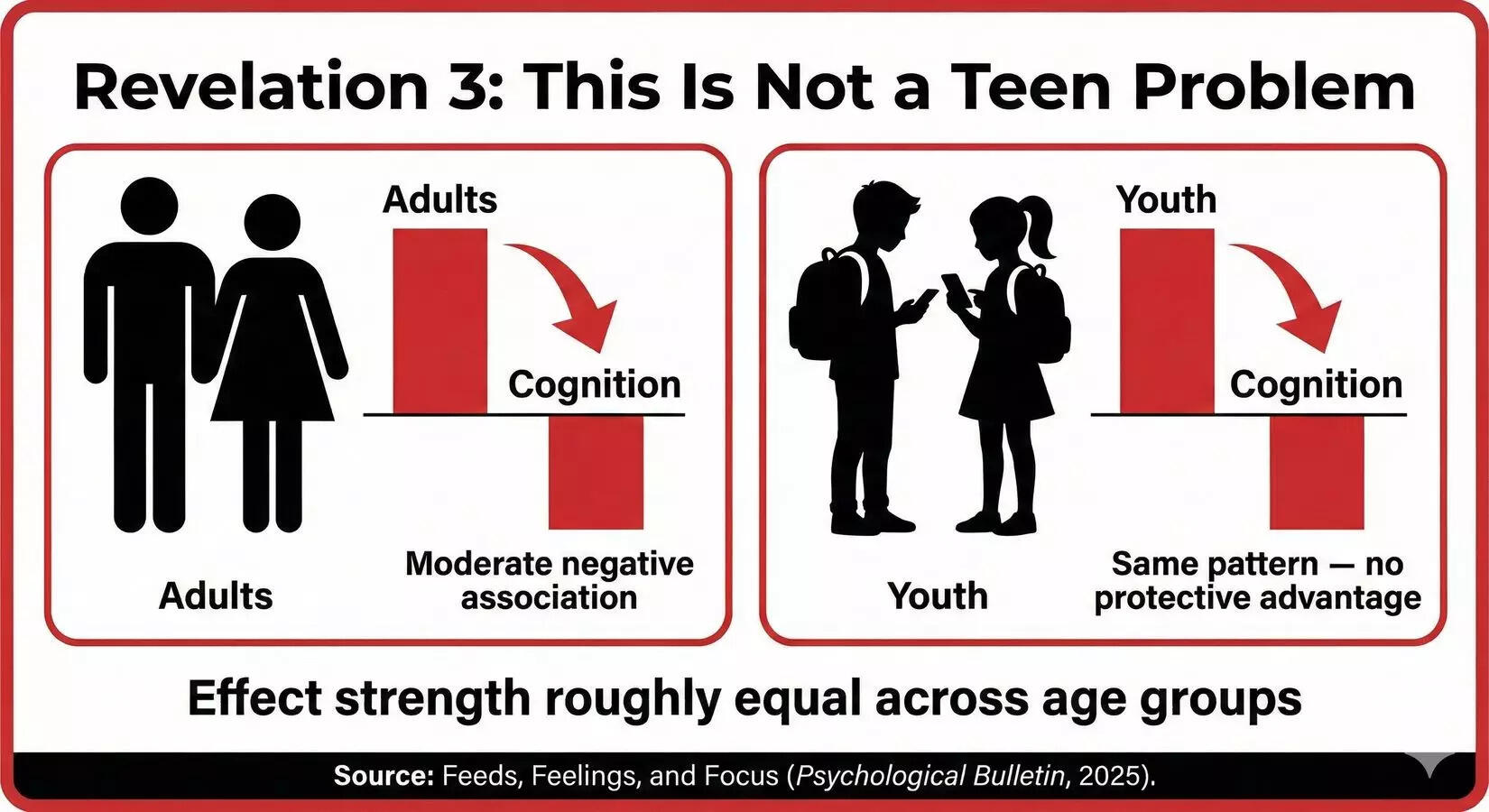
Perhaps the most humbling insight from the study is that 73 percent of participants were adults, yet their patterns of attention loss, stress and sleep disruption were virtually identical to those of younger users. The belief that maturity offers psychological protection collapses under the data.Adults often insist they use the feed “mindfully,” “sparingly,” or only to “unwind,” yet the nervous system processes the rapid novelty in the same way regardless of age. The feed interacts with human architecture, not life stage. Vulnerability here is not developmental. It is universal.
Revelation 4: Time vs Agency
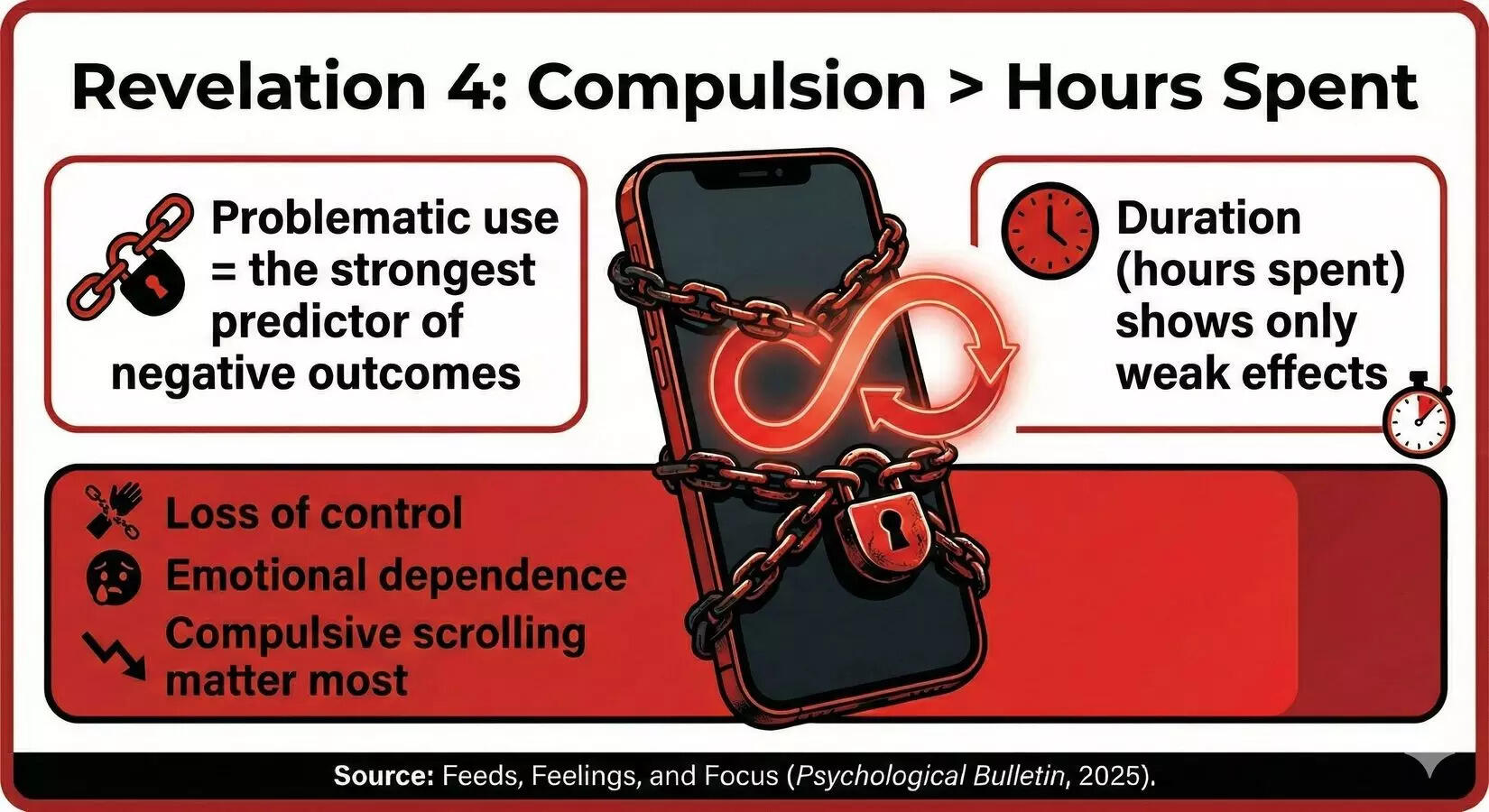
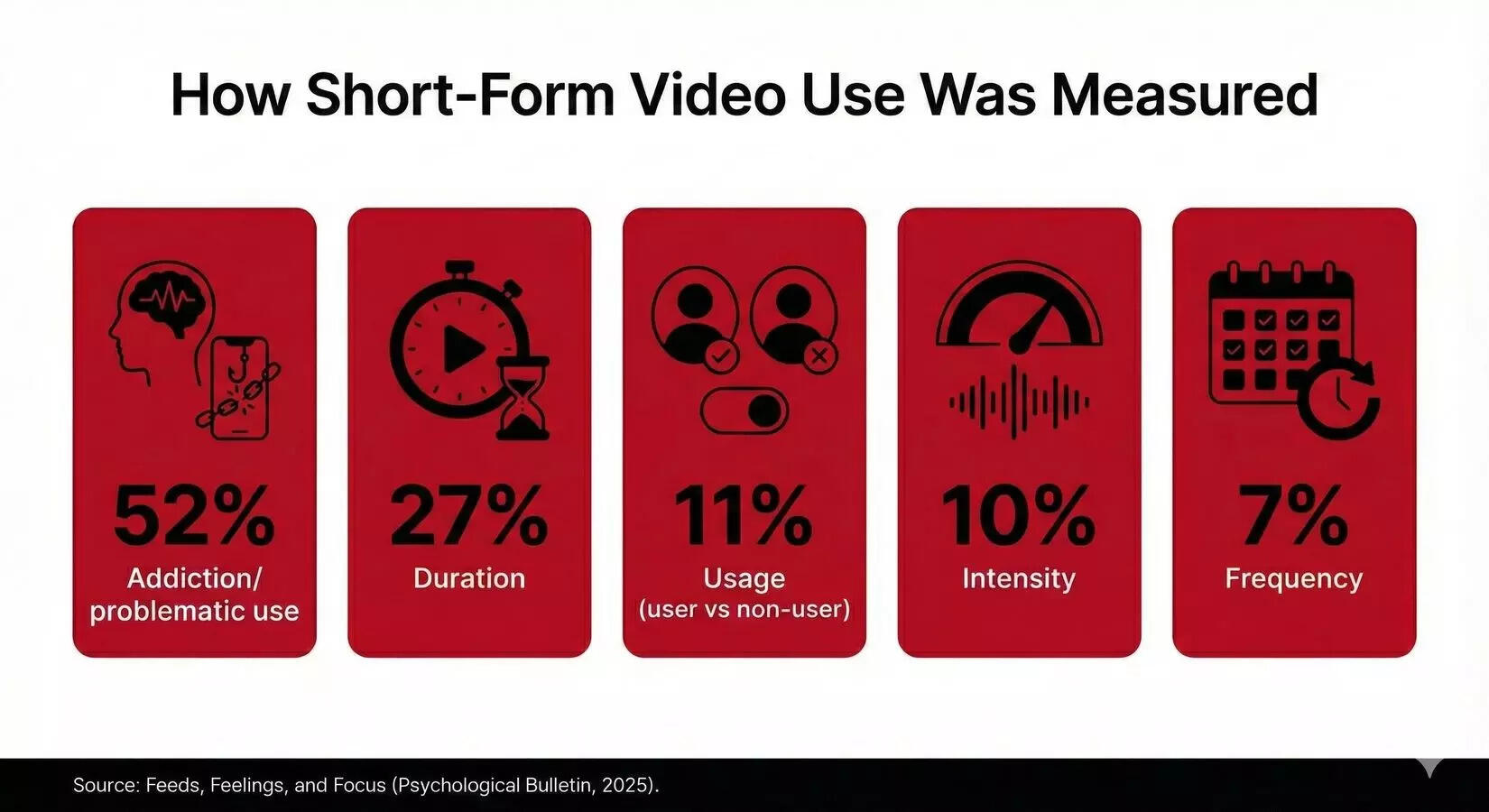
One of the study’s most philosophically revealing insights is the distinction between how much people use short-form video and how they use it. Duration alone shows far weaker associations with harm. The stronger effects appear when behaviour shifts into problematic use, which accounted for 52 percent of all measurement categories.When users report that opening the app feels automatic, or that stopping feels oddly difficult, the correlations slide toward the –0.20 to –0.30 range. These numbers do not signal catastrophe but erosion — not of hours, but of autonomy. The harm does not lie in long sessions; it lies in unconscious ones.
Revelation 5: The psyche resists — but unpredictably
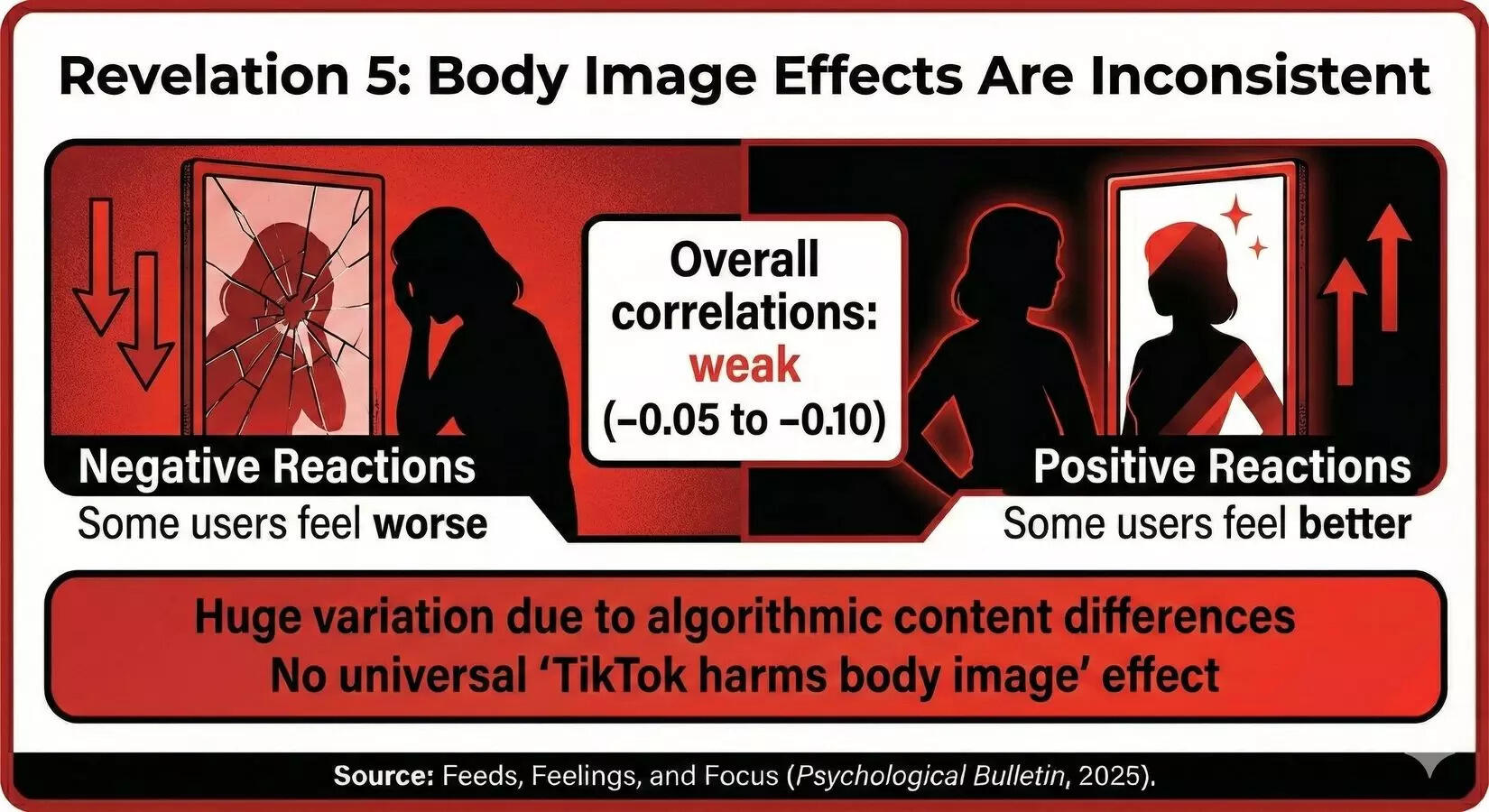
Surprisingly, the study finds no consistent overall effect on body image or self-esteem. The correlations hover in the –0.05 to –0.10 range — too small to form a reliable pattern. Unlike image-centric platforms, SFV is too chaotic, too diverse, too disordered to impose a single narrative.For every polished influencer, there are hundreds who look and sound like the rest of us. Some users feel worse; others feel better. The average flattens. This is not safety — it is unpredictability. The algorithm does not dictate self-image; it amplifies the version of yourself it already believes in, without ever showing the whole mirror.
Enter the Quagmire
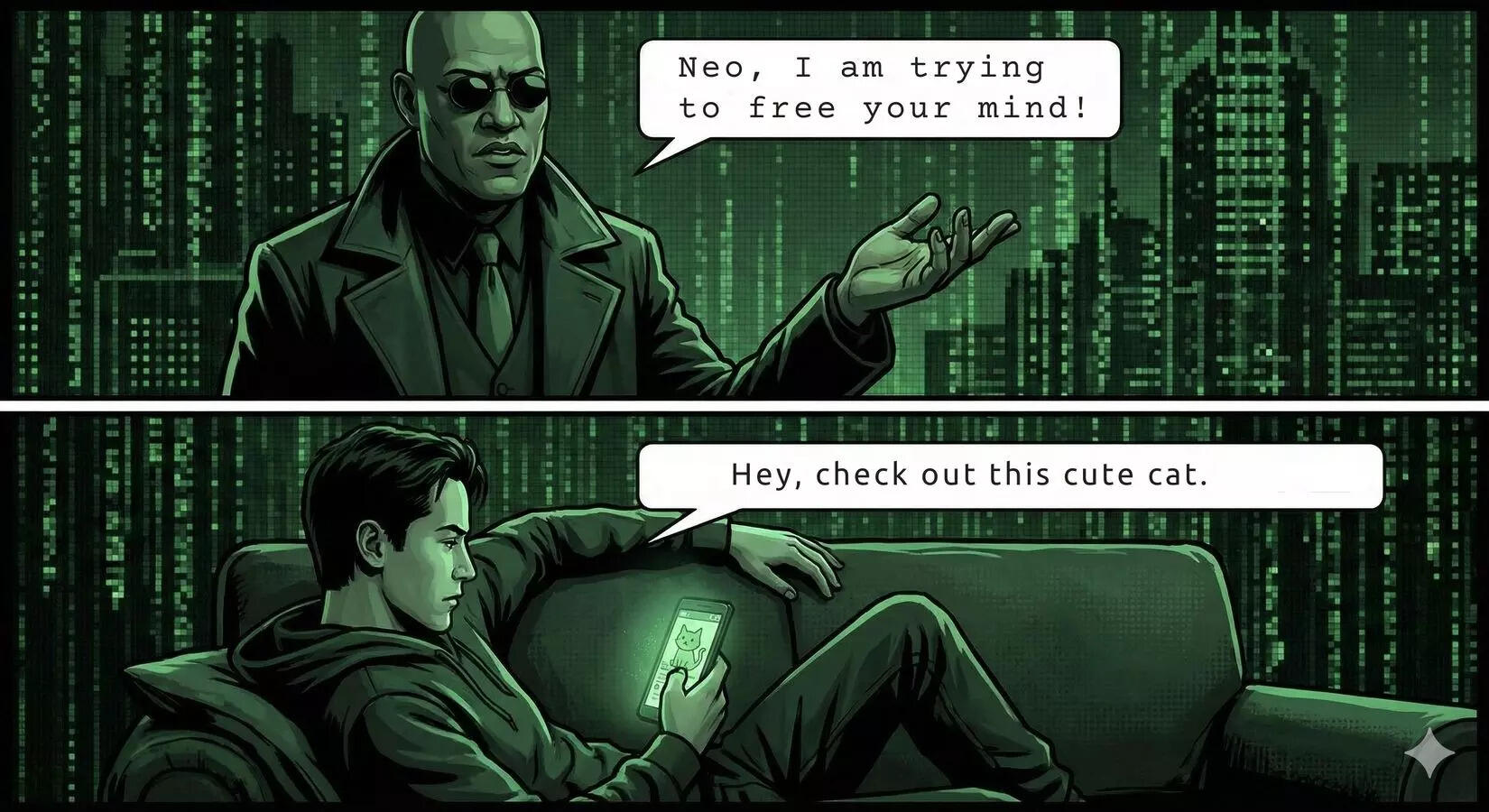
And once you see this psychological landscape clearly, the metaphor of The Matrix stops feeling like science fiction and starts feeling like an instruction manual. In The Matrix, Morpheus asks Neo: If you couldn’t wake up from a dream, how would you differentiate between the real world and the dream world? It would appear that Deus Ex-Machina didn’t need to put us in endless fields to conquer minds but just hand us a small device to keep us hooked. For life. The real world has not been replaced by a simulation, yet our inner world increasingly behaves as if it has. The question is no longer whether we are trapped in a dream. It is whether we notice that the dream is humming away behind our eyes even when we think we are awake.








 हिन्दी
  English