 Sipu Jha
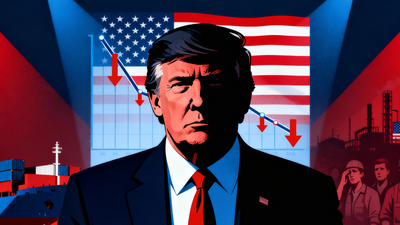
US President Donald Trump has framed his sweeping tariff policy as essential for protecting American workers and manufacturing, promoting it as a cornerstone of his “America First” agenda.Since returning to office this year, the Trump administration has overseen a historic surge in tariff collections. According to Fox Business, total duty revenue reached $215.2 billion in Fiscal Year 2025 (ending September 30). October alone brought in a record $34.2 billion. The Treasury also already reported $41.6 billion in tariff revenue in Fiscal Year 2026, and since Trump unveiled his “Liberation Day” tariffs in April, monthly collections have climbed sharply—from $23.9 billion in May to $29 billion in July, with August and September together adding $62.6 billion. Trump’s logic was– tariffs raise the cost of imported goods, encouraging manufacturers to relocate production to the United States while generating substantial government revenue.However, examination of economic data and analysis from world-leading institutions reveals a fundamental contradiction between Trump’s claims and the consequences unfolding in the American economy.
The economic logic of tariffs: Examining the foundation
At the core of Trump’s tariff strategy is the belief that foreign producers will shoulder most of the cost. But the economic mechanics of tariffs rarely work that way. A tariff is, fundamentally, a tax on imports — and unless foreign exporters aggressively cut prices, which happens only to a limited extent, most of the burden shifts inward. Economists call this tax incidence, the real-world distribution of who ends up paying once markets adjust. In today’s globalised supply chains, where imported components sit inside everything from electronics to machinery, the incidence is overwhelmingly pushed down the chain.That pattern has been evident for months. Even in mid-2025, when the distribution looked slightly different, Americans were still paying the overwhelming share of tariff costs, according to Goldman Sachs.US consumers absorbed about 22 per cent, while American businesses carried roughly 64 per cent, leaving foreign exporters with only 14 per cent. But the burden is projected to tilt even more heavily toward households by year-end. According to the estimates from earlier this year, US consumers are likely to shoulder around 55 per cent of tariff costs, with American companies taking on 22 per cent. Foreign exporters’ contribution rises only modestly to about 18 per cent, reflecting the limited extent to which they cut prices. The remaining 5 per cent falls into routing adjustments and other leakages rather than any identifiable group escaping the tax. The bottomline is– despite political claims that tariffs make foreign producers pay, the economic weight has always landed — and will continue to land — primarily on Americans themselves. The pass-through mechanismThe Federal Reserve’s real-time analysis of 2025 tariffs provides definitive evidence of how costs flow through the economy. The Federal Reserve Board examined tariffs implemented in February and March 2025 on imports from China and found that tariffs passed through fully and quickly to consumer goods prices within two months of implementation. Their theoretical analysis predicted that a 10 percentage-point tariff increase on imports from China raises consumer prices across a variety of goods categories, with a large share of goods categories experiencing at least a 1 percent price increase following such a tariff change.By August 2025, the Federal Reserve Bank of St. Louis quantified the cumulative effect: tariffs accounted for 0.5 percentage points of headline PCE annualized inflation and 0.4 percentage points of core PCE annualized inflation between June and August 2025. When measured over the 12-month period ending August 2025, tariffs explained 10.9% of headline PCE annual inflation.Former IMF Deputy Managing Director Gita Gopinath directly addressed Trump’s tariff strategy in October, stating that while tariffs have “significantly boosted government revenue,” the gains have come “largely at the expense of domestic firms and households hitting American businesses and consumers.” She noted specifically that tariffs have “contributed to higher prices, burdening households,” with costs rising “in several everyday consumer items” including “household appliances, furniture, coffee.“Yale Budget Lab’s comprehensive analysis of all 2025 tariffs found that consumer prices rise 1.2% in the short-run, equivalent to an average per household income loss of approximately $1,700 in 2025 dollars. This price increase represents a transfer of wealth from American consumers and businesses to the federal government through tariff revenue collection.
Scenario analysis simplified: What happens when tariffs are imposed
As we talk about who bears the real burden of the tariffs, it’s also important to understand the basics of what happens when tariffs are actually imposed as per the rules of economics.Scenario 1: Buyers accept higher pricesThis has indeed been the dominant pattern. Yale Budget Lab’s July 2025 analysis found that 2025 tariffs disproportionately affect clothing and textiles, with consumers facing 40% higher shoe prices and 36% higher apparel prices in the short-run, with prices remaining 19% and 17% higher in the long-run respectively. The impact is regressive: lower-income households spend larger shares of income on these essentials, meaning tariffs function as a consumption tax that falls heaviest on those least able to absorb price increases.The Federal Reserve’s preferred inflation gauge rose to 2.6% in June, up from 2.4% in May, with core inflation rising to 2.8%—directly contradicting claims that tariffs wouldn’t raise prices.Scenario 2: Buyers reduce consumption & economic uncertainty emergesThe San Francisco Federal Reserve’s analysis of 40 years of international tariff data found that following tariff increases, the unemployment rate increases by roughly 10 basis points for every 1 percentage point increase in tariff rates. This means that given Trump’s tariff increases averaging 20-50 percentage points on major trading partners, unemployment would be expected to rise 0.5-0.6 percentage points—a substantial economic impact.Importantly, the analysis reveals that tariffs act initially as a demand shock—uncertainty causes consumers and businesses to reduce spending, which temporarily suppresses inflation while increasing unemployment. However, this dynamic reverses: “Over time, the economy adjusts: The unemployment rate returns to its original level or even declines slightly, whereas inflation picks up and peaks three years after the initial change in tariffs, relative to the scenario where tariffs remain unchanged.“
Coffee exposes reality?
Trump, who has long claimed that tariffs don’t hurt American consumers, ended up acknowledging the opposite — and his latest policy move proves it even further. When Fox News host Laura Ingraham recently pointed out that coffee prices are high, Trump said he would “lower some tariffs” to bring prices down “very quickly.”That admission became reality soon after, when the White House rolled back tariffs on more than 200 food products — including coffee, beef, bananas and orange juice — following rising public frustration over soaring grocery bills. Coffee, which is almost entirely imported, has seen prices jump roughly 15 per cent since January, according to CNN, in part because of Trump’s own sweeping tariffs imposed earlier this year.By suggesting that cutting tariffs will reduce prices — and then issuing a sweeping set of exemptions that took effect retroactively — Trump has inadvertently conceded that tariffs function like taxes that raise costs for Americans. This contradicts years of his rhetoric insisting that “foreign countries pay” and that his duties do not fuel inflation.Economists, businesses, and multiple studies have long shown that US importers pay tariffs and often pass those costs on to consumers. Even Treasury Secretary Scott Bessent said the administration expects prices for items like coffee and bananas to fall once tariff reductions are announced. Time will tell whether companies reverse the increases.
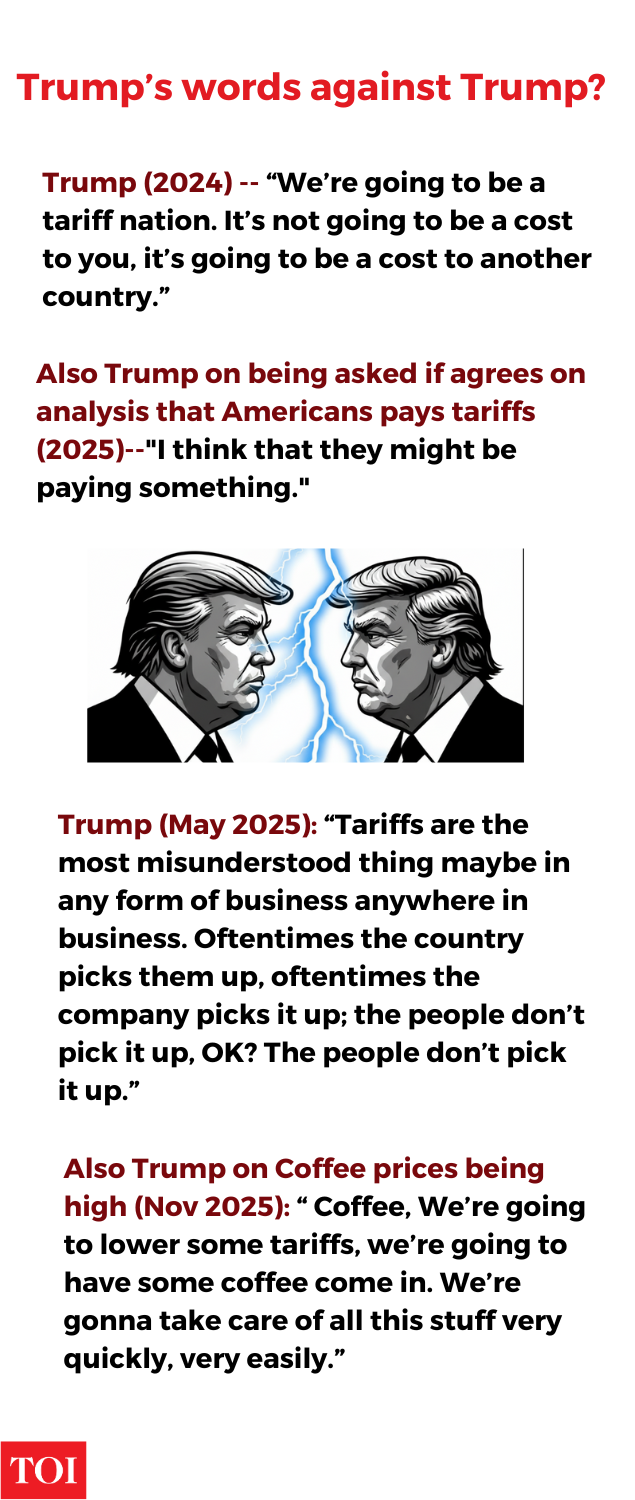
This was not the only recent contradiction. A few days before the “coffee price admission”, Donald Trump acknowledged that American consumers “might be paying something.” The remark came after a reporter cited Chief Justice John Roberts’ description of tariffs as taxes paid by Americans. Though Trump insisted the US still “gains tremendously,” his comment amounts to a rare admission that tariffs do raise costs for consumers — contradicting his previous statements insisting “foreign countries pay”.
The supply chain complication: Intermediate goods
When American companies import components from abroad to assemble products domestically, they now pay tariffs on those inputs. A World Bank analysis examining the US-China trade war demonstrated that tariffs on imports of Chinese upstream intermediate goods negatively affect US downstream exports, output and employment. The effects are particularly severe in US industries that rely heavily on targeted intermediate goods.This creates a cascade of cost increases. When companies face tariffs on inputs essential for production—semiconductors, steel, or automotive components—they have limited ability to substitute domestically, amplifying cost pressures throughout the economy. The Federal Reserve’s June 2025 Monetary Policy Report acknowledged this dynamic, noting that “input cost pressures were widespread in manufacturing and retail, largely reflecting tariff-induced increases.“
The Contradiction: How Trump claims prices are going down while inflation goes up
Trump administration officials have claimed that tariffs are not driving inflation, pointing to specific data suggesting certain metrics have declined. This statement requires careful interpretation based on the timing of tariff effects discovered through rigorous economic research.The San Francisco Federal Reserve’s analysis of historical international data reveals that tariffs initially create a negative demand shock that temporarily suppresses inflation even as prices for tariffed goods rise. The mechanism operates as follows: Uncertainty about future trade policy causes firms to delay investment and consumers to reduce spending. This demand contraction creates downward pressure on overall price levels that can temporarily mask the upward pressure from higher tariff costs. Foreign exporters, facing reduced demand, may lower their prices to maintain market share.However, this is a temporary phenomenon lasting approximately 1-2 years. Subsequently, inflation surges as supply-side pressures dominate. The San Francisco Fed found that inflation “peaks three years after the initial change in tariffs.” The administration’s statements about stable or declining prices capture data from early 2025—the demand-shock phase—while ignoring the cost-push inflation that follows.This timeline is critical for understanding the economic logic: immediately after tariff increases, weak demand may suppress overall inflation even while specific goods prices rise. But this represents economic contraction, not success. Americans reduce consumption not because they choose to but because they face economic uncertainty and potential job losses. The cost comes later in the form of persistent, elevated inflation years 2-3 after tariff implementation.
The revenue story: Government gains, but economy loses More
Tariff revenues have surged in recent months. According to Fox Business, the US collected a record $34.2 billion in October alone. Total tariff receipts reached $215.2 billion in fiscal year 2025, and the Treasury has already reported $41.6 billion in collections so far for fiscal 2026.Since Trump unveiled his “Liberation Day” tariffs, monthly revenues have climbed sharply — rising from $23.9 billion in May to $29 billion in July, while August and September together generated $62.6 billion. Trump has repeatedly highlighted these figures, arguing that tariff revenues — now at historic highs — could finance his proposed one-time $2,000 dividend for low- and middle-income households.Yale Budget Lab’s analysis quantifies this tradeoff: while all 2025 tariffs raise government revenue, they simultaneously reduce consumer welfare and economic output more than the revenue collected. As of November 2025, Yale estimates the short-run per-household income loss at approximately $1,700, with the post-substitution effect settling at a $1,300 loss per household.Furthermore, Trump’s promise of $2,000 dividend payments faces a fundamental mathematics problem. The Tax Foundation estimated that Trump’s new tariffs would raise only $158.4 billion in 2025 and $207.5 billion in 2026. But checks limited to tax filers with incomes below $100,000 could cost $279.8 billion—already exceeding two years of projected revenue. Expanding payments to include non-filers could push costs to $606.8 billion, nearly double the expected 2025–26 tariff revenue.
Bottomline
The data points overwhelmingly in one direction: tariffs function as a tax on Americans, not on foreign rivals. As mounting evidence shows prices rising even as Washington records historic revenue, Trump’s strategy exposes a deeper dilemma — whether a policy can remain politically popular while imposing growing economic costs on the very households it claims to protect.How the administration navigates that contradiction may determine not only the trajectory of the economy but also the durability of its “America First” economic narrative.







 हिन्दी
  English