 Sipu Jha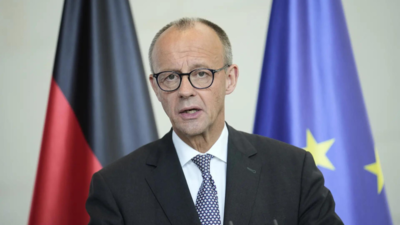
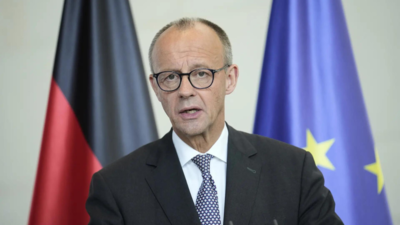
Seven months into his chancellorship, Friedrich Merz traveled for his first official visit to Israel, a trip that lasted less than 24 hours. The visit drew intense scrutiny — particularly in Germany — over whether it would send the wrong signal amid the ongoing conflict in Gaza and escalating violence in the West Bank.Among the Israeli public, Merz remains relatively unknown, historian Moshe Zimmermann told DW.“If you asked people in a survey, ‘Who is the current Chancellor of Germany?’, no more than 10% of Israelis would know that his name is Friedrich Merz,” Zimmerman said. “For the vast majority, Angela Merkel is still the Chancellor — and she was very popular here.”
Lately, however, there have been increasingly critical voices coming from Germany regarding Israel’s military conduct in Gaza, and that was somewhat unusual for Israelis. Differences over ‘Palestinian issue’All eyes were on the joint statement and press conference between Prime Minister Benjamin Netanyahu and Friedrich Merz to see whether the bilateral relationship had been affected. While they acknowledged differences on some issues, both leaders reiterated the strength of the bond between their countries.“The visit reaffirms the strength of the bilateral relationship, Germany’s commitment to Israel and Israel’s commitment to Germany — a partnership that has grown steadily stronger over recent years,” said Jeremy Issacharoff, a former Israeli ambassador to Germany between 2017 and 2022.“The press conference showed that the relationship is strong, but there are differences, primarily over how to move forward on the Palestinian issue,” Issacharoff added. “I think both countries recognize that.”During his meeting with Israeli President Isaac Herzog the previous evening, Merz conceded that the timing of his visit was “complicated.” The ceasefire process in Gaza has not advanced to its second phase, daily airstrikes continue to cause casualties in the devastated territory and Israel is still awaiting the return of the remains of its final hostage from Gaza.Meanwhile, in the Israeli-occupied West Bank, a sharp rise in violent settler attacks against Palestinians, along with Israeli annexation policies, has alarmed European nations.“It’s a symbolic visit, but also an important one,” said Shimon Stein, who served as Israel’s ambassador to Berlin from 2001 to 2007. “Merz has expressed solidarity and friendship with Israel from the outset. Yet it comes at a time of many open conflicts, both domestically and regionally.”Differences over two-state solutionLike many Western leaders, the German chancellor reiterated support for a two-state solution, even though current conditions appear to make the establishment of a Palestinian state more distant than ever.“Our conviction is that the prospective establishment of a Palestinian state alongside Israel offers the best prospect for the future,” Merz said, adding that any two-state solution could only emerge at the end of negotiations, not the beginning, and reiterating Germany’s refusal to recognize Palestinian statehood for now.Zimmermann saw little that was new in the chancellor’s approach. “The Chancellor mentioned, of course, that Germany opposes annexation of the West Bank. That’s a compulsory exercise. But nothing was said about what is actually happening there today,” Zimmermann told DW. “As German Chancellor, he confirmed the old policy: non-recognition of the Palestinian state — unlike some other European countries.”The German chancellor did not travel to the occupied West Bank to meet Palestinian leaders or civil society representatives. His office noted only a phone call with Palestinian President Mahmoud Abbas prior to the regional trip.Prime Minister Netanyahu quickly dismissed any notion of Palestinian statehood. His far-right government has repeatedly rejected the prospect of an independent Palestinian state, advocating instead for broader regional peace.“We believe there is a path to advance broader peace with the Arab states and a workable peace with our Palestinian neighbors,” Netanyahu said. “But we’re not going to create a state that would be committed to our destruction at our doorstep.”Arms embargo a one-time measureAnother point of contention appears to have eased. While Merz acknowledged that certain Israeli military actions in Gaza put Germany in a “dilemma” and urged Israel to respect international law, he stressed that the decision to suspend arms deliveries was a one-time measure. Germany suspended the delivery of some arms to Israel in August amid growing concerns over civilian casualties in Gaza. The suspension was lifted in November following the ceasefire agreement between Israel and Hamas.Defense cooperation remains a cornerstone of German-Israeli ties despite the war in Gaza, which a UN committee has labeled genocide — a charge rejected by Israel.Netanyahu emphasized that 80 years after the Holocaust, it is Israel that keeps Germany and Europe safe, citing Berlin’s recent acquisition of Israel’s Arrow Defense 3 system as proof.Limited German influenceThe Israeli prime minister also made clear that any political developments in Gaza will be discussed in Washington later this month, when he is scheduled to visit the White House. Many observers agree that Germany’s direct political role in the region is limited — neither Germany nor the European Union is currently calling the shots, Shimon Stein said; decisions are made in Washington.“With Trump pushing plans like his own, Israel — after October 7 — has become totally dependent on America,” Stein said. “So much so that I don’t see Netanyahu having much room to act independently,” he said, adding that this was quite “disturbing, as an Israeli.”Moshe Zimmermann echoed that view. “Germany cannot initiate anything here, except perhaps provide financial support to the Palestinians,” he said. “That means when it comes to who will finance Trump’s plans, the answer is, among others, Germany.”So far, “this chancellor has not yet made a name for himself among Israelis and expatriate Israelis, which is not surprising,” Zimmermann added. “Israelis are focused on what is happening in America — and Netanyahu has said as much. That is our way of saying that you Europeans are irrelevant.”





 हिन्दी
  English