 Sipu Jha

In an era where global powers are flexing their nuclear muscles and dormant arsenals hum with renewed urgency, India stands at a perilous crossroads: should it reignite the fire of nuclear testing to assert its strategic sovereignty, or maintain the delicate restraint that has balanced diplomacy and deterrence for decades? The shadow of India’s 1998 Pokhran-II tests still lingers, marked by geopolitical reverberations and economic sanctions. Yet today, with US President Donald Trump publicly accusing rival states like Pakistan and China of clandestine nuclear tests, India faces a high-stakes dilemma.
India’s nuclear journey began with its first nuclear test, code-named ‘Smiling Buddha’, in 1974, which stunned the world with a bold demonstration of atomic capability. However, there was then a long gap of 24 years before India conducted its next round of tests, the definitive Pokhran-II in 1998.
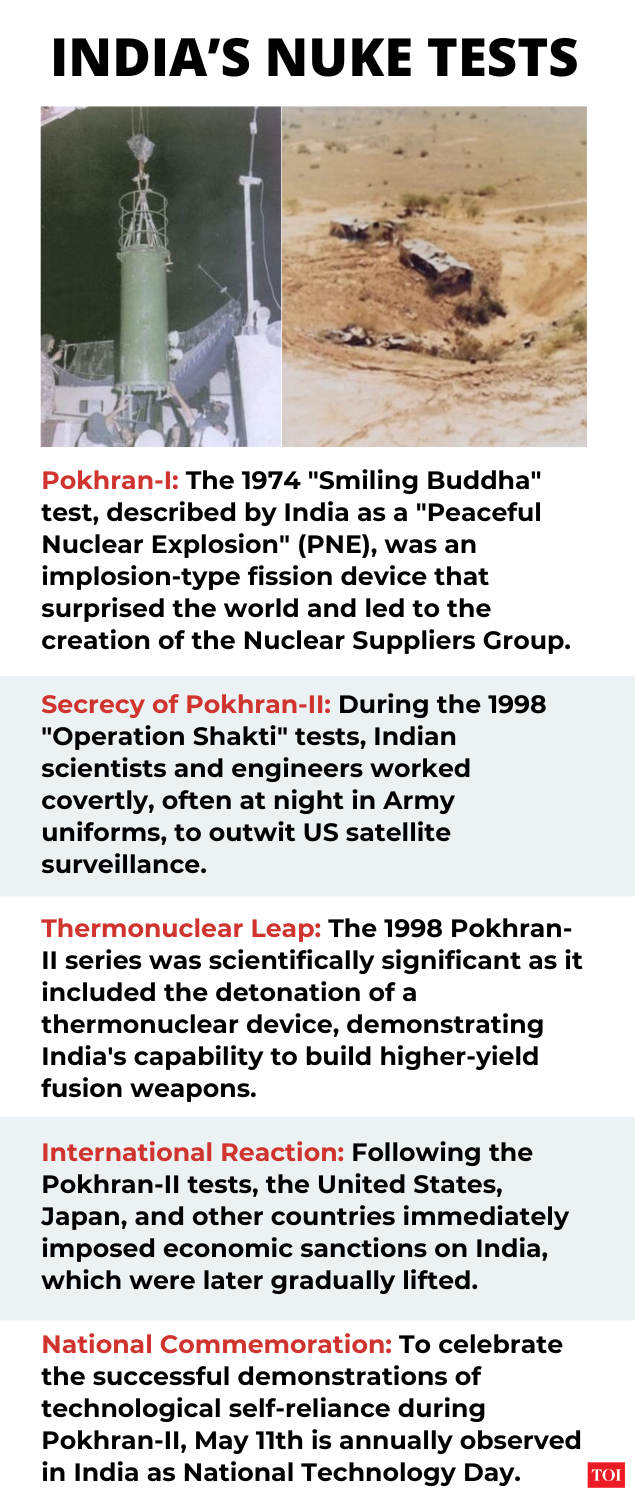
Now, 27 years after that landmark moment, the clock ticks again — prompting a crucial question: Is it time for India to conduct another series of nuclear tests to secure its place amid a shifting geopolitical order? The answer may shape not just India’s nuclear strategy, but the future stability of South Asia and its global standing.Daryl Kimball, executive director of the Arms Control Association in Washington, said that a resumption of US atomic tests would “open the door for states with less nuclear testing experience to conduct full-scale tests that could help them perfect smaller, lighter warhead designs”.Joseph Rodgers, fellow at the Washington-based Centre for Strategic and International Studies, said that states such as China or India stand to profit from a resumption of nuclear tests.“It makes more sense for them to test” than it does for the US or Russia, the two states that have conducted most atomic tests to date, Rodgers said.
Tump triggers debate
Ahead of his meeting with Chinese president Xi Jinping in South Korea on October 29–30, 2025, Trump posted on social media that, because other countries were conducting nuclear tests, he had instructed the US military to begin testing nuclear weapons again on “an equal basis” with those nations, and that this process would “commence immediately”.Trump’s comments were interpreted by many as a sign the US was preparing to restart full-scale nuclear blasts for the first time since 1992.

In an interview with 60 Minutes on CBS, Trump reiterated his position. “I am saying that we’re going to test nuclear weapons like other countries do, yes,” Trump said when asked by if he planned for the US to detonate a nuclear weapon for the first time in more than 30 years.“Russia’s testing, and China’s testing, but they don’t talk about it,” he added. “I don’t want to be the only country that doesn’t test,” he said, adding North Korea and Pakistan to the list of nations allegedly testing their arsenals.
What he probably meant
Just days after Trump’s remark, US Energy Secretary Chris Wright clarified that America is not planning to conduct nuclear explosions.“These are not nuclear explosions,” Wright told Fox News on Sunday. “These are what we call sub-critical explosions.” But Wright, whose agency oversees testing, said people living in the Nevada desert should have “no worries” about seeing a mushroom cloud.“Americans near historic test sites such as the Nevada National Security Site have no cause for concern,” Wright said. “So we’re testing all the other parts of a nuclear weapon to make sure they deliver the appropriate geometry, and they set up the nuclear explosion.”
What are sub-critical nuclear tests
Sub-critical nuclear testing refers to experiments that involve nuclear materials like plutonium but use less than the amount necessary to start a chain reaction that would cause a nuclear explosion. No nuclear explosion occurs because the test does not achieve “criticality,” the point at which a self-sustaining nuclear reaction happens.These tests involve compressing or shocking small amounts of fissile material with high explosives to study how the material behaves under extreme conditions.Subcritical tests help scientists validate computer models and ensure the safety, security, and reliability of nuclear weapons without performing full nuclear detonations.They are usually done underground to contain any radioactive byproducts and prevent a nuclear blast.Countries like the US, Russia, and China use subcritical tests to maintain their nuclear stockpiles under international test bans like the CTBT.Thus, subcritical tests are a way to “test” the components of nuclear weapons at a small, safe scale without violating nuclear test bans or triggering nuclear explosions.
Can sub-critical nuke tests be detected
Sub-critical nuclear tests are generally very low-yield and do not produce a nuclear explosion, so they release minimal energy and radiation. Because of this, subcritical tests are often difficult or impossible to detect by international monitoring systems like the Comprehensive Nuclear-Test-Ban Treaty (CTBT) International Monitoring System (IMS).The IMS uses seismic, hydroacoustic, infrasound, and radionuclide stations to detect nuclear explosions worldwide. While it can detect all full-scale nuclear tests, the very low yield of subcritical tests—often below a threshold of about 1 kiloton equivalent—means they usually do not produce detectable seismic or atmospheric signatures. Radionuclide detectors also rely on gases released during an explosion, which do not occur in subcritical tests.Sub-critical tests are mostly not picked up by the IMS or satellite monitoring, making them effectively clandestine from the perspective of existing international nuclear test detection systems unless detected through other intelligence sources or on-site inspections after the CTBT enters into force.
What India’s next nuclear test could look like
If India were to conduct a nuclear test today, it would reflect significantly evolved scientific, strategic, and geopolitical conditions compared to the 1998 Pokhran-II tests. The characteristics of a modern Indian nuclear test would likely include:
- Advanced Warhead Designs India’s nuclear program has progressed since 1998, including development of thermonuclear weapons and miniaturised warheads suitable for its ballistic missile arsenal like the Agni series. Tests today would likely focus on validating thermonuclear yield and sophisticated warhead designs to ensure reliability and accuracy.
- Subcritical and Computer-Simulated Testing While explosive nuclear tests are possible, India might also incorporate subcritical tests — experiments that do not produce a self-sustaining chain reaction — and extensive computer simulations. These methods enhance warhead performance confidence without a full-scale test, but a full test could be opted for if strategic or political signals require it.
- Test Site and Environmental Measures Like Pokhran in Rajasthan, the test would likely occur at a well-established test site with extensive monitoring and safety protocols. Satelite and seismic detection globally would instantly detect the test, making secrecy impossible.
- International Fallout India would anticipate immediate diplomatic repercussions, including likely suspension of nuclear cooperation with the US under the 123 Agreement and possible sanctions.
What is the 123 Agreement
The 123 Agreement, formally called the India–United States Civil Nuclear Agreement, is a bilateral pact signed in 2008 that allows civil nuclear trade and cooperation between India and the United States. It was a landmark deal that ended decades of nuclear isolation for India, enabling it to engage in global nuclear commerce despite not being a signatory to the Nuclear Non-Proliferation Treaty (NPT). The agreement requires India to separate its civilian and military nuclear facilities, with civilian reactors subject to International Atomic Energy Agency (IAEA) safeguards while retaining control of its nuclear weapons program. The 123 Agreement facilitates technology transfer, fuel supply, and nuclear commerce, strengthening India’s civilian nuclear energy capabilities and strategic partnership with the US.
What happens if India tests nukes
Per Article 14 of the 123 Agreement, should India conduct a nuclear test explosion, the United States holds the right to immediately terminate all nuclear cooperation. This has significant ramifications for India’s civilian nuclear energy expansion plans and international standing. Past statements by US policymakers, including former US president Barack Obama, emphasized pushing for India’s eventual ratification of the Comprehensive Nuclear-Test-Ban Treaty (CTBT) as part of broader nonproliferation goals.
Are sub-critical tests covered under 123 Agreement?
The 123 Agreement between India and the United States does not explicitly mention subcritical nuclear testing. The agreement is primarily focused on prohibiting “nuclear explosive devices” testing and maintaining a moratorium on nuclear testing as a condition for continued civil nuclear cooperation.Subcritical tests, which do not involve a self-sustaining nuclear chain reaction or an actual nuclear explosion, typically fall outside the scope of what is conventionally defined as nuclear explosive testing. This nuance means subcritical tests are not explicitly banned under the 123 Agreement’s terms related to nuclear testing moratoriums.However, any full nuclear explosive test would constitute a breach, prompting the US to have the right to terminate cooperation and possibly impose sanctions.
World’s nuclear arsenal
At present there are 9 countries (Russia, US, China, France, UK, Pakistan, India, Israel and North Korea) that possess nuclear weapons. These countries have roughly 12,331 nuclear warheads, with over 9,600 in active military stockpiles, according to the Federation of Atomic Scientists’ 2025 Status of the Worlds Nuclear Forces. While this is a significant decline from the approximately 70,000 warheads owned by the nuclear-armed states during the Cold War, nuclear arsenals are expected to grow over the coming decade.Russia has the most confirmed nuclear weapons, with nearly 5,500 nuclear warheads. The US follows behind with 5,177 nuclear weapons. Total nuclear warheads owned by these 2 countries alone counts for nearly 90% of nuclear weapons in the world.Over 2,000 nuclear weapons tests have been carried out since 1945. The first nuclear device was detonated as a test by the United States at the Trinity site in New Mexico on July 16, 1945, with a yield approximately equivalent to 20 kilotons of TNT.






 हिन्दी
  English