 Sipu Jha
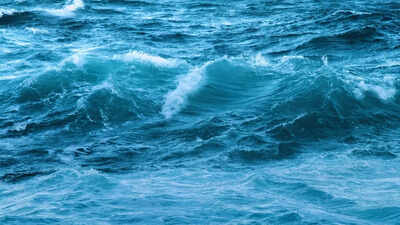
Oceanographers studying the Atlantic Ocean are revisiting an old assumption using newer data and slower, more detailed analysis. For decades, researchers believed the Atlantic lacked a true equatorial water mass, unlike the Pacific and Indian oceans. Instead, water in this zone was thought to be an extension of South Atlantic Central Water. Using temperature and salinity measurements from thousands of Argo floats, scientists have now found a clearer pattern. In the upper 2,000 metres of the Atlantic, especially near the equator, water properties show a consistent structure that does not fully match known categories. The findings suggest that a distinct body of water exists within the equatorial Atlantic thermocline, shaped by mixing rather than direct formation. This adds a new layer to how the Atlantic Ocean is understood and classified.
A vast underground ocean has been lurking beneath the Atlantic for millions of years
Ocean water is not uniform. Scientists define water masses by shared physical properties, mainly temperature and salinity, which tend to follow tight relationships over large distances. These patterns often point to a common origin or shared history. Once formed, water masses slowly change as they move, mix, and interact with biology. Because they store heat and dissolved gases, their behaviour matters for climate studies. Most major water masses were identified decades ago, using ship based measurements that were limited in space and time. The arrival of Argo floats has changed this picture, offering repeated, deep profiles across entire ocean basins.
The equatorial Atlantic was long overlooked
In the Pacific and Indian oceans, equatorial waters have been recognised since the mid-twentieth century. The Atlantic was treated differently. Its equatorial zone was assumed to be filled mainly by South Atlantic Central Water flowing northward. Earlier datasets were too sparse to separate subtle differences. As a result, small but consistent variations in temperature and salinity were grouped together. This meant that any equatorial signal was effectively blurred into surrounding water masses.
New data reveals about temperature and salinity
Using Argo data, researchers of a study named “Is There the Equatorial Water Mass in the Atlantic Ocean?” built detailed volumetric diagrams showing how temperature and salinity vary with depth and latitude. In the equatorial Atlantic, between about 10 degrees south and 10 degrees north, the main thermocline shows a tight relationship that stands apart from both South and North Atlantic Central Waters. This layer sits roughly between 150 and 500 metres deep. It is marked by lower thermoclinicity, meaning temperature changes more gently with depth. The pattern is consistent and repeatable, which is key for identifying a separate water mass.
Mixing creates Atlantic equatorial water
The newly identified Atlantic Equatorial Water does not form at the surface like central waters do. Instead, it appears to be created by mixing along density surfaces. South Atlantic Central Water dominates this mixture, with a smaller contribution from North Atlantic Central Water. The estimated ratio is about three and a half to one. This mixing happens within the equatorial current system, where eastward and westward flows overlap. These alternating jets increase lateral spreading, allowing waters to blend without much vertical movement. Over time, this process produces a stable, recognisable signature.
Where does this water sits in the Atlantic system
Spatially, Atlantic Equatorial Water occupies a narrow band around the equator. It is separated from neighbouring waters by thermohaline fronts rather than sharp boundaries. To the south, the separation broadly follows the South Equatorial Current, while to the north it aligns with the North Equatorial Current. These fronts help maintain the distinct temperature salinity relationship. Although the water is a mixture, its internal consistency meets the classical definition of a water mass used in oceanography.
Why this matters for ocean science
Recognising Atlantic Equatorial Water helps complete the global picture of major ocean water masses. It also improves how scientists trace heat and salt movement through the Atlantic. The study relies only on temperature and salinity, which is a limitation. Future work using oxygen, nutrients, or isotopes may confirm or refine these findings. For now, the result shows that even well-studied oceans can still reveal quiet structural details when observed closely enough.







 हिन्दी
  English