 Sipu Jha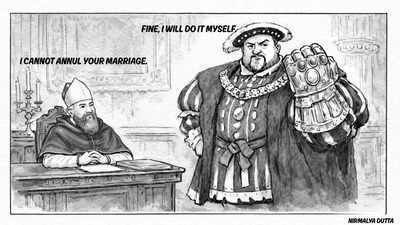
In Yes Minister, when Jim Hacker finds out that Italian terrorists have access to British-made weapons, Sir Humphrey Appleby tries to mollify him by pointing out it’s not their department’s problem. British weapons in the hands of foreign terrorists were outside the Ministry of Administrative Affairs’ jurisdiction. Probably a Defence Ministry problem, or a Foreign Office problem, the unflappable bureaucrat points out, before a beleaguered Hacker hits back: “I am talking about good and evil.” This leads Sir Humphrey to point out that made it a “Church of England” problem.That quip, while hilarious, stands the test of time, because knowing the difference between good and evil is a heavy cross to bear for an institution created by a megalomaniac king who wanted a divorce.
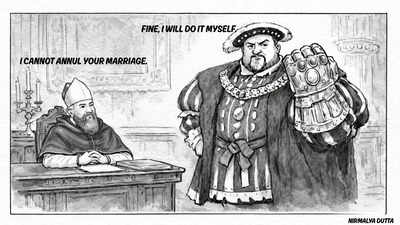
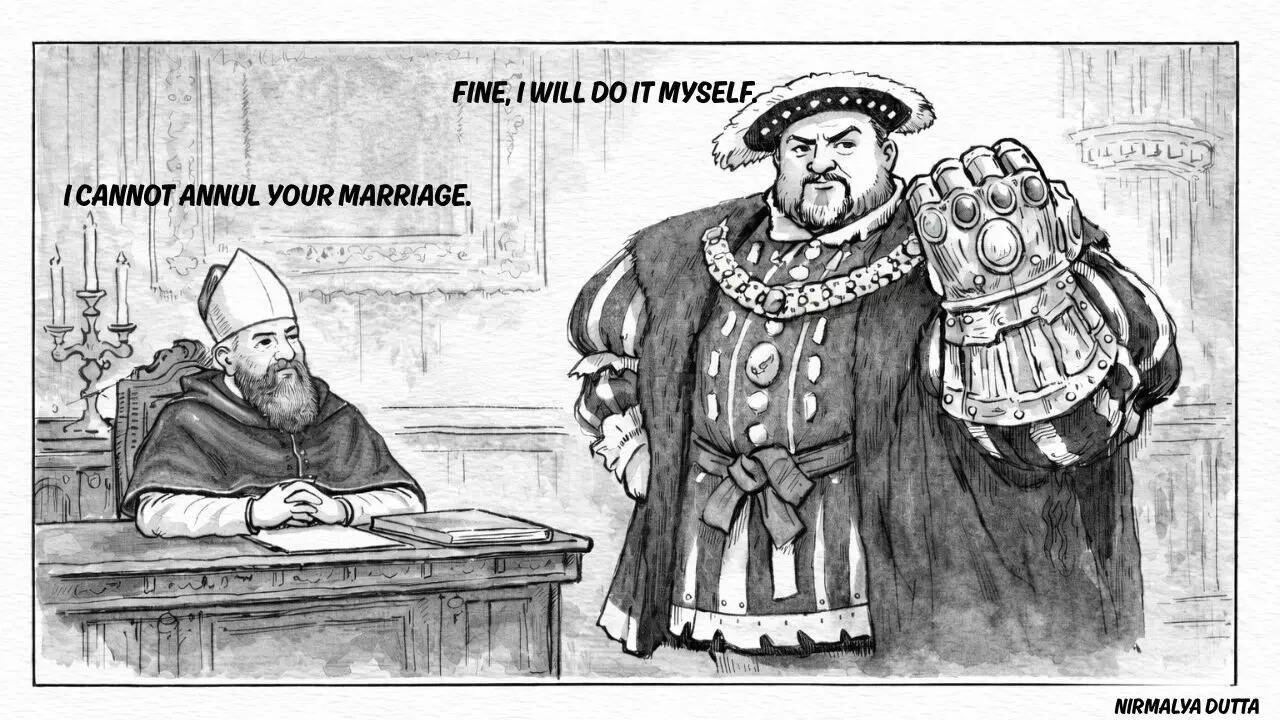
Now, the Church is in the news for getting its female Archbishop of Canterbury for the first time in its nearly 500-year-old history. In classic ecumenical tradition, her predecessor had to resign over an abuse scandal involving hundreds of boys.But why does England have a separate Church?It begins, inevitably, with Henry VIII, who married Catherine but couldn’t produce a male heir. The Pope refused to annul the marriage because Catherine was the aunt of Charles V, the Holy Roman Emperor whose armies effectively controlled Rome — a man at whose snook the Pope could ill afford to cock. So, Henry decided it was time to do a Thanos and take matters into his own hands.The English Reformation followed. In 1534 Parliament passed the Act of Supremacy, one of the first instances of a government nationalising a foreign institution, which in this case was Roman Catholicism.From that moment on, the CoE was in the thick of things. Under James I and Charles I, it saw a fight between the clergy who wanted to go back to the Puritan basics and the royalists who wanted the pageantry and theatrics. Their fight was one of the inspirations for the High Sparrow arc in Game of Thrones, just like the Red Wedding was inspired by the Battle of the Roses.The Puritans won briefly.During the English Civil War, Oliver Cromwell put a break on the monarchy, named himself Lord Protector and banned all things fun, which instantly made the British nostalgic for the monarchy. During Cromwell’s time, the episcopal Church was effectively outlawed, and when Cromwell’s nepo kid failed to hold on to power, the church and crown returned with a vengeance.But the moment that really earned the Church its liturgical stripes was two books: the Book of Common Prayer and the King James Version of the Bible.In 1549, Archbishop Thomas Cranmer produced the first edition of the Book of Common Prayer. Before this, English worship followed Roman Catholic rites in Latin. Cranmer translated them into English and standardised them across the kingdom.This was the moment England became liturgically independent, taking Catholic structure and making it British, the theological equivalent of chicken tikka masala: foreign in origin but completely British.The Book of Common Prayer combined Protestant theology with Catholic ceremony to give a book whose phrases are still spoken across the world by English speakers, who might not be believers:
- Earth to earth, ashes to ashes, dust to dust.
- Till death us do part.
- In the midst of life we are in death.
The most famous is obviously peace in our time, which was uttered by Neville Chamberlain after the ill-fated Munich Agreement.Then came the King James Bible, which in time would become the most published book in the world, competing with the Little Red Book, Harry Potter and Don Quixote.Those two books gave England a way to worship independently of Rome while preserving much of the Catholic structure in English form.The CoE retained many of the traditions.
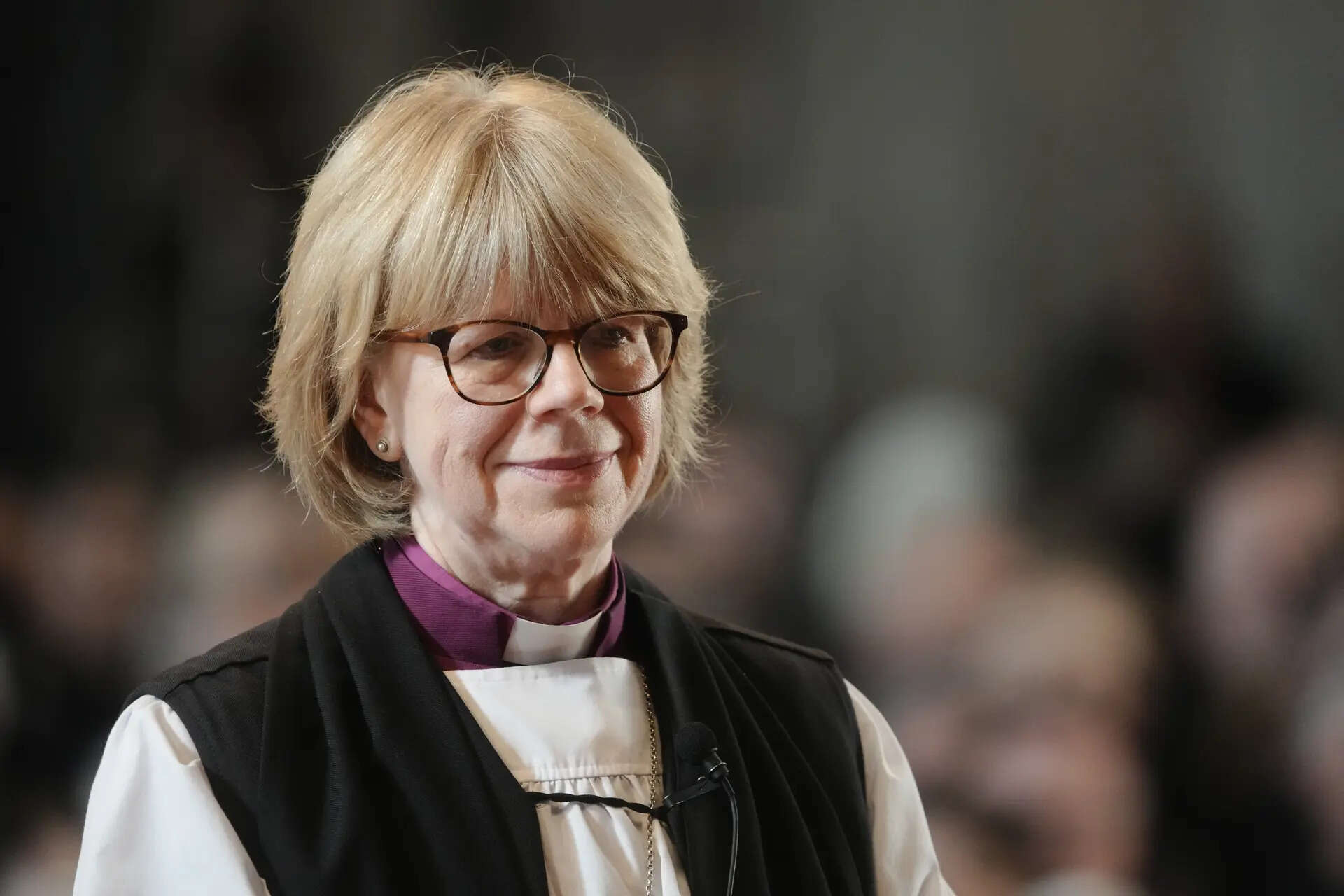
The Confirmation of Election ceremony legally confirming Dame Sarah Mullally as the new Archbishop of Canterbury, at St Paul’s Cathedral, central London, Wednesday Jan. 28, 2026. (Jeff Moore/Pool via AP)
Bishops still stood in a lineage traced back to the apostles. Baptism and Eucharist remained central. Vestments, altars, kneeling, and liturgical seasons stayed. The Mass was not reinterpreted. Cranmer rejected transubstantiation (bread and wine becoming blood and body) but preserved Communion as a sacred ritual. The choreography remained Catholic. The theology shifted Protestant. And some things were still hushed up.This hybrid identity became the Anglican formula: Catholic structure plus Protestant doctrine.Bishops, creeds, and hierarchy stayed. Papal supremacy and indulgences were swept under the rug.In the 18th and 19th centuries, the Church didn’t stand still. A religious revival led by preachers like John Wesley pushed the idea that faith should be personal and emotional, not just ceremonial. This movement energised ordinary believers and eventually gave rise to Methodism. A few decades later, another group inside the Church went in the opposite direction. The Oxford Movement argued that Anglicanism should reclaim its older Catholic-style rituals, emphasising tradition, ceremony, and sacred continuity.
At the same time, the Church remained tightly bound to the British state. Bishops sat in Parliament, monarchs ruled as heads of the Church, and political leaders were expected to belong to it. Religion was not just private belief. It was built into the machinery of government.The 20th century dismantled that certainty. Conservatives accused secularism of creeping in. The British Empire slowly faded and the Church adapted. In 1994, women were ordained priests. By 2015, women bishops were approved. The LGBT+ movement remains a question, though. Priests are not allowed to solemnise same-sex marriages, but same-sex couples can receive prayers of blessing. Abuse scandals continued to expose institutional failures.Into this turbulence steps Sarah Mullally, the first woman to hold the office in nearly 1,400 years. Her background as a nurse and administrator suggests a leader shaped as much by systems management as theology.The appointment also highlights England’s constitutional theatre. The archbishop is formally appointed by King Charles III, relayed through Prime Minister Keir Starmer, who has no theological role whatsoever. An atheist head of government advising a Christian monarch on a church appointment is the perfect embodiment of British satire.Reactions, as usual, were split. Many in Britain celebrated the progressive milestone. Conservative Anglican leaders around the world condemned it. The Vatican – which still doesn’t ordain female priests – put out a bland statement. The kind you give when you see your colleague get promoted.For Sarah Mullally, symbolism is the easy part. Governance is harder. She inherits a church facing three blunt pressures: decline, division, and credibility. Attendance continues to fall in an increasingly secular Britain, leaving the Church culturally visible but spiritually fragile. Internally, evangelical conservatives, Anglo-Catholic traditionalists, and liberal reformers coexist in permanent tension over gender, sexuality, and doctrine. Externally, safeguarding scandals have eroded moral authority and public trust.
Perhaps the situation was best summed up by a septuagenarian Canterbury tour guide on her predecessors and his expectations: “Some of them have been very good, some of them have been pretty bad. Some of them have been very contentious, and some of them ended up murdered. I hope it doesn’t happen to this one.” As British a sentiment as one can get.Of course, Henry VIII – based on what we know about him – would have been horrified knowing that a woman was now in charge of the Church he had created. Sir Humphrey would probably nod and say that he had always backed having a woman in charge. Or at least, an inter-departmental committee backed the general idea. Hacker would probably wonder if it could get him re-elected.All things considered, it’s hard not to smirk at the bathetic irony: an institution born because a man wanted to divorce his wife is now being led by a woman who will head one of the most influential Christian denominations in the world.







 हिन्दी
  English