 Sipu Jha
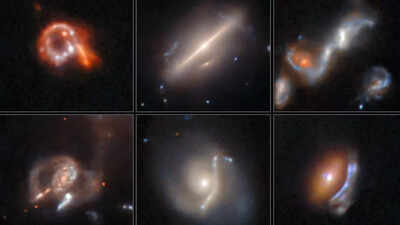
For more than 35 years, the Hubble Space Telescope has been quietly building one of the largest visual records of the universe ever assembled. The problem is scale. With nearly 100 million small image cutouts stored in its archive, no team of astronomers could realistically examine everything by eye. Important details were always going to slip through.Recently, NASA confirmed that artificial intelligence is now filling that gap. In a post shared by NASA Hubble on X, the agency revealed that an AI-powered system had uncovered more than 1,300 unusual celestial objects hidden deep within Hubble’s existing data, many of which had never been formally identified before.
How decades of data were analysed in days with the help of AI
What would have taken humans years was completed in just two and a half days. Researchers deployed an AI system, known as Anomaly Match, which is capable of scanning Hubble’s entire image archive and flagging objects that appeared visually unusual. Rather than cataloguing stars and galaxies one by one, the system focused on anomalies. The research was published under the title “Identifying astrophysical anomalies in 99.6 million source cutouts from the Hubble legacy archive using AnomalyMatch”.This approach reflects a broader shift in astronomy. Because of the growing data, it becomes impossible for humans to detect them. As per the X post by NASA Hubble, the AI helped narrow the field, allowing researchers to concentrate on the most promising and puzzling findings.
What the AI actually found
Most of the objects that were picked out were galaxies caught in the midst of very dramatic interactions. Some of them had elongated tidal streams of stars and gas, indicative of galactic collisions. Others had signs of gravitational lensing, where massive galaxies in the foreground were warping light into arcs and rings.The software has also picked out jellyfish galaxies that are shedding gas, irregular star-forming regions, and edge-on planet-forming disks that look strangely familiar. After human verification, over 800 of the confirmed anomalies were found to have never appeared in scientific literature. This number suggests that even with decades of observation, astronomers were missing some data.
Why this AI approach matters
The timing is significant. New observatories like NASA’s Nancy Grace Roman Space Telescope, ESA’s Euclid mission, and the Vera C. Rubin Observatory are expected to produce data volumes far exceeding Hubble’s output. Without automated systems, much of that information would remain underexplored.AI tools like AnomalyMatch may soon become standard, helping researchers locate rare events, unexpected structures, and possibly phenomena not yet theorised. The shift is less about automation and more about survival in a data-rich era.







 हिन्दी
  English