 Sipu Jha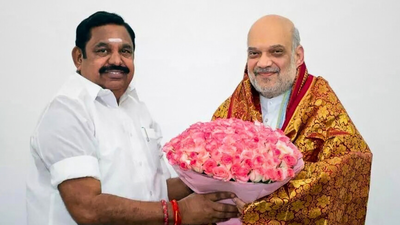
NEW DELHI: Once upon a time, the Jayalalithaa-led AIADMK pulled the plug on a vulnerable Atal Bihari Vajpayee government at the Centre. The withdrawal of support in 1999 triggered the NDA’s collapse after a no-confidence motion, forcing midterm Lok Sabha elections. For the BJP, it was not merely a political setback but a stinging lesson in the fragility of coalition politics.By any measure, the 1999 episode could be read as a betrayal. And yet, nearly three decades on, history appears to be folding in on itself.
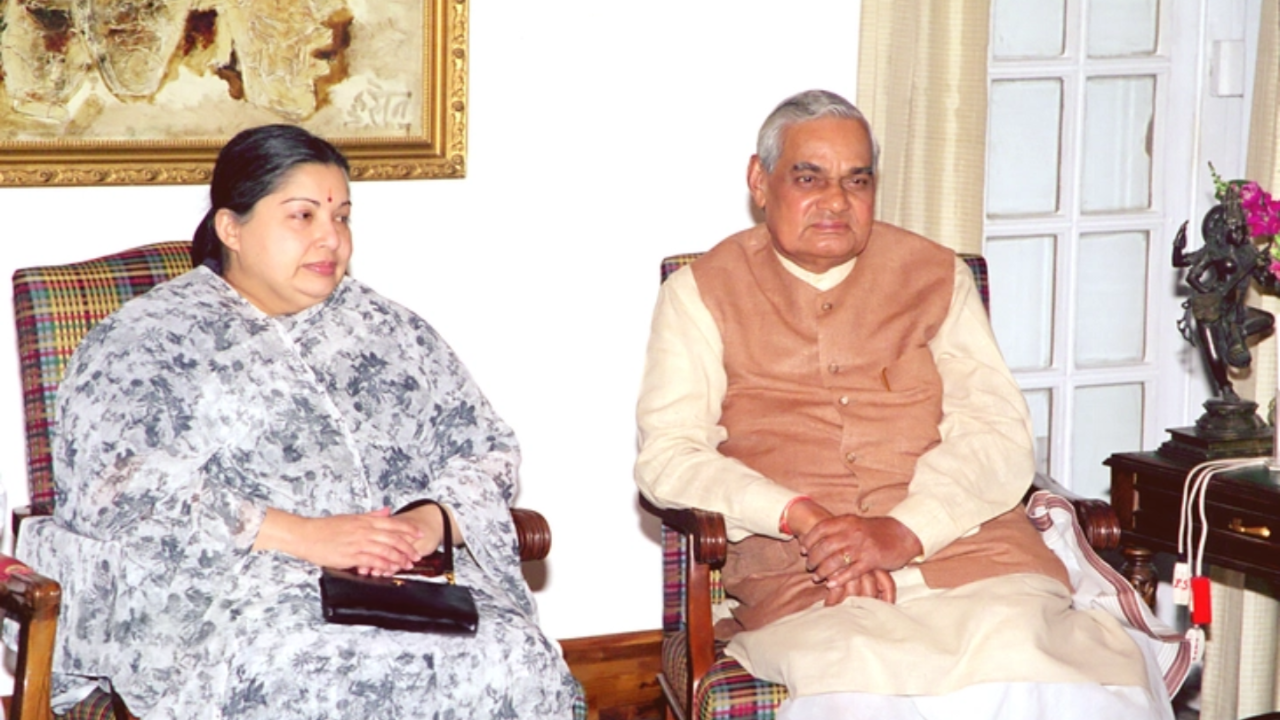
(File photo)
With the Tamil Nadu Assembly elections just months away, the BJP has formally sealed an alliance with the AIADMK, now led by former chief minister and party general secretary Edappadi K Palaniswami (EPS). The objective is unmistakable: to build a formidable front aimed at unseating the incumbent DMK government under chief minister M K Stalin.From 1999 to 2026, the relationship between the BJP and the AIADMK has followed a familiar cycle – alliance, rupture, and reunion. Despite repeated breakups, political compulsions have ensured that the two parties keep finding their way back to each other.
The pattern
While the BJP and AIADMK share a long history of alliances, the relationship has rarely been smooth. It has unravelled abruptly more than once, exposing deep mistrust beneath the surface.The most dramatic rupture came in 1999, when Jayalalithaa withdrew support to the Vajpayee government, leading to its collapse by a single vote. Yet, within a few years, the two parties were back together. That cycle has repeated itself multiple times since then – most recently after the 2024 Lok Sabha elections, when they fought separately, only to return to the same negotiating table ahead of the 2026 assembly polls.The story of BJP-AIADMK ties is therefore less about ideology and more about arithmetic – a relationship driven by necessity.
A timeline of ties and tensions
1998–99: The first alliance and the big collapse
In the 1998 Lok Sabha elections, which paved the way for BJP stalwart Atal Bihari Vajpayee to become prime minister, the BJP extended a conciliatory hand to the Jayalalithaa-led AIADMK. The partnership, however, proved short-lived. Within a year, the AIADMK withdrew its support from the NDA, bringing down the vulnerable Vajpayee-led multiparty government.The rupture came against the backdrop of multiple corruption cases against Jayalalithaa and her fraught relationship with the DMK. The Supreme Court dealt a blow to her legal strategy by upholding the constitution of special courts and rejecting attempts to transfer the cases back to regular courts. This judicial setback hardened her political stance, culminating in the withdrawal of support from the Centre.
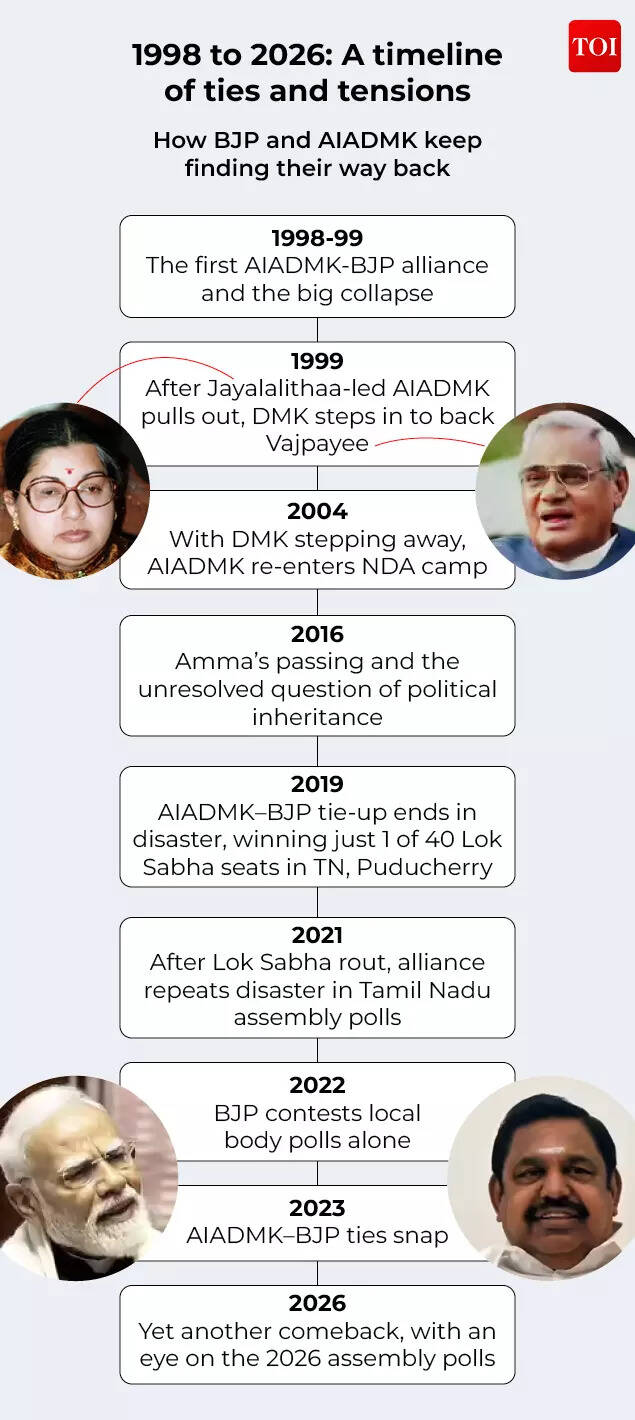
In a dramatic turn, the rival DMK, led by veteran Dravidian leader M Karunanidhi, stepped in to extend support to the Vajpayee government, which went on to complete a full five-year term.
2004: Reunion
Months ahead of the 2004 Lok Sabha elections, the DMK severed ties with the BJP-led NDA. The saffron party then turned once again to the Jayalalithaa-led AIADMK, forging a fresh alliance in Tamil Nadu. The experiment, however, yielded little electoral dividend, with the BJP failing to win a single seat in the state.Nationally, the NDA’s “India Shining” campaign lost its sheen, paving the way for the Congress-led United Progressive Alliance to return to power at the Centre, with Manmohan Singh taking over as prime minister.In May 2004, then BJP president M Venkaiah Naidu told reporters in Chennai that the alliance with the AIADMK had been forged specifically for the elections—by then already over—signifying the largely tactical nature of the tie-up.
2016-2019: Post-Amma era
Following the death of veteran politician and AIADMK supremo J Jayalalithaa in late 2016, the party that had ruled Tamil Nadu for decades was plunged into intense factionalism. A bitter succession battle unfolded, with multiple claimants emerging in the post-Amma era, including the Sasikala family, O Panneerselvam and Edappadi K Palaniswami, who eventually consolidated his position and now heads the party.During this period, while a formal alliance was absent, the AIADMK began extending policy-based support to the Narendra Modi-led government at the Centre.The relationship eventually culminated in an electoral alliance for the 2019 Lok Sabha elections. The experiment, however, ended in a rout, with the AIADMK-BJP combine losing 39 of the 40 Lok Sabha seats in Tamil Nadu and Puducherry.
2021-2023: Together, then apart again
Despite the 2019 debacle, the AIADMK-BJP alliance continued into the 2021 Assembly polls. The result was another defeat: AIADMK won just 66 seats, BJP managed four, and the DMK-Congress alliance stormed back to power under Stalin.
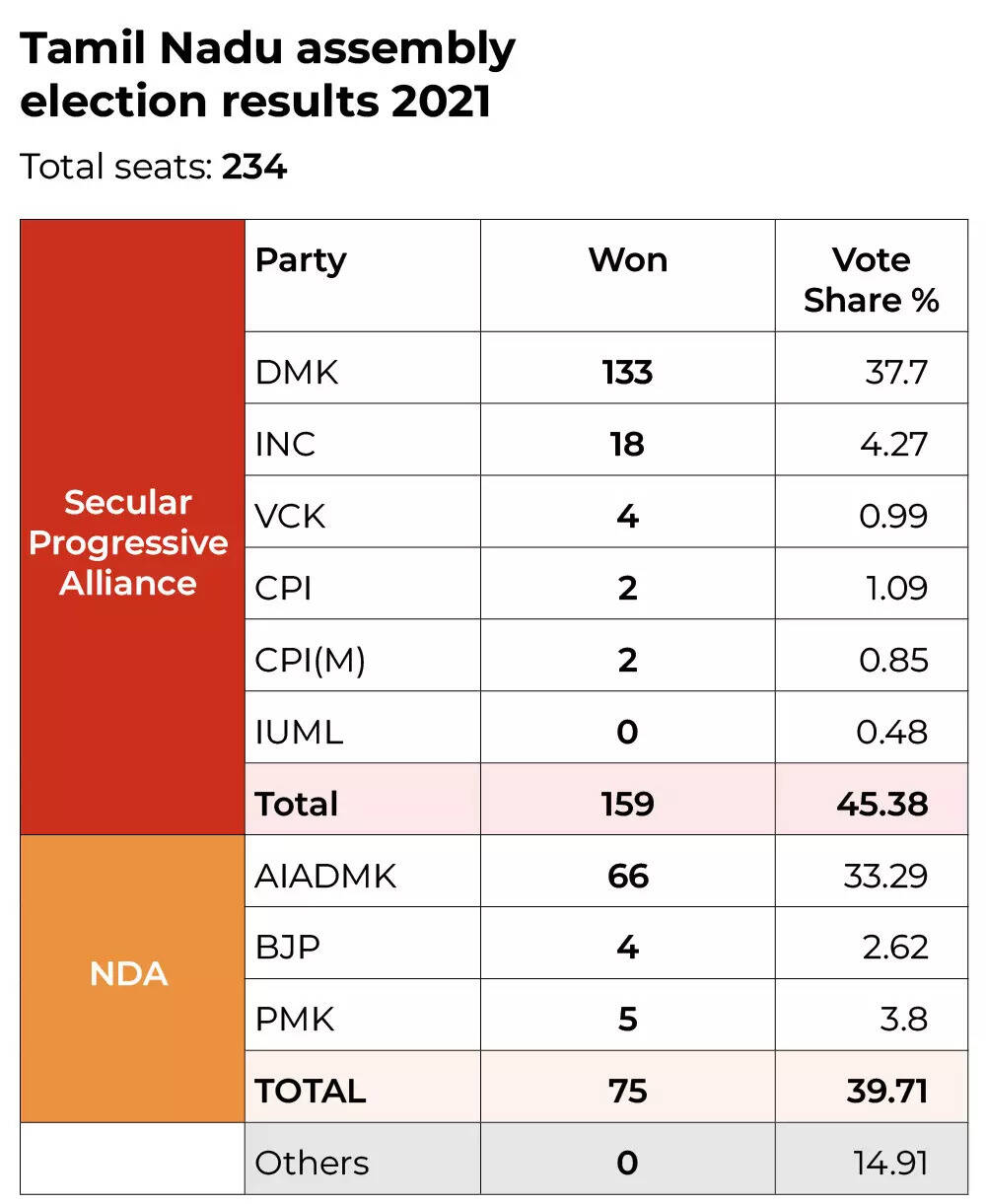
The results suggested that the alliance helped the BJP gain a foothold but did little for the AIADMK.By 2022, the BJP contested local body polls alone. Ties finally snapped in 2023 after the BJP’s then state chief K Annamalai made controversial remarks on Jayalalithaa, triggering outrage within the AIADMK.
2026: Another comeback
Two years after their split, the BJP and AIADMK formally came together again in 2025, announcing that the NDA would contest the upcoming Assembly elections under the leadership of EPS.Once again, political necessity trumped past bitterness.
Why they need each other in 2026
For much of the past year, negotiations between the BJP and the AIADMK have been anything but decisive. The EPS-led AIADMK has repeatedly vacillated, weighing and re-weighing the costs and benefits of embracing the BJP as a partner to take on what is widely seen as a strong and entrenched Stalin-led DMK.Despite the prolonged uncertainty, the deal now appears almost final. All indications suggest that the two parties are set to formally revive the NDA alliance in Tamil Nadu just ahead of the polls.As the election drumbeat grows louder, Prime Minister Narendra Modi, undoubtedly the BJP’s most potent electoral face over the past decade, is scheduled to visit Madurai in the last week of February. In a symbolic show of unity, Palaniswami is expected to share the stage with PM Modi at a BJP-led rally, signalling that old animosities may finally be set aside.
BJP’s compulsion
Tamil Nadu remains one of the BJP’s weakest links – a state where the saffron party has struggled to translate its national dominance into local relevance.The BJP’s renewed push for an alliance shows a hard political reality: the Dravidian voter base cannot be wooed by outsiders. Tamil Nadu politics remains firmly anchored in grassroots Tamil parties, principally the ruling DMK and the opposition AIADMK.Amit Shah, in particular, has sharpened his attacks on the Stalin government, accusing it of being “the most corrupt in the country” and of undermining Hindu values. His rhetoric often positions the AIADMK as a “natural ally,” a party that straddles the line between secular Dravidian politics and a softer form of Hindu assertion.The BJP’s immediate agenda is not necessarily to dominate but to prevent vote fragmentation that would otherwise benefit the DMK-Congress alliance.
EPS’s doubts about the BJP
The AIADMK’s hesitation is rooted in precedent. The BJP has a track record of entering alliances as a junior partner, often presenting itself as a supportive force with access to power at the Centre, only to eventually upend the balance and emerge as the dominant player.The most recent example is Bihar. Like the AIADMK, Nitish Kumar’s JD(U) has been an on-again, off-again ally of the BJP and was long regarded as the “big brother” in the state. That equation changed dramatically in November 2025, when the BJP, for the first time, emerged larger than the JD(U) in terms of seats, even while conceding the chief minister’s post to Nitish Kumar.While the BJP is still far from posing an immediate threat to the AIADMK in Tamil Nadu, the insecurity within the EPS camp is palpable.
Eyeing an entry in Tamil Nadu
The BJP’s renewed push for an alliance shows a hard political reality: the Dravidian voter base cannot be wooed by outsiders. Tamil Nadu politics remains firmly anchored in grassroots Tamil parties, principally the ruling DMK and the opposition AIADMK.The BJP’s immediate agenda is not necessarily to dominate but to prevent vote fragmentation that would otherwise benefit the DMK-Congress alliance. Tamil Nadu is one of the few states where the BJP’s organisational presence is weaker than that of the Congress, a party that has been in steady national decline for over a decade.To rebuild a broader NDA, the BJP is reaching out to a range of regional players. T T V Dhinakaran’s AMMK is already signalling interest in joining hands, while talks are ongoing with Pattali Makkal Katchi (PMK) founder S Ramadoss. Former allies and breakaway factions are also being courted as part of a larger consolidation exercise.Two years after their split, the BJP and AIADMK formally came together again in 2025, announcing that the NDA would contest the upcoming Assembly elections under the leadership of EPS.In New Delhi, the AIADMK is seen as the BJP’s primary vehicle for political relevance in the southern state, a view that reflects the urgency of Amit Shah’s strategy.
A ‘natural alliance’
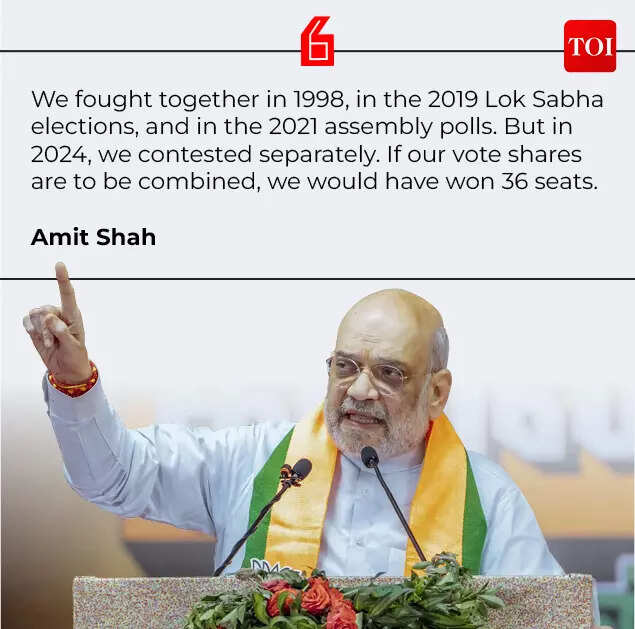
Calling the BJP-AIADMK tie-up a “natural alliance,” Shah argued that the outcome of the 2024 Lok Sabha elections would have been very different had the two parties contested together.“We fought together in 1998, in the 2019 Lok Sabha elections, and in the 2021 assembly polls. But in 2024, we contested separately. If our vote shares are to be combined, we would have won 36 seats,” he said, adding that 2024 and 2025 had been victorious years for the BJP in several states and that the trend would repeat in Tamil Nadu and West Bengal.
Tamil Nadu BJP chief Nainar Nagenthran echoed the sentiment, claiming widespread public disillusionment with the DMK government. He blamed former minister Senthil Balaji for the Karur stampede during actor-politician Vijay’s TVK rally.These public assertions are aimed at projecting confidence, yet they also underline a deeper truth: without the AIADMK, the BJP has little realistic chance of expanding in Tamil Nadu on its own.
Caste arithmetic
The AIADMK’s electoral strategy continues to focus on Dalits and Thevars – communities that together account for roughly one-third of the state’s electorate. The BJP, in contrast, is pursuing a broader Hindu consolidation strategy that often cuts across Tamil Nadu’s complex caste equations.The NDA could also benefit from the support of the Vanniyars, who make up around 15 per cent of the population and are largely represented by the PMK.EPS himself brings caste capital to the alliance. A Gounder, classified under the Backward Classes, he represents a community that constitutes around 7 per cent of the state’s population and is concentrated in the Kongu Nadu belt.
What next?
After years of mistrust, breakups and reconciliations, both parties now appear determined to hold hands against the Stalin government.Palaniswami has called the AIADMK-BJP alliance “essential” to unseat what he terms an “anti-people” DMK government.“AIADMK will capture power with absolute majority in 2026… Never in the history of Tamil Nadu has there been such a corrupt, incompetent anti-people government,” EPS said.Amit Shah struck a similar tone, accusing the DMK of dynastic politics and corruption, and declaring that the NDA would remove the Stalin government “at all cost.”From 1999 to 2026, the BJP and AIADMK have parted ways more than once, only to reunite when elections approach. Whether this latest reunion becomes a durable partnership or another short-lived truce will ultimately be decided by the Tamil voter.








 हिन्दी
  English