 Sipu Jha
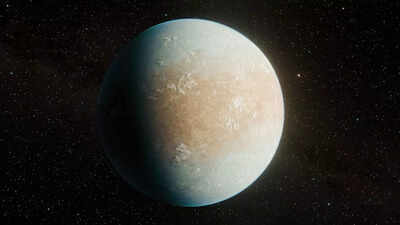
A planet that looks faintly familiar has emerged from old space telescope data, though it may be far from welcoming. Scientists analysing observations from NASA’s retired Kepler mission report a possible rocky world, slightly larger than Earth, circling a nearby star at a distance much like our own orbit. The planet, known as HD 137010 b, sits near the outer edge of what astronomers call the habitable zone. That placement hints at the long-discussed possibility of liquid water but also raises doubts. The star is cooler and dimmer than the Sun, and the planet may receive far less energy than Earth does. For now, the finding rests on a single observation and remains provisional.
A cold Earth-sized planet candidate surfaces in old NASA telescope data
The discovery comes from continued work on data gathered during Kepler’s K2 mission, which ended in 2018. Although the telescope is no longer operating, its archive is still yielding new results. In this case, researchers identified a single transit event, a brief dip in starlight caused by a planet crossing the face of its star.HD 137010 b is listed as a candidate rather than a confirmed planet. That distinction matters. Astronomers usually need to see repeated transits at regular intervals to be confident they are seeing a real world and not a statistical fluke or stellar noise. Still, even one clean signal can carry useful information.
An orbit similar to Earth but around a dimmer star
Based on the length of the transit and models of the star itself, the team estimates that the planet takes roughly a year to complete one orbit. That makes it unusual among known exoplanets, many of which circle their stars in days or weeks.The host star, HD 137010, is a K-type dwarf. It is smaller, cooler and less luminous than the Sun. As a result, a planet at an Earth-like distance would receive much less heat. Calculations suggest HD 137010 b may get less than a third of the energy Earth receives from sunlight.
Surface temperatures could rival frozen Mars
That reduced energy budget has consequences. Without a strong greenhouse effect, the planet’s surface temperature could be extremely low. Estimates place it around minus 90 degrees Fahrenheit, slightly colder than the average temperature on Mars.Such figures come with large uncertainties. They depend on assumptions about the planet’s reflectivity, atmosphere and internal heat. Even so, the numbers underline how Earth-like size and orbit do not guarantee Earth-like conditions.
Habitability depends on atmosphere and chance
Despite the cold outlook, the researchers are cautious rather than dismissive. Their models suggest that if HD 137010 b has a thick atmosphere rich in carbon dioxide, it could retain enough heat to allow liquid water on its surface.Using these models, the team estimates a 40% chance that the planet lies within the conservative habitable zone and a 51% chance that it falls within a broader, more optimistic definition. At the same time, they acknowledge roughly even odds that the planet sits beyond the habitable zone altogether. The balance is uncertain and finely poised.
Confirmation will be slow and difficult
Turning HD 137010 b from candidate to confirmed planet will not be easy. With an orbital period close to one year, transits happen rarely. Missing one means waiting many months for the next opportunity.Future observations may come from NASA’s TESS mission or from the European Space Agency’s CHEOPS satellite, both designed to study planets around nearby bright stars. If those efforts fail, confirmation could be delayed until more powerful space telescopes come online.
A nearby system suited for future study
One reason the planet has drawn attention is its relative proximity. At about 146 light years away and orbiting a star bright enough for detailed measurements, HD 137010 b could become a valuable target if confirmed.For now, it sits in a quiet category of maybes. It is neither a clear second Earth nor an obviously dead world. Instead, it reflects the slow, careful pace of planetary science, where even a single shadow crossing a distant star can open years of further work or fade just as quietly back into the data.







 हिन्दी
  English