 Sipu Jha
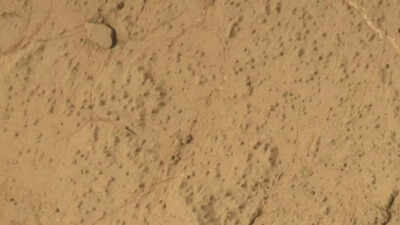
The Curiosity rover, along the lower slopes of Mount Sharp inside Gale Crater, has reportedly uncovered the largest organic molecules ever found on the Red Planet. Decane, undecane, and dodecane are the mid-sized hydrocarbons that look a lot like fragments of fatty acids preserved in mudstone that’s 3.7 billion years old. Scientists reveal these molecules can form both naturally and through life. But the discovery has reignited speculation that Mars might have hosted microbial life long ago.According to NASA, the findings were published in March 2025, describing how prebiotic chemistry has advanced further on Mars than previously what was observed. As cited, NASA, the mudstone samples may be the proof that Mars had life.
NASA Curiosity rover discovers ancient molecules on Mars
The rover’s instruments reportedly detected these organics in mudstone samples and found them to be the largest on Mars so far. Scientists noticed they resemble fatty acids, which on Earth are key building blocks for cells. On Mars, though, cosmic radiation tends to destroy such molecules over billions of years. Lab tests and modelling were used to rewind 80 million years of surface exposure. Data seems to make a biological explanation credible, with lead scientists reportedly stressing the need for more experiments simulating Martian conditions. Curiosity’s been at this for over a decade. Launched back in 2012, it’s been exploring ancient lakebeds, rocky outcrops, and now these sulfate-rich layers. The mountain we’re climbing, Mount Sharp, has layers like a giant cake.
Mars’ Gale Crater and findings
Gale Crater has been giving up secrets since 2012. From methane plumes to complex organics, the place seems like a goldmine for astrobiologists. These latest molecules might not prove life, but they add a new layer to the puzzle.The findings also set the stage for sample-return missions. Perseverance, another rover on Mars, might help refine the story.







 हिन्दी
  English