 Sipu Jha
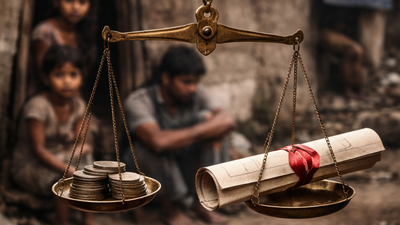
Justice comes with hidden costs that those already burdened by the perpetual cycle of poverty, a cycle that shackles every step each day, feel too acutely to ignore. Rights exist. Legal aid is free for them. However, they do not have the privilege of affording the costs, both literal and opportunity-related, associated with recurring court dates. Injustice in any form hits them harder. Some remain under the dark cloud of lack of awareness about their existing rights, while others fear the consequences that may follow if they assert them.Poverty not only strips away social standing, hinders growth, and erodes health, but also robs dignity, striking most brutally at the vulnerable.When poverty forces people from disadvantaged backgrounds to toil relentless hours under harsh conditions just to ensure their child sees a meal on his plate, even if not the future he dreams of but enough to keep hope alive, survival becomes the only priority.Poverty cements their feet and, at the same time, pushes them into legal vulnerability.And when such individuals are confronted with injustice of any sort, whether a wrongful accusation, workplace exploitation, eviction, domestic abuse, discrimination, or even a sudden legal summons, it takes far more than courage to access their own legal rights.
The constitutional promise vs ground reality
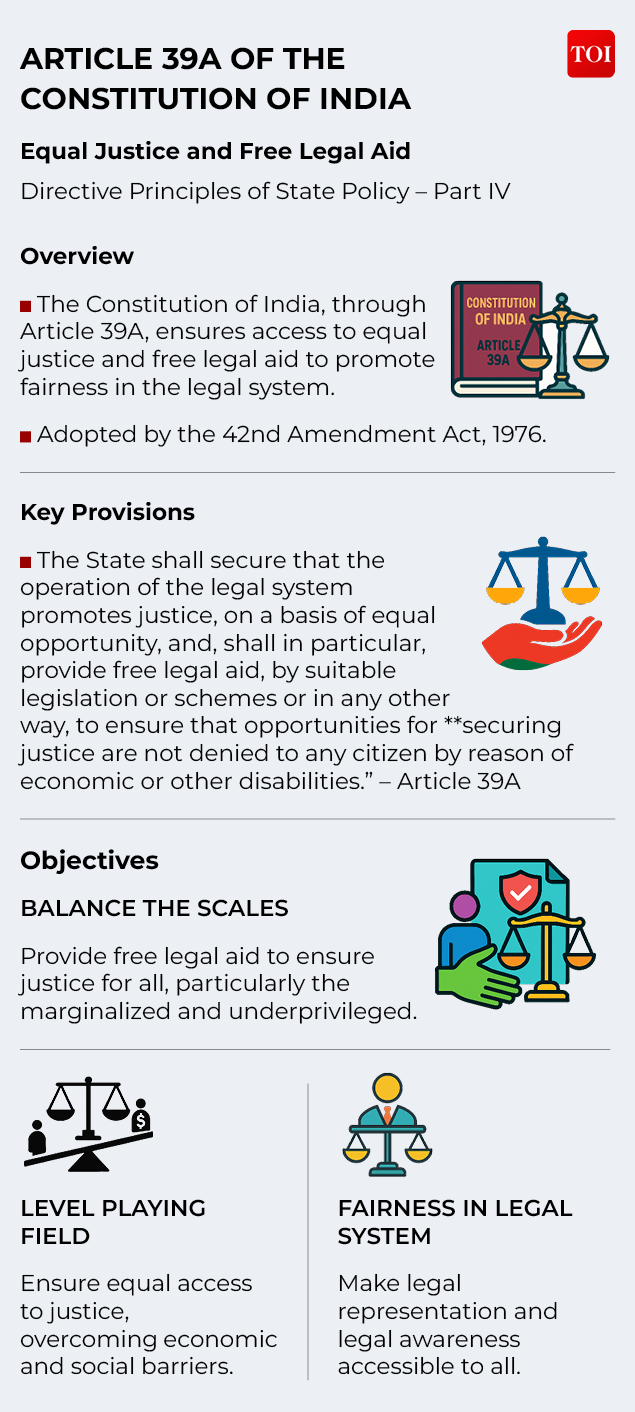
To ensure that no person is denied justice merely because they cannot afford legal representation, Article 39A of the Constitution of India, introduced through the 42nd Amendment in 1976, mandates the State to provide free legal aid and ensure equal justice for all.
.
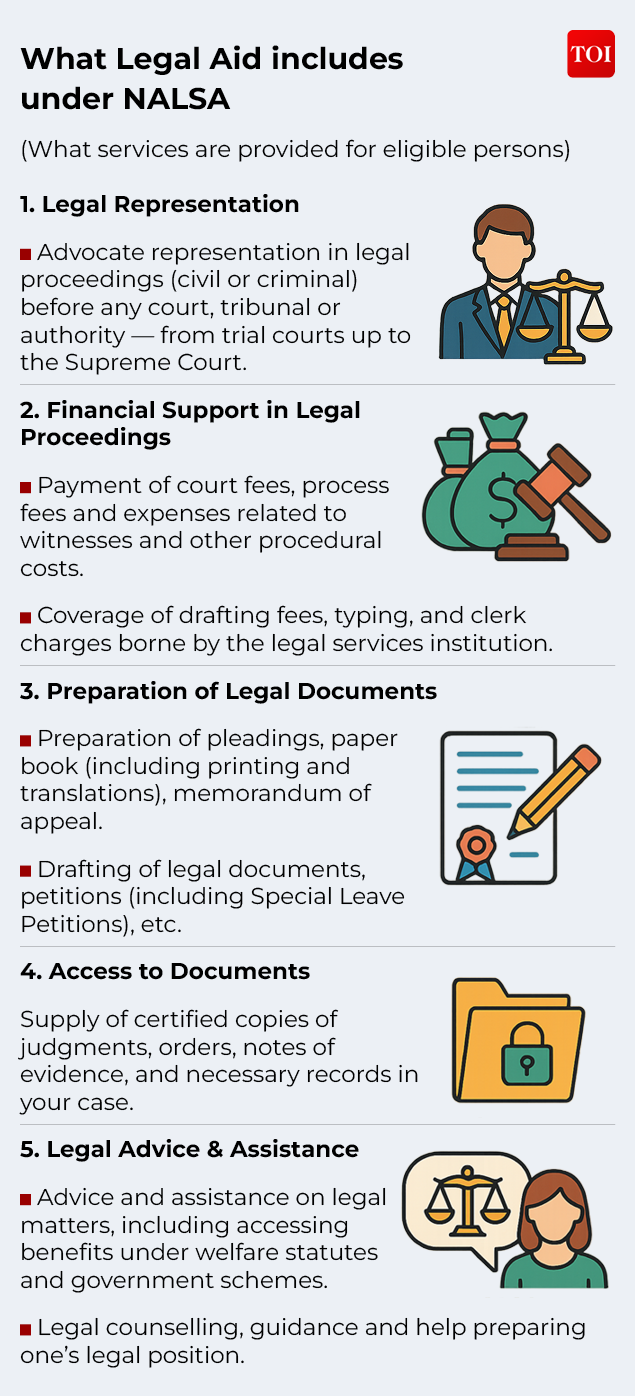
This constitutional vision was institutionalised through the Legal Services Authorities Act, 1987, under which the National Legal Services Authority (NALSA) was established in 1995 as the central body to implement legal aid programs across the country.The legal aid system in India is structured as a nationwide network, from the National Legal Services Authority (NALSA) at the Centre, chaired by a Supreme Court judge with the Chief Justice of India as Patron-in-Chief, to State and District Legal Services Authorities, and local Taluka bodies. At the grassroots, paralegal volunteers, drawn from communities, including teachers, social workers, Anganwadi workers, law students, and marginalized groups serve as bridges between citizens and the justice system.
.
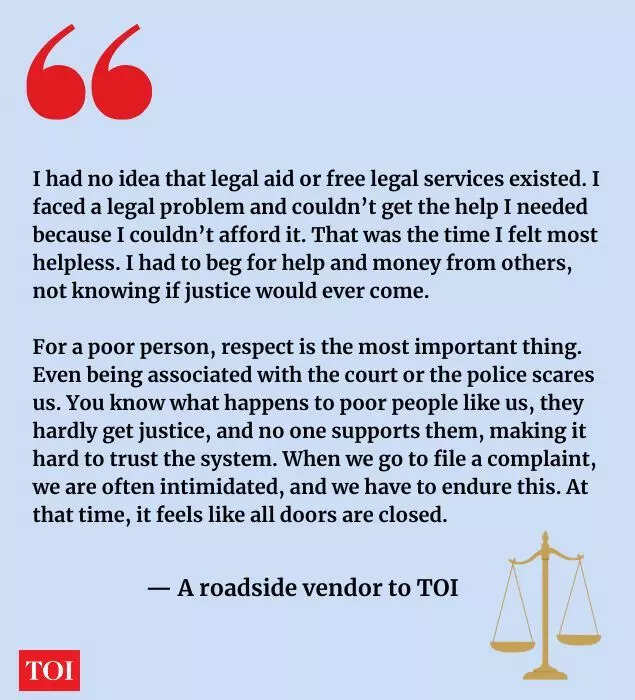
The idea being simple yet ambitious, justice should reach the doorstep of the poor.Yet access remains low. Former Chief Justice of India, former Judge of the Supreme Court of India, and former Executive Chairman of the National Legal Services Authority (NALSA), Justice Uday Umesh Lalit, in an interview to Sansad TV, noted after reviewing nationwide data:“Statistics showed that people get legal aid in less than 1% of the cases where justice is required. If we look at how many people are below the poverty line, it is inconsistent that only 1% would need legal aid. Either they do not know it is their right, or they do not have confidence in the system.”That single statistic exposes a deep structural contradiction, a country with millions eligible for free legal assistance sees only a tiny fraction accessing it.Amid the daily struggles of poverty, many people remain unaware of their right to legal aid or free legal services. A roadside vendor narrated how police use court cases to intimidate them. When asked if he knew that legal aid is free, he expressed shock.“I had no idea that legal aid or free legal services existed. I faced a legal problem and couldn’t get the help I needed because I couldn’t afford it. That was the time I felt most helpless. I had to beg for help and money from others, not knowing if justice would ever come. For a poor person, respect is the most important thing. Even being associated with the court or the police scares us. You know what happens to poor people like us, they hardly get justice, and no one supports them, making it hard to trust the system. When we go to file a complaint, we are often intimidated, and we have to endure this. At that time, it feels like all doors are closed,” he told TOI.
.
Poverty and legal vulnerability: A reinforcing cycle
According to the latest World Bank data, between 2011‑12 and 2022‑23, India lifted roughly 269 million people out of extreme poverty, reducing the poverty rate from 27.1% to 5.3%. Yet around 75 million people still live in extreme poverty, leaving them vulnerable not only to deprivation in food, healthcare, and education, but also to challenges in accessing legal protections and exercising their rights effectively.
.
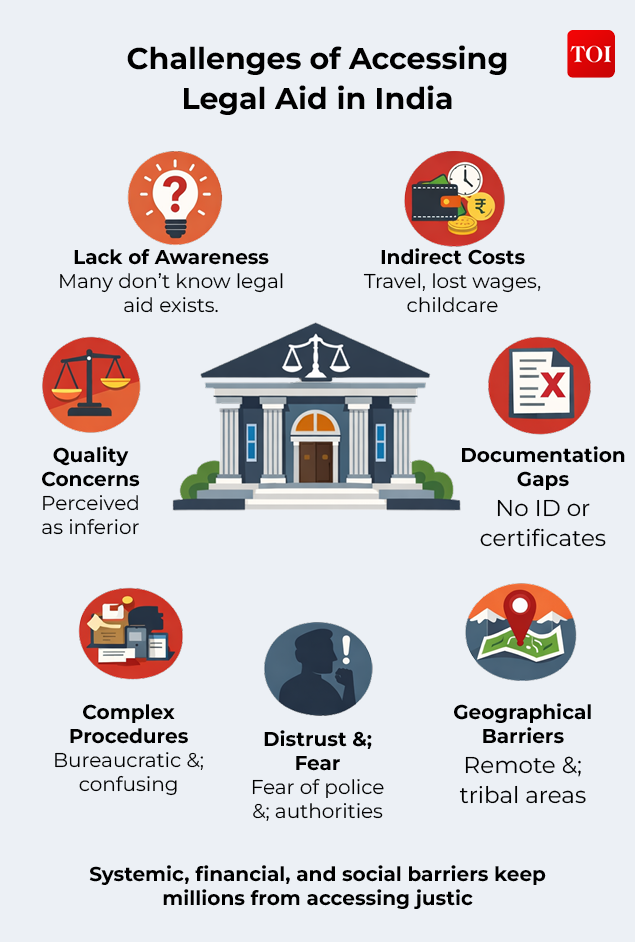
People living in deprivation often face:
- inability to miss daily wages to attend hearings,
- lack of transport to courts,
- absence of identity or property documents,
- fear of police or authority figures,
- dependence on informal or exploitative intermediaries,
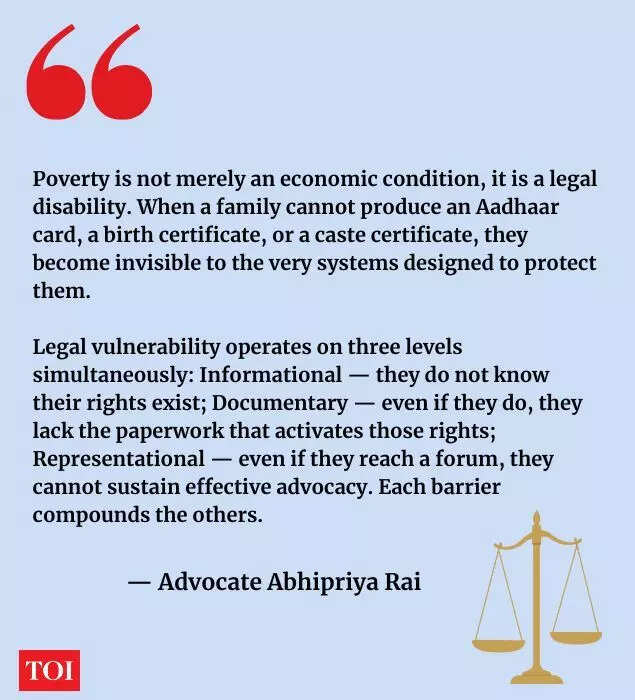
For many, even receiving a legal notice or court summons can trigger panic rather than protection. Without awareness or guidance, such notices may be ignored, not out of defiance but confusion or fear, sometimes worsening legal consequences.Advocate Abhipriya Rai explained, “Poverty is not merely an economic condition, it is a legal disability. When a family cannot produce an Aadhaar card, a birth certificate, or a caste certificate, they become invisible to the very systems designed to protect them.”
.
She added that legal vulnerability operates on three levels simultaneously. “Informational: they do not know their rights exist. Documentary: even if they do, they lack the paperwork that activates those rights. Representational: even if they reach a forum, they cannot sustain effective advocacy. Each barrier compounds the others.”Legal vulnerability therefore becomes not a separate condition, but a direct extension of economic vulnerability.
What grassroots organisations witness
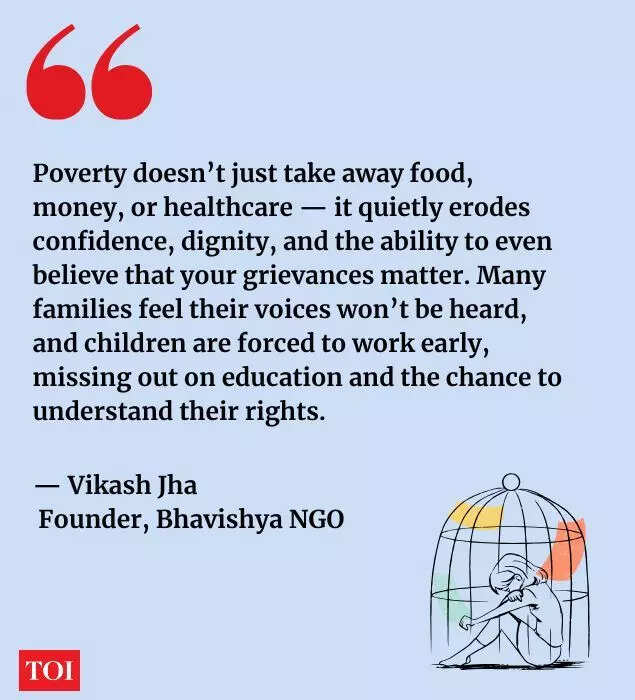
NGO workers who interact daily with marginalised families consistently observe how poverty quietly erodes agency and confidence.According to Vikash Jha, founder of Bhavishya NGO, poverty often prevents families from even believing their grievances will be heard. Lack of access to nutritious food, clean water, healthcare, and quality education weakens both physical and psychological resilience. He noted that many children from such backgrounds begin working early to support their households, further reducing their chances of awareness about rights or legal remedies.
.
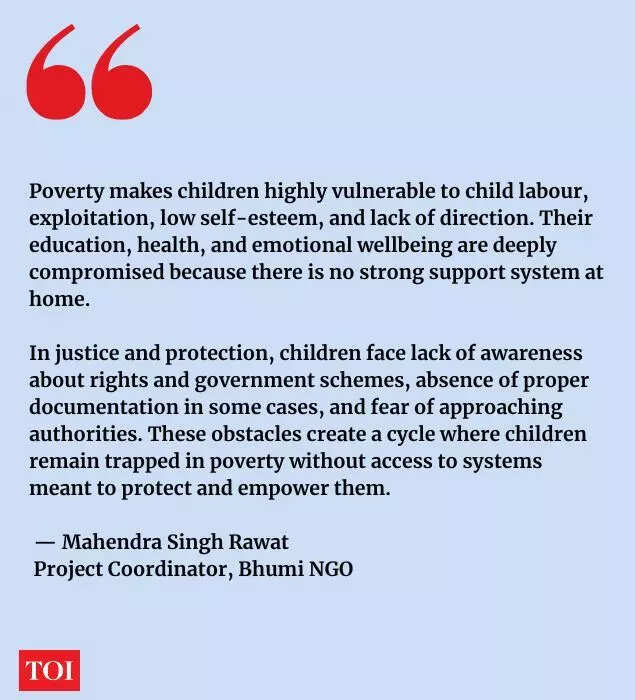
TOI also spoke to Mahendra Singh Rawat, project coordinator at Bhumi NGO, Delhi, who has worked with underprivileged children in shelter homes and slum communities for over three years. He highlighted how poverty affects every aspect of a child’s life:“It is not only financial deprivation, but also limits awareness, opportunities, confidence, and aspirations. Many parents are daily wage workers with unstable incomes. Many children drop out early, and some are pushed into begging or work to support their families”. He further noted that there is lack of awareness about rights and government schemes, absence of proper documentation in some cases, and fear of approaching authorities that further perpetuates lack of access to justice among the poor even when the legal aid framework exists.
.
A Delhi-based cleanliness worker who wished to remain anonymous added: “Demanding better conditions is a privilege daily wage workers like me cannot afford. Even if it badly affects our health, we cannot quit. Nobody cares. I may be useful to the system, but I am not treated as a dignified part of it and I don’t feel that my voice would be heard even if raised.”
Why free legal aid alone is not enough
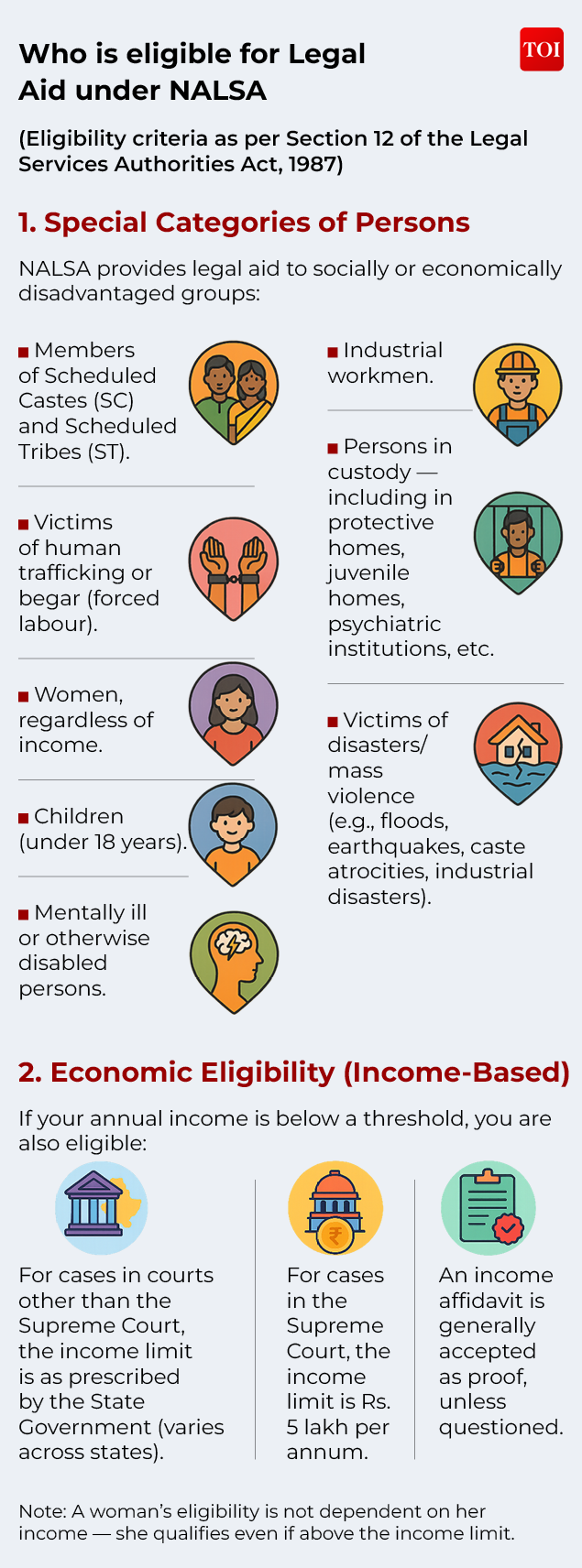
India’s legal aid framework is widely regarded as one of the most comprehensive in the world. Eligibility typically includes:
- persons below income thresholds,
- women and children,
- Scheduled Castes and Scheduled Tribes,
- persons with disabilities,
- victims of trafficking or disaster,
- industrial workmen,
- those in custody,
.
Services may include legal advice, representation, drafting documents, and mediation, all free of cost.Yet access gaps persist because formal entitlement does not automatically translate into practical accessibility.
Common barriers include:
- lack of awareness about the rights, legal aid framework, and eligibility,
- distrust of state institutions,
- language barriers,
- social stigma,
- procedural complexity,
- perception that free services are inferior,
The Hidden Costs of Justice
Although legal representation may be free, justice still carries indirect expenses:
- travel costs to courts,
- lost wages from attending hearings,
- childcare arrangements,
- repeated procedural delays,
Reflecting on these hidden costs, Adv. Abhipriya observes:“A worker who cannot read the summons served to her, who has been told by police to ‘go home and settle,’ does not see the law as a resource. She sees it as a threat. That fear is rational.” On the broader framework, she notes, “India has one of the most elaborate statutory frameworks for protecting the poor in the developing world. But a right that cannot be exercised is not a right. It is a promise that was never kept.”For daily wage earners, a single missed workday can mean a missed meal. Multiple court dates can therefore translate into financial distress, discouraging people from pursuing even legitimate claims.
Can legal aid help alleviate poverty?
Adv. Abhipriya noted that legal aid, when delivered effectively, has immediate, tangible impacts. The mechanism is more direct than people assume:When a woman who has been illegally terminated recovers her wages through a legal aid lawyer, she has protected her family’s food security for months. Similarly, when a family obtains a stay against illegal demolition, children stay in school.She added that legal aid, when delivered well, is poverty alleviation, without a welfare scheme label attached.Between 2015 and 2025, over 1.61 crore citizens received legal aid, while over 40 crore cases were settled through National Lok Adalats, and the Legal Aid Defence Counsel System disposed of nearly 8 lakh criminal cases in three years.Government funding for NALSA for 2022‑23 was Rs. 190 crore, which was increased to Rs. 400 crore for 2023‑24, dropped to Rs. 200 crore in 2024‑25, and rose again by 25 percent to Rs. 250 crore in the Union Budget 2026‑27.However, structural challenges still persist:Awareness: Judges and legal experts have emphasised that many eligible people are unaware of free legal aid, with most assuming they cannot access assistance because it is unaffordable.Quality: Justice Nagarathna emphasized that “legal aid to the poor does not mean poor legal aid.” Panel lawyers are often junior, overloaded, and inadequately compensated. Wide disparities persist between legal aid representation and private representation. This is not a criticism of individual lawyers but a systemic design failure.Geography: Tribal families in remote areas often cannot reach District Legal Services Authorities, and the digital divide creates additional barriers for accessing online portals.Fund utilisation: Hon’ble Chief Justice Surya Kant disclosed at the Conference that by September 2025, only 16.93% of the Legal Aid and Advice budget had been utilised, while outreach expenditure had exceeded its allocation. Money meant for representation and aid delivery remained unspent, while funds for awareness were overspent, an inversion of priorities.
Why this conversation matters
On World Social Justice Day, observed annually on February 20 by the United Nations, the global spotlight turns to poverty, inequality, exclusion, and human rights. For India, it underscores the urgent challenge of bridging the gap between legal rights and actual access to justice.As harsh as it may sound, society often reserves dignity for those who are affluent and demands subservience from those who struggle simply to survive, educate, and aspire. Poverty does not only deprive, it silences. Understanding how poverty intersects with legal vulnerability is essential not merely for policy reform, but for safeguarding democracy itself. Because access to justice is not just another welfare benefit, it is the foundation that determines whether rights exist only on paper or in reality.



 हिन्दी
  English