 Sipu Jha
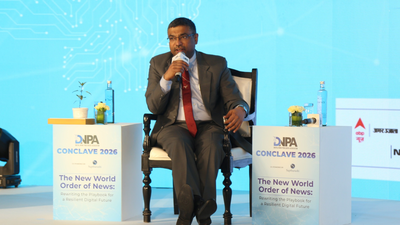
At the DNPA Conclave 2026, policymakers and industry leaders came together to discuss the evolving digital ecosystem and the challenges of governing communications in the time of artificial intelligence. Speaking during a session on ‘The Regulatory Reset: Governing India’s Digital Communications in the AI era’, ministry of electronics and information technology secretary S Krishnan outlined how India seeks to balance free expression with platform accountability.He said, “Freedom of expression is subject to certain restrictions which are ingrained in Article 19(2) of the Constitution. Those grounds are very clear. So on those grounds there could be reasonable restrictions on freedom of speech. And the courts have repeatedly upheld that.”Krishnan added that social media regulations do not go beyond the constitutional mandate. He highlighted Section 69A of the IT Act as a key regulatory mechanism, which addresses certain restrictions permitted under Article 19(2). Other grounds under Article 19(2), such as defamatory and obscene content are dealt with through separate legal provisions but form part of the wider regulatory framework.Krishnan added that the government works within the framework of the law. He emphasized that platforms operating in India must not go against constitutionally valid restrictions, adding that if they wanted to operate in India, they should abide by Indian laws.When asked why sensationalised content tends to get wider reach, Krishnan said that it is a deeper reflection of society. He also highlighted the government’s new rule regarding the labelling of synthetically generated content so as to ensure users are aware of what they are consuming.His remarks underscored the government’s position that while digital innovation and AI are reshaping communication, regulatory oversight will continue to operate firmly within constitutional boundaries.









 हिन्दी
  English