 Sipu Jha
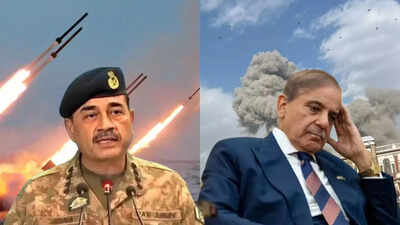
NEW DELHI: As the United States and Israel launched coordinated strikes on Iran , Pakistan finds itself staring at the prospect of a two-front strategic squeeze. What began as cross-border clashes with the Afghan Taliban has now coincided with a rapidly expanding conflict to Pakistan’s west, raising fears of a “double whammy” that could destabilise its already fragile security and economic landscape.With tensions simmering on the eastern border with India and domestic militancy resurging, a new war in Iran threatens to compound Pakistan’s vulnerabilities in ways that could reshape its regional calculus.
A region on the brink
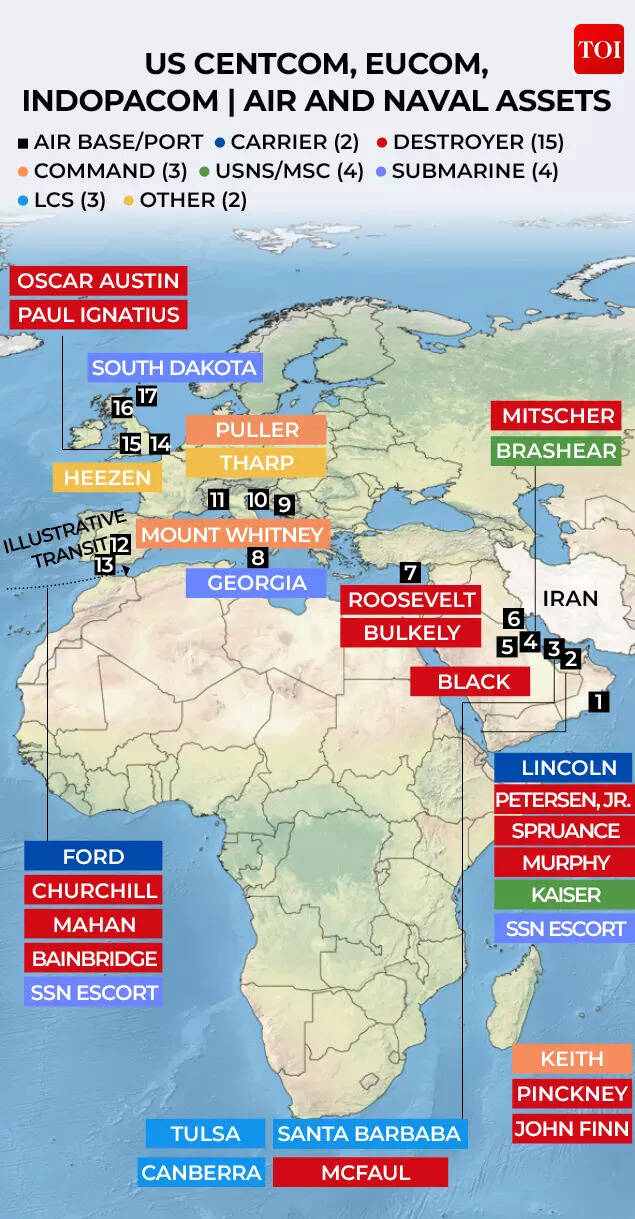
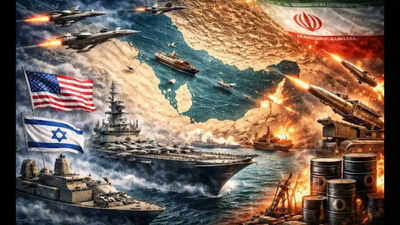
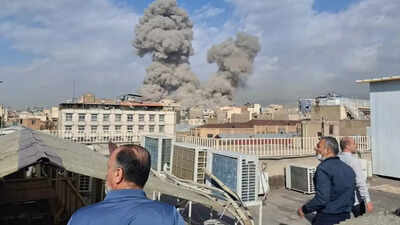
The crisis escalated dramatically after Israel launched preventive missile strikes on Iran, with US media reporting that Washington had begun coordinated strikes alongside its ally. Explosions were reported in Tehran, while Israel declared a nationwide state of emergency and shifted its Home Front Command guidelines from full activity to essential activity.Iranian state media confirmed blasts in the capital, and connectivity disruptions were reported across parts of Tehran. Iran vowed a “crushing response,” while the Israel Defense Forces said it had detected ballistic missiles launched from Iran toward Israeli territory, urging citizens to move into protected spaces.US President Donald Trump confirmed that the United States had initiated “major combat operations in Iran,” describing Tehran as “very difficult” and “very dangerous” and stating that Washington faced a “big decision” in negotiations.
.
The strikes come even as diplomatic efforts between the US and Iran faltered. A third round of talks was held in Geneva, but the sudden escalation has cast doubt over any immediate diplomatic breakthrough.For Pakistan, which shares a long and porous border with Iran’s restive Sistan-Baluchestan province, the implications are immediate and serious.
Already at war with Afghanistan
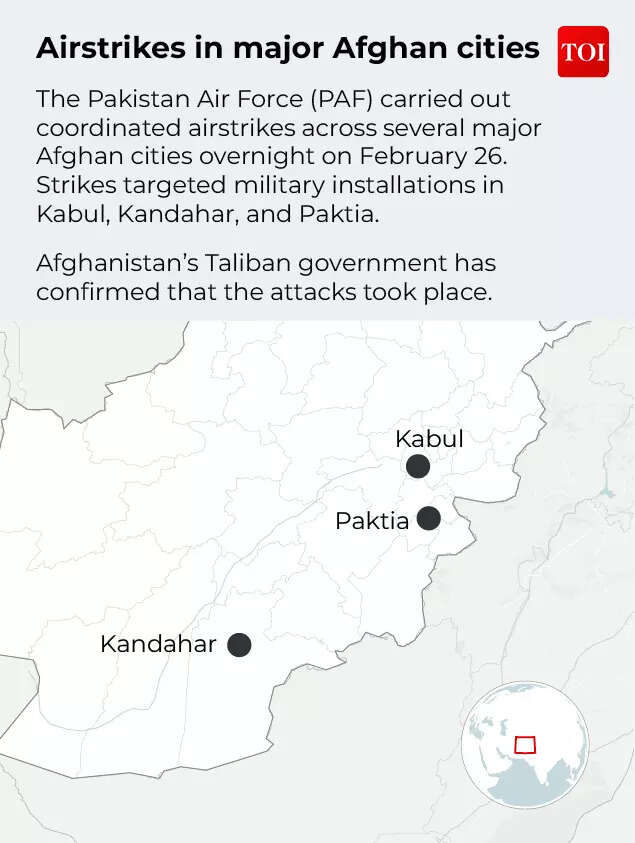
Even before the Iran escalation, Pakistan had launched air strikes on cities in neighbouring Afghanistan following months of cross-border attacks. Islamabad’s Information Minister Attaullah Tarar described the situation bluntly, stating on X that “now it is open war.”The fighting followed retaliatory exchanges between Afghan forces and Pakistani troops along their disputed frontier. Casualty figures from both sides remain contested, with sharply different claims about losses inflicted.At the heart of the dispute is Pakistan’s long-standing accusation that the Afghan Taliban government has failed to rein in the Tehreek-e-Taliban Pakistan (TTP), which has stepped up attacks inside Pakistan since the Taliban returned to power in Kabul in 2021.
.
Afghanistan’s Taliban authorities deny allowing their territory to be used against Pakistan. However, militant violence inside Pakistan has surged, deepening mistrust between the two neighbours.Diplomatic efforts involving Qatar, Turkey, Saudi Arabia and Iran have failed to produce a durable ceasefire. China has called for restraint and urged both sides to resolve disputes through dialogue.The clashes mark what analysts describe as the most serious confrontation between Pakistan and the Afghan Taliban regime in months, with Pakistan reportedly targeting Taliban government sites rather than just alleged TTP positions.
The Balochistan factor
The most immediate concern for Pakistan in the event of a prolonged Iran conflict is spillover into Balochistan.Balochistan borders both Afghanistan and Iran and has long been a theatre of insurgency led by groups such as the Baloch Liberation Army (BLA). The province is strategically crucial, hosting the China-Pakistan Economic Corridor (CPEC) and the Gwadar port.Unrest in Iran’s Sistan-Baluchestan province could energise cross-border ethnic linkages and embolden separatist elements on both sides of the border. Any weakening of Iranian state control in border areas could create operational space for militants, smugglers and insurgent networks.Pakistan has historically cooperated with Iran on border security, including joint patrols and intelligence sharing. However, if Iran becomes consumed by war with Israel and the US, its ability to coordinate on border control may be severely reduced.An emboldened BLA, operating in tandem with other militant groups, could stretch Pakistani security forces thin at a time when they are already heavily deployed along the Afghan frontier.
Strategic overstretch
Pakistan’s military doctrine has traditionally been India-centric, focusing on deterrence along its eastern border. But recent years have forced a recalibration toward internal security and western border management.Relations with India remain in deep freeze less than a year after their worst conflict since 1971. Cross-border exchanges and diplomatic ties have remained limited, and trust is minimal.A simultaneous crisis with Afghanistan and instability spilling over from Iran would leave Pakistan managing acute tensions on its western front while keeping a wary eye on India.This scenario risks strategic overstretch. Troop deployments, intelligence resources and air assets would need to be divided across multiple theatres. Any miscalculation could prove costly.
Economic shockwaves
Beyond security concerns, a war involving Iran has significant economic ramifications for Pakistan.Iran is a key regional energy player. Any disruption to oil supplies or a spike in global crude prices would hit Pakistan’s already fragile economy. Islamabad is struggling with inflation, external debt and currency pressures.The Strait of Hormuz, through which a substantial portion of global oil shipments pass, could become a flashpoint. Escalation in the Gulf would ripple across energy markets, driving up import costs.Pakistan also shares trade routes and informal cross-border commerce with Iran. Border closures or insecurity could disrupt livelihoods in already impoverished regions.Foreign investment could suffer further setbacks as investors reassess risk in a region marked by simultaneous conflicts.
China’s delicate position
China, a close partner of Pakistan, has urged both Pakistan and Afghanistan to exercise restraint and reach a ceasefire. Beijing maintains ties with both Kabul and Islamabad through a tripartite mechanism.However, China also has substantial energy and infrastructure interests in the Gulf. An expanded Iran conflict complicates Beijing’s regional balancing act.For Pakistan, which relies heavily on Chinese investment and diplomatic backing, Beijing’s priorities will matter. If China shifts focus toward stabilising the Gulf or protecting its own assets, Islamabad may find itself with less direct support in managing western border turbulence.
Diplomacy on life support
With the US-Iran nuclear talks disrupted and the Pakistan-Afghanistan dialogue stalled, diplomacy appears increasingly marginalised.Regional actors such as Saudi Arabia, Qatar and Turkey have attempted mediation in the Pakistan-Afghanistan dispute. Iran had also signalled willingness to facilitate dialogue.Now, with Tehran under direct military pressure, its capacity to play mediator is diminished.Pakistan’s options are narrowing. It must manage tensions with Kabul, prevent insurgent escalation in Balochistan, guard against spillover from Iran and avoid provoking instability along the eastern front.
Oil shock and Hormuz risk: A fresh blow to Pakistan’s fragile recovery
A sustained rise in global oil prices, coupled with any disruption in the Strait of Hormuz, could deliver a sharp external shock to Pakistan’s already fragile recovery. The country imports the bulk of its crude oil and refined petroleum, making it highly vulnerable to price volatility. Even a moderate spike in Brent crude can widen Pakistan’s import bill by billions of dollars annually, exerting fresh pressure on its current account and foreign exchange reserves.Higher energy costs would likely feed directly into inflation, reversing recent gains in price stability. Transport, electricity generation and fertiliser production are heavily dependent on imported fuel. As input costs rise, the impact would cascade through food prices and manufacturing, squeezing household purchasing power and dampening consumer demand. For a government attempting fiscal consolidation under IMF oversight, the dilemma becomes acute: either pass on higher fuel prices to consumers and risk public anger, or absorb part of the shock through subsidies, thereby straining public finances.The Strait of Hormuz is particularly critical. A substantial portion of global oil shipments transits this narrow waterway. Any military escalation that disrupts tanker traffic would not only drive up crude prices but also increase freight and insurance premiums. For Pakistan, this means higher landed costs even if supply volumes remain intact.Investor confidence could also suffer. Currency markets tend to react swiftly to oil shocks in energy-importing economies. A weaker rupee would further inflate import costs and complicate debt servicing, especially on dollar-denominated obligations.In short, an oil shock tied to Hormuz instability would not just be an energy problem for Pakistan. It would threaten macroeconomic stability, strain fiscal space, revive inflationary pressures and slow growth at a moment when policymakers are struggling to restore confidence and momentum.
A dangerous convergence and an uncertain road ahead
What makes this moment particularly perilous for Pakistan is the convergence of multiple crises unfolding at once. An active conflict with Afghanistan has already heated up one western front, while a war involving Iran threatens to destabilise another. At the same time, the eastern border with India remains tense, with relations still strained after recent hostilities. The cumulative effect is strategic compression, with Islamabad facing pressure from nearly every direction.Domestically, the situation is no less challenging. Militant violence has resurged, political divisions persist and economic stress continues to weigh on governance. If unrest in Iran spills into Balochistan and emboldens separatist outfits such as the BLA, Pakistan could confront escalating violence in both its northwest and southwest simultaneously. Such a scenario would stretch security forces and intelligence resources, potentially forcing reactive deployments rather than long-term strategic planning.Much will depend on whether the Iran-Israel-US confrontation is contained or turns into a prolonged campaign. A limited exchange might restrict regional fallout, but an extended conflict could fundamentally alter the security environment along Pakistan’s western flank. In that context, de-escalation with Afghanistan becomes even more urgent. Strengthening border management, preventing militant exploitation and coordinating with regional partners, including China and Gulf states, will be crucial.Ultimately, Pakistan’s room for manoeuvre lies in balancing deterrence with restraint while avoiding strategic overextension. As instability spreads across its western neighbourhood, Islamabad faces a stark reality: first the Taliban challenge, now a potential Iran war. Together, they risk becoming a destabilising double blow at a time when the country can least afford it.


 हिन्दी
  English