 Sipu Jha
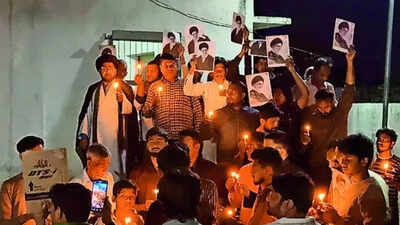
KINTOOR (BARABANKI): In 1834, a Shia cleric named Sayed Ahmad Musavi Hindi left the village of Kintoor in what is now UP on a pilgrimage to Iran. He settled and raised a family there, creating a lineage that would shape Iran’s sociopolitical destiny – first through the 1979 Islamic Revolution led by his great-grandson Ruhollah Khomeini, and then the latter’s successor Khomeini, Ali Khamenei.Almost two centuries since Musavi turned his back on Kintoor, this village around 4,000km from Tehran mourns Khamenei’s killing last weekend like a death in the family.Within hours of news arriving about the air strike in which Iran’s supreme leader died, Muslim residents of Kintoor – both Shia and Sunni – were out on the streets, holding portraits of Khamenei and shouting slogans against Israel and the US. Shops shut, majlis (assemblies) were organised and processions by mourners dressed in black stretched into the night.Two days on, the frisson of anger and grief hasn’t subsided. “Khamenei opted for bravery instead of surrender,” a protester said. “His death is worthy of remembrance.”The story goes that Ahmad Musavi travelled to Iran with the then nawab of Awadh and would have returned to Kintoor, one of the flashpoints of the 1857 Sepoy Mutiny, if British allowed him to. “Musavi saheb fuelled anti-British sentiment in India through his writings, which is why the colonial regime blocked his return,” said 33-year-old Adil Kazmi, a descendant of the Ayatollah patriarch’s cousin, Mufti Mohammad Quli Musavi.Ahmad Musavi was born in Kintoor but received an Islamic education at Najaf in Iraq, the cradle of Shia scholarship, to become a respected Twelver Shia cleric. His progeny adopted the name “Khomeini” from the Iranian city of Khomeyn that would later become his adopted home.Adil’s cousin Rehan said Ahmad Musavi retained the suffix “Hindi” after his family surname as a marker of his Indian roots even as he embraced Iran, marrying his mentor’s daughter and becoming father to three daughters and a son named Syed Mostafa. The latter was Khomeini’s father.Ahmad Musavi died in 1869 and was buried in Karbala.Adil’s father, 67-year-old Syed Nihal Kazmi, recalls a team from Iran visiting Barabanki 25 years ago to research Khomeini’s ancestry and check on the community his ancestors were part of.Historian Ravi Bhatt traces the migration further back. “It is believed that Khomeini’s ancestors had come to India from Nishapur in northeast Iran and later called their relatives to settle in Barabanki, which had become a major Islamic centre,” Bhatt told TOI.Inside homes in Kintoor, portraits of Khomeini still hang on the walls. The family’s connection with the village may have been severed two centuries ago, but a part of this Barabanki pocket won’t let go.





 हिन्दी
  English