 Sipu Jha
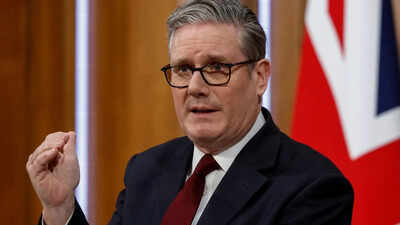
File photo: British PM Keir Starmer
UK Prime Minister Keir Starmer said on Monday that Britain “will not be drawn into the wider war” in the Middle East, even as it works with the US, European partners and Gulf allies on a “viable collective plan” to reopen the Strait of Hormuz, the critical energy chokepoint disrupted by the ongoing regional conflict.Speaking at a press conference at 10 Downing Street, Starmer said reopening the strait was essential to restore shipping flows and stabilise global markets, but stressed that it would be a difficult task and would not involve a Nato mission.
Starmer rules out deeper UK military involvement
Starmer said he wanted the war to end quickly and made clear that while Britain would support efforts to restore freedom of navigation, it would not allow itself to be pulled into a broader regional military conflict.“I want to see an end to this war as quickly as possible. Because the longer it goes on, the more dangerous the situation becomes,” Starmer said.He added that the Strait of Hormuz must be reopened to “ensure stability in the markets”, but cautioned that it was not a “simple task”.The conflict began on February 28, when the US and Israel launched airstrikes on Iran, after which Tehran retaliated by attacking Gulf states hosting American bases and choking off the Strait of Hormuz.
UK working on ‘viable collective plan’
Starmer said Britain was coordinating with allies to formulate a workable strategy to restore safe passage through the strait.“We’re working with all of our allies, including our European partners, to bring together a viable collective plan that can restore freedom of navigation in the region as quickly as possible and ease the economic impacts,” he said, as quoted by news agency AFP.Starmer said the UK was working with “all of our allies” to develop a “viable, collective plan” to restore navigation in the region.Britain is discussing with the US, allies in Europe and the Gulf the possible use of mine-hunting drones that the UK already has in the region, though Starmer signalled London is unlikely to send a warship.He also said the effort would be difficult, describing it as, “to say the least, not easy”.
No Nato mission, Starmer says
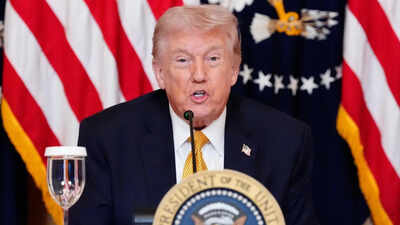
Starmer also explicitly ruled out a Nato-led operation after US President Donald Trump warned that the alliance faced a “very bad” future if allies did not help secure the strait.“Let me be clear, that won’t be and it’s never been envisioned to be a Nato mission,” Starmer told reporters.Starmer said any future operation would instead have to be “an alliance of partners”, not a formal Nato deployment.That position aligns with broader European reluctance to frame the crisis as a Nato war.Germany insisted the conflict was “not Nato’s war”, with Chancellor Friedrich Merz’s spokesman saying the alliance’s territorial defence mandate did not apply. German defence minister Boris Pistorius also said there would be “no military participation” from Berlin, though Germany remained open to diplomatic efforts to secure passage.
Starmer says ties with Trump remain strong
Starmer said he spoke to President Trump on Sunday and that the two discussed the Strait of Hormuz and the broader Middle East situation.Asked about his relationship with Trump, Starmer said, “It’s a good relationship”, and said they had a “good discussion about the Strait of Hormuz”, according to PTI.“We are strong allies, have been for decades. But it is for me to act in what I consider to be in the best interest of Britain,” he added.A Downing Street spokesperson said on Sunday night that the two leaders had discussed “the ongoing situation in the Middle East and the importance of reopening the Strait of Hormuz to end the disruption to global shipping, which is driving up costs worldwide”, PTI reported.The spokesperson also said Starmer expressed condolences for American service personnel killed during the conflict, and that both leaders agreed to remain in touch.
Trump pressures allies as Europe pushes back
Starmer’s remarks came after Trump publicly urged several allies to contribute military assets to reopen the strait.Trump had called on countries including China, France, Japan, South Korea and Britain to send warships to escort tankers through the waterway, warning that refusal would be “very bad for the future of Nato”.However, the response from allied capitals has been cautious.Poland ruled out military participation, Spain said it was “absolutely not” considering a military contribution, while Japan and Australia also signalled reluctance, with Canberra saying it would not send a navy ship.The European Union is instead exploring alternatives. EU foreign policy chief Kaja Kallas said the bloc was discussing whether to expand its Aspides naval mission in the Red Sea into the Persian Gulf or create a “coalition of the willing”.
Strait closure continues to shake oil and shipping
The closure of the Strait of Hormuz remains central to the economic fallout of the conflict.Oil prices stayed above $100 per barrel on Monday as the war entered its third week, underlining the urgency of restoring tanker access through the key route.About one-fifth of the world’s traded oil normally passes through the strait.The wider regional security picture remains tense. Dubai International Airport gradually restarted operations after a drone struck a fuel tank and caused a fire, while the UAE said it was attacked on Monday by six ballistic missiles and 21 drones from Iran. The Emirati defence ministry said those attacks brought the total since the start of the war to 304 ballistic missiles, 15 cruise missiles and 1,627 drones, with seven deaths, including two troops.Iran, however, has maintained that the Strait is not universally closed. Iranian foreign minister Abbas Araghchi said the waterway was closed only to the US, Israel and their allies, saying, “From our perspective it is open… It is only closed to our enemies.”
Britain sticks to de-escalation line
Starmer’s position also reflects his earlier resistance to US pressure for a more direct British role in the war.Trump had criticised Starmer for initially refusing to allow the US to use British bases to strike Iran and for declining to send an aircraft carrier to the region.Starmer defended that decision on Monday, saying British troops should only be committed where action is legal and backed by a “proper thought-through plan”.







 हिन्दी
  English