 Sipu Jha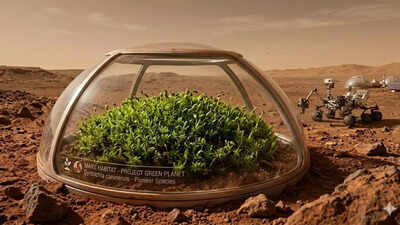
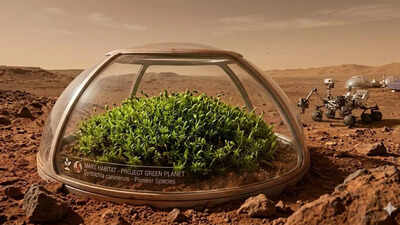
Scientists have made an astonishing finding that brings us closer than ever to the concept of ‘Green Mars’, by discovering a desert moss species – Syntrichia caninervis – which may be able to act as a pioneer in colonising the Red Planet. A paper published in The Innovation (Cell Press) details the abilities of this amazing plant to lose more than 98 per cent of its cellular water and completely resume its photosynthetic activity within two seconds of being rehydrated.This moss has been tested under ‘Mars Simulation’ conditions, where it has survived extreme temperatures as low as -196 degrees Celsius and received high doses of radiation, all of which would be fatal to the vast majority of living organisms on Earth. It was pointed out by the Chinese Academy of Sciences that this moss is therefore classified as ‘extremotolerant’ and has exhibited greater survivability than tardigrades, providing a biological model in which to assist future terraforming efforts and produce sustainable oxygen on other planets.
This ‘dead’ plant comes back to life in 2 seconds after losing 98% of its water
Syntrichia caninervis has been found to have near-supernatural powers of survival under total dehydration. Research published in the journal The Innovation (Cell Press) has shown that the moss can lose more than 98 per cent of its cellular water and remain dormant for many years. Amazingly, when re-exposed to moisture, this moss can ‘come back to life’ and start photosynthesising again within two seconds, which makes it an excellent plant for the arid, dusty conditions of Mars.
The capability of surviving in extreme conditions
To test its capabilities, scientists placed moss in a ‘Mars simulation’ chamber, with 95 per cent (carbon dioxide), very low atmospheric pressure, and very high levels of ultraviolet radiation (UV). According to the Chinese Academy of Sciences, the moss survived the conditions for seven days and then regenerated new green branches. The survival rate of this species under these conditions indicates that it has the potential to survive on Mars, where the atmosphere is extremely thin and unbreathable for humans, much better than any other known complex organism.
Beating deep-freeze and radiation
Moss can survive extreme cold and radiation better than any other organism, including tardigrades (water bears). The moss was kept at -196 degree Celcius (in liquid nitrogen) and exposed to 5,000 Gy of radiation for 30 days, according to the journal The Innovation (Cell Press). A radiation dose of just 5 to 10 Gy is typically lethal to humans, but this moss survived a staggering 5,000 Gy; therefore, moss is capable of repairing its DNA, making it a biological tank that can endure the unshielded cosmic radiation found in deep space.
Creating soil for the future
While moss cannot be eaten by humans, it is a candidate for becoming a ‘pioneer species’ for humanity to be able to grow food on Mars in the future. According to experts who were quoted in ResearchGate, as moss grows and then decays, it produces organic materials which mix in with the sterile Martian sand (regolith), creating fertile soil over time, allowing future colonists the opportunity to grow crops such as potatoes or oxygen-producing trees in greenhouses on Mars.









 हिन्दी
  English