 Sipu Jha
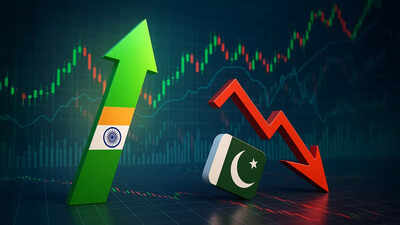
“In another decade, we’re going to have another “North and South Korea at night” photo.”With that one line on X, economist Noah Smith dropped an image into everyone’s mind: A future satellite shot where a border glows in the dark, one side blazing with light, the other visibly behind. His post has been widely shared and quoted in Indian and Pakistani timelines.Strip away the drama and the tweet is really about one thing: compounding GDP growth. The original Korea-at-night image became famous because it compresses decades of economic divergence into a single frame. Smith is hinting that, on current trends, we may see something similar for India and Pakistan – even if the story won’t be as extreme as the two Koreas.
India vs Pakistan: GDP paths that are pulling apart
On paper, India and Pakistan still share plenty: A long border, dense populations, a common colonial history, and deep cultural overlaps. But the GDP numbers show they are now moving on very different economic trajectories.In 2024, India’s economy was about $3.9 trillion in nominal terms, compared with roughly $370-410 billion for Pakistan – a gap of around 10:1. India’s GDP per capita was about $2,700, versus roughly $1,500-1,700 in Pakistan.India’s economy grew at its fastest clip in six quarters in the July-September period, expanding 8.2% from a year earlier and easily beating market forecasts of about 7.3%. The reading was also stronger than the 7.8% growth recorded in the previous quarter, even as Washington slapped new US tariffs of up to 50% on a range of Indian exports. India’s economy is now on track to clock about 7% of growth for the current fiscal year.
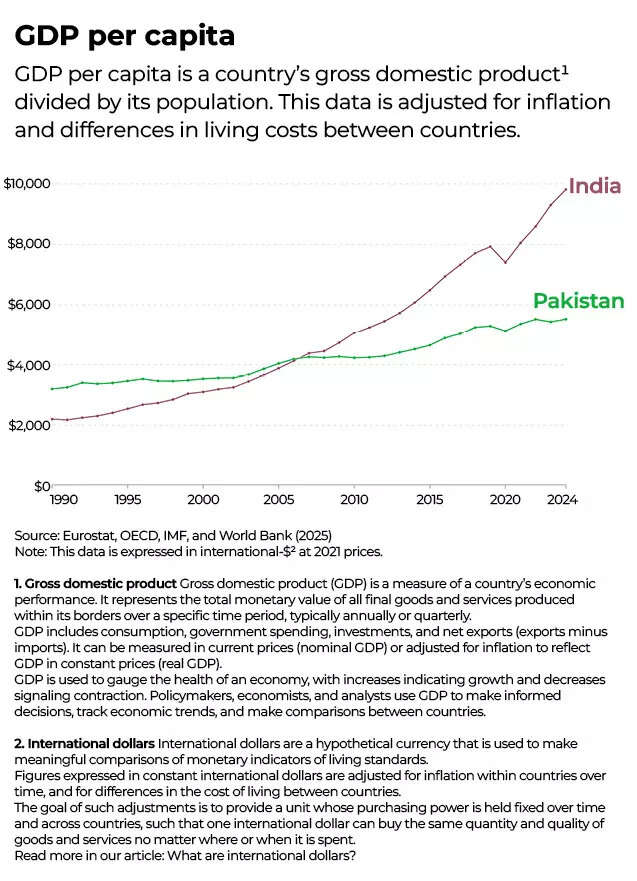
GDP per capita: India vs Pak
Pakistan, by contrast, managed growth of roughly 2.38% in 2024 after a contraction in 2023.Those differences might look small in a single year, but over time they compound. If India sustains growth in the 6-7% range while Pakistan stays closer to 2-3%, the absolute GDP gap widens dramatically. That is already visible: recent estimates put India’s economy at more than ten times Pakistan’s size, and some Indian states now have output similar to, or larger than, Pakistan’s entire GDP.The quality of that growth story matters too. India has built a broad-based mix of services (IT, finance, telecom), manufacturing and a large domestic market. The World Bank notes that India has stayed the fastest-growing major economy despite a tough global environment, backed by reforms and strong services activity.Pakistan, meanwhile, has lurched through repeated balance-of-payments crises and IMF programmes. An IMF-cited analysis recently highlighted how “elite capture” and corruption are effectively taxing growth.If India keeps outgrowing Pakistan at anything like the recent pace, Smith’s imagined “before and after” shot of the subcontinent in 2035 will show a much brighter India, with more continuous belts of light along expressways and industrial corridors – and a Pakistan that has grown, but not nearly as fast.








 हिन्दी
  English