 Sipu Jha

India’s Global Capability Centre (GCC) ecosystem is entering a decisive phase. Long seen as cost-efficient offshore back offices, GCCs are now becoming central to how global corporations build products, deploy technology and make strategic decisions. With evolving hiring patterns, and traditional IT services firms feeling the heat, the GCC story has moved well beyond topline growth numbers.As multinational companies deepen their India presence, understanding where GCC hiring stands today, and where it is headed, has become critical to assessing the future of India’s technology and talent growth story.
What is a GCC — and why does it matter?
Global Capability Centres are captive units set up by multinational companies to deliver services such as technology development, engineering, finance, analytics, compliance and increasingly, core research and product innovation. Unlike other outsourcing companies, the GCCs function as an extension of the parent companies themselves with long-term engagements.As of December 2025, the number of GCCs in the Indian context is over 1700, and these have become one of the pillars in the generation of white-collar skills. As these centres evolve from execution hubs into innovation engines, their impact is reshaping India’s talent market, IT services industry and long-term economic positioning.
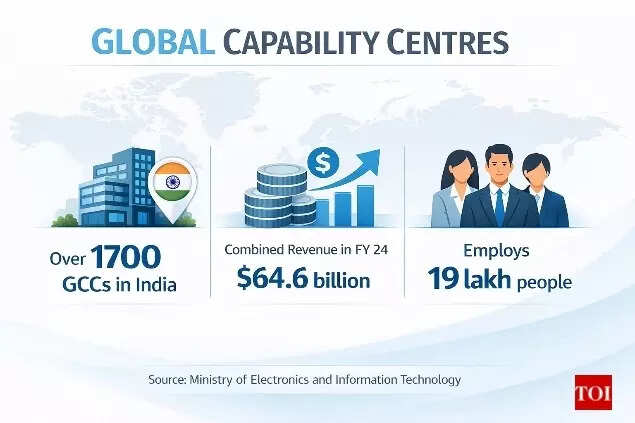
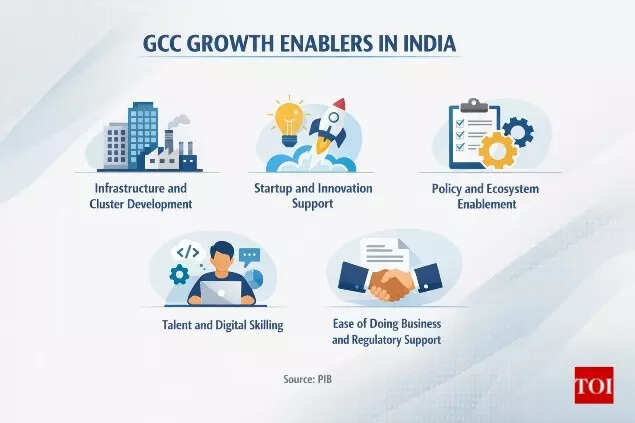
“What started as a basic support desk has now evolved into an innovation powerhouse, driving research, design, and development,” says a PIB release.Further, giving an overall of the GCC’s current status in the country it added, “These GCCs have rapidly grown into strategic hubs for innovation and value creation. In just five years, their combined revenue has jumped from $40.4 billion in FY19 to $64.6 billion in FY24, growing at a healthy pace of 9.8% annually.”“Not limited to numbers, these GCCs now employ over 19 lakh people across the country, shaping the future of tech and business from right here in India. These centres drive innovation, digital transformation, and strategic operations for their parent organizations worldwide,” it added.Further underlining the role of GCCs as a structural driver of India’s economic transformation, the government pointed to their growing importance in high-end engineering, innovation and strategic services.

A more selective phase of hiringAs GCCs take on more complex and business-critical mandates, the nature of hiring is also changing, with companies prioritising capability and impact over sheer headcount growth.Hiring by GCCs today is less about scale and more about depth, as said by Neeti Sharma, CEO, TeamLease Digital, while talking to TOI. “GCCs’ hiring has become selective and capability led as compared to volume hiring earlier. India has over 1800 GCCs employing over 1.9 million employees. But hiring today is lesser about adding headcount and more about building depth in AI, cloud, data, cybersecurity and governance roles. The newer roles are concentrated in high-impact digital functions. GCCs are also hiring more internally through reskilling, signalling a shift from volume hiring to long-term talent architecture building,” she said.This shift is also reflected in hiring data and recruiter pipelines, pointing to a clear change in both the pace and composition of talent demand. While sequential hiring growth remains healthy, the nature of talent demand has changed significantly, according to Kartik Narayan, CEO, Jobs Marketplace at Apna.co.“Sequential hiring of around 5% to 7% which in itself is quite impressive is leading the topline number growth in GCC hiring. However the bigger shift which is taking place is in the composition and mix of talent being hired,” he told TOI.He further pointed to a clear seniority shift.
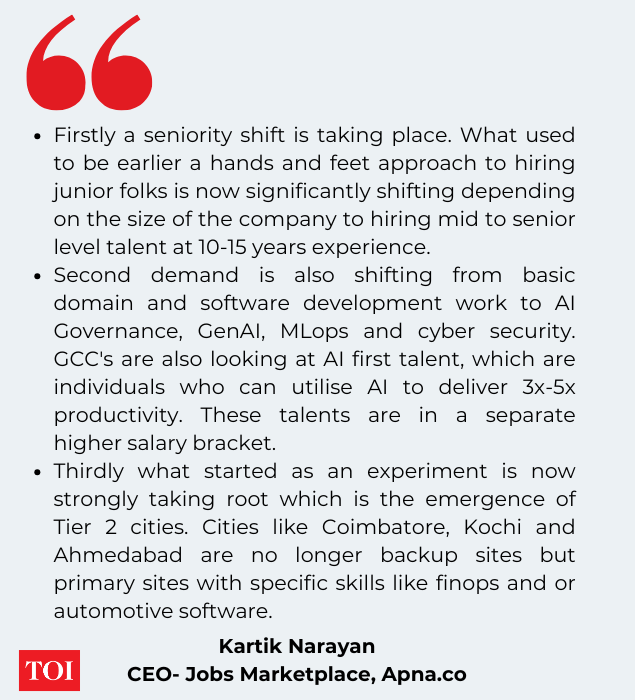
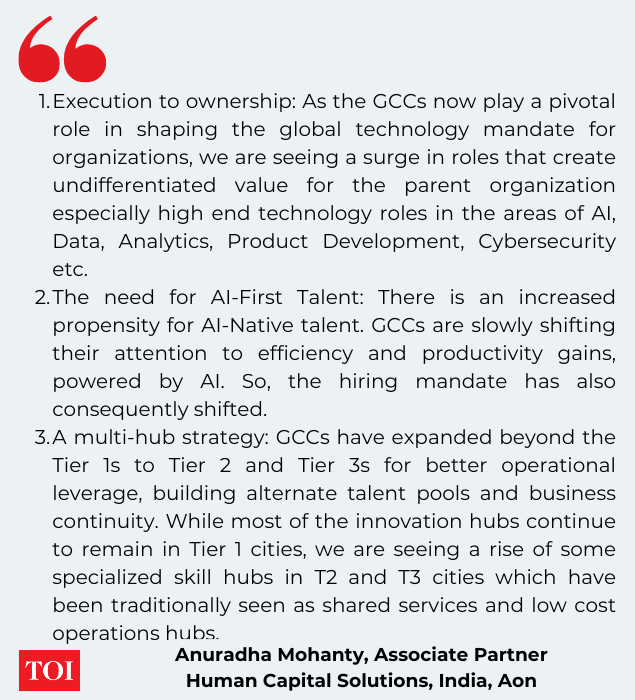
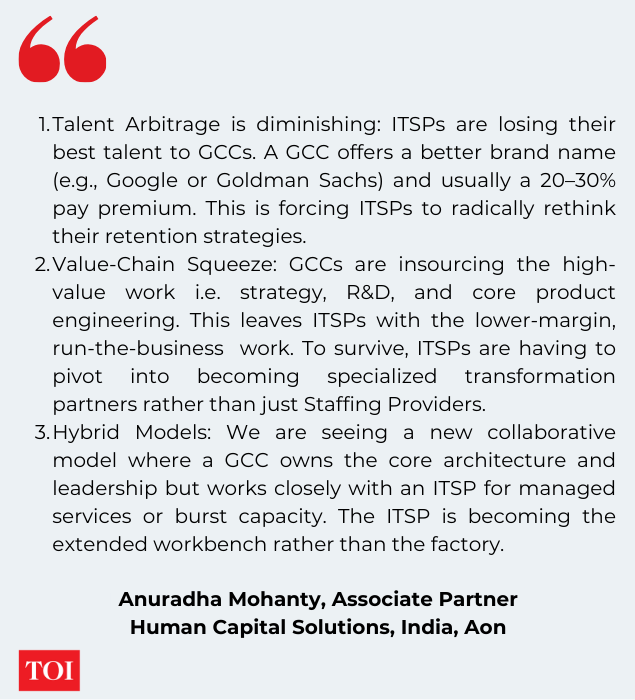
Meanwhile, Anuradha Mohanty told TOI about how she sees the GCC growth story as more than just numbers, highlighting deeper structural changes. “Beyond the 12-15% CAGR we see in headcount, we are seeing a maturity migration in GCCs,” she said, “observing 3 qualitative shifts”.
Moving beyond cost arbitrage
The drivers behind GCC expansion in India have evolved sharply over the years. What began as a cost- and scale-led strategy is increasingly shifting towards higher-value work, deeper ownership and strategic relevance within global enterprises.“GCCs in India are no longer a volume & cost play, it has moved to bringing high value in Automation, Research and Development,” said Neeti Sharma.
Today, the expansion is driven by a mix of cost, capability and confidence. GCCs are moving critical work such as AI engineering, cloud platforms, product development, risk and compliance to India. Stable policy, strong STEM pipelines, and proven delivery maturity have made India not just a delivery hub, but a core innovation and decision-making centre for global firms.
Neeti Sharma, CEO, TeamLease Digital
Meanwhile, Narayan described this phase as the emergence of “GCC 4.0”, while giving out pointers on his stand on the GCC expansion.
The GCC expansion is undergoing a fundamental shift in what can be called the GCC 4.0, where the earlier confidence in having teams in India deliver on process execution is now transforming itself into end to end ownership.
Kartik Narayan, CEO- Jobs Marketplace, Apna.co
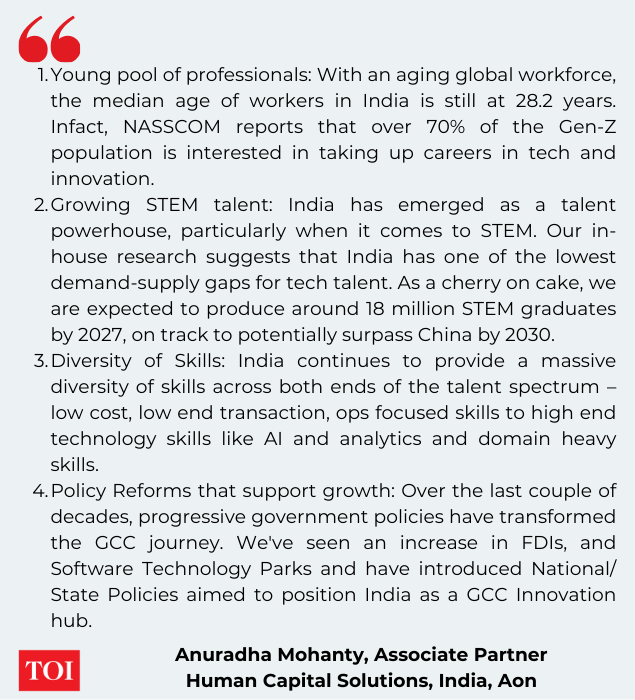
This includes responsibilities that go well beyond execution. “This is leading to not just product conceptualisation, product design, execution but includes even customer feedback loops for product and service improvement,” he explained.The shift has also elevated leadership roles within India-based centres. “The above is leading to greater trust being now placed in Indian leadership roles. Therefore these roles in India now have global mandate and are ceasing to be only back office. Enterprise wide technology strategy is now being crafted in India,” the Apna Co CEO (Jobs) further added.Geopolitics, too, is playing a role. “The third driver which is increasing in an increasingly geopolitically volatile era is the need to de-risk and in this India is coming across as a hub of superior talent, stable govt and a high tech ecosystem,” Narayan added.Meanwhile, Anuradha Mohanty, cited young professionals, skill diversity and more for the expansion.
Reshaping talent and wages
As GCCs move up the value chain, their growing influence is being felt across India’s labour market, particularly in how talent is valued and compensated. The shift towards high-impact digital and engineering roles is reshaping salary benchmarks, career trajectories and hiring expectations, creating sharper differentiation between specialised and generalist skills across the technology workforce.High-demand skills are commanding sharp premiums. High-demand digital and engineering skills are getting sharp premiums, reflecting the increasing complexity of roles being anchored in India.
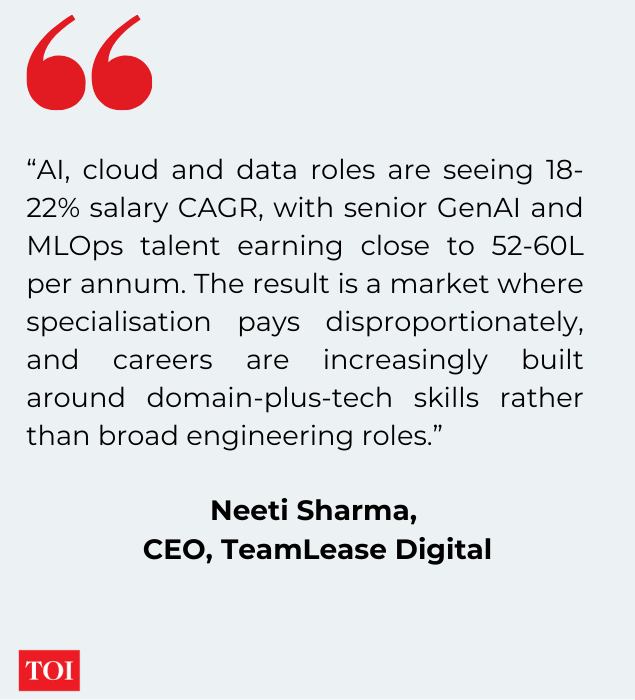
The hiring lens itself is changing. Kartik Narayan added that, “In the last 12 months, the index is shifting towards proven capabilities as compared to credentialing or salary as a surrogate for talent.”This is reflected in stronger acceptance rates “at 60-70% as compared to 35 to 40% as seen in the IT services market.”Meanwhile, the Associate Partner, Human Capital Solutions, India at Anuradha Mohanty talked about the “profound impact” GCCs have in India.
The impact is profound, and quite possibly disruptive for traditional players. We’re seeing a K-Shaped wage recovery. While entry-level salaries for generic roles remain stagnant, super-specialist roles are seeing exponential hikes. There’s also a shift in EVP from being positioned as Global Delivery Centres to Global Technology/ Innovation Centres driving global mandates from India. The changing construct of more end-to-end work, greater ownership, more cross functional teams is helping GCCs redefine their value proposition and attract high-potential talent.
Anuradha Mohanty, Associate Partner, Human Capital Solutions, India, Aon
Pressure on IT services firms
The rise of GCCs is increasingly altering the competitive dynamics for Indian IT services companies.Narayan highlighted the scale of changes in hiring momentum in three points.
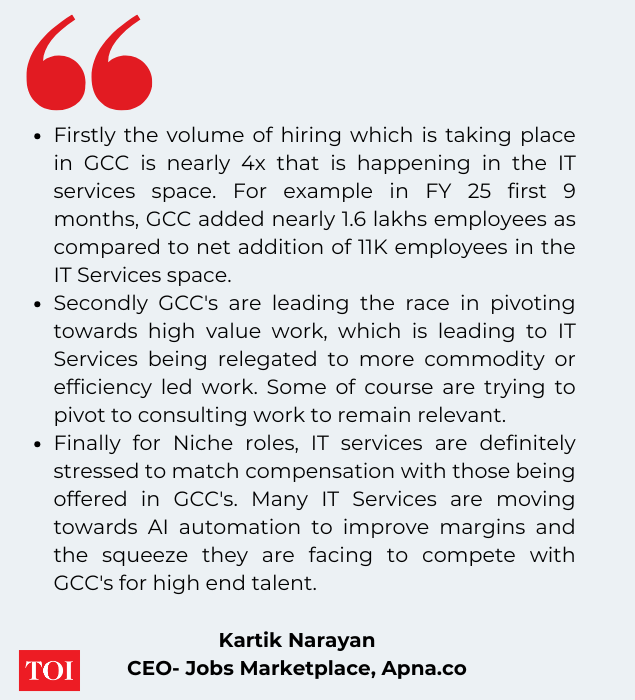
Meanwhile, Mohanty described it as “shifting from partnership to something I like to call ‘co-opetition’.”
GCC story to go on
Experts see GCCs as a long-term structural pillar of India’s economy rather than a passing trend.“GCCs are a structural pillar of India’s employment and skills economy,” Neeti Sharma said, adding, “With 1,800+ centres today and steady additions over the last two years, GCCs are expected to continue expanding into AI, cloud, data, cybersecurity and governance functions, while also spreading into Tier-2 cities where costs are 20–30% lower.”Narayan projected strong value growth alongside this expansion. “GCC story in India will stand for structural reasons. In terms of value it can grow up to $110 billion by 2030 (from the current ~$65 bn).”He also sees India emerging as a global AI operations hub. “GCC story in itself is becoming GCC as a service with several more mid market and emerging enterprises which will make India its hub due to availability of rich talent and evolving models . India contributes over 28% of global STEM talent. As long as there is a war for engineering talent and English speaking ability, India will be the only viable global talent moat for companies globally.” he said.Further, sharing her own perspective, Anuradha Mohanty described it as “The GCC story going from being a footnote to a movement.” “Over the next decade, India will emerge as one of the strongest and biggest Global Technology Hubs. Weforesee that GCCs will start owning larger chunks of the Global Strategy with global leadership mandates being driven from here. It will no longer be a game of volume, size or scale but building long term value creation and talent engine for future capabilities. We would start seeing more customer facing, end-to-end jobs and stronger CoEs for emerging skills,” she said.“India is moving from an Information Technology hub to a Deep Tech hub. With the government’s focus on semiconductor fab and National Research Foundations, GCCs in the next decade will also focus on hardware, biotech, and material science. As far as strong predictions go, here’s mine: India is no longer where the world’s work gets done; it is where the world’s future is being decided. We have moved from providing the capacity to scale to providing the intellectual capital to lead. The path to the global C-suite will soon run directly through India,” she added.
A structural story
The evolution of GCCs points to a structural shift in India’s economic and talent landscape rather than a cyclical upswing. As global companies embed more complex, high-value work in their India centres, GCCs are increasingly shaping how technology is built, how talent is developed and how global business decisions are executed from the country.For India, the implications extend beyond just simple growth. If current trends hold, GCCs will not only anchor high-value employment and innovation domestically, but also play a central role in positioning the country as a global centre for digital, engineering and AI-led work over the next decade.







 हिन्दी
  English