 Sipu Jha
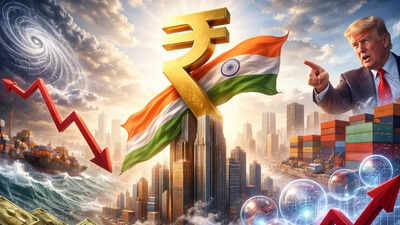
Economic Survey 2025-26: India stands tall in the global economic order – as the world’s fastest growing major economy that is exhibiting resilience in the face of global economic turmoil and Donald Trump’s tariff threat. Post the imposition of 50% tariffs on India, most economists revised India’s GDP growth forecasts downwards. But surprising, the economy not only held firm, its growth pace actually picked up!“In reality, growth accelerated due to a slew of structural reforms and policy measures,” the Economic Survey 2025-26 tabled in the Parliament on Thursday says. “Fast forward five months, and India is now anticipating a fullyear real growth rate of over 7%, with another year of real growth at or near 7%,” the survey says.Yet, as the Economic Survey notes the paradox of 2025 is that India’s strongest macroeconomic performance in decades has collided with a global system that no longer rewards macroeconomic success with currency stability, capital inflows, or strategic insulation.And even though global growth and trade have held up better than expected, few are certain why this is the case. Hence, there is a lingering concern that the negative effects of the ongoing global political and economic turmoil may manifest with a lag.Also Check | Economic Survey 2026 Highlights“Fragility, uncertainty and episodic shocks are increasingly structural features of the system, and the balance of risks has shifted perceptibly over the past year. Geopolitical competition has intensified, the security environment in Europe has become increasingly complex, and financial vulnerabilities associated with leveraged technology investments are looming,” the Economic Survey warns.Fundamentally, factors that shape the trade policy are changing. It is now majorly about security and political considerations rather than efficiency or multilateral rules. Taken together, these developments suggest a world that is less coordinated, more risk-averse, and more exposed to non-linear outcomes with a narrower margin of safety, the Economic Survey cautions.In this background, it envisages three scenarios for the global economy in 2026, explaining what they in turn would mean for India’s growth story:
Scenario 1: The best-case for the world in 2026
This is the ‘best-case’ scenario shared by the Economic Survey – which for the world in 2026 would mean ‘business as in 2025. However, it is increasingly less secure and more fragile.“In this setting, with the margin of safety being thinner, minor shocks can escalate into larger reverberations. Financial stress episodes, trade frictions, and geopolitical escalations do not lead to systemic collapse, but they do create volatility and require governments to intervene more actively to stabilize expectations,” the Economic Survey explains.According to the Economic Survey, this scenario is less about continuity and more about managed disorder, with countries operating in a world that remains integrated yet increasingly distrustful.“One could attach a subjective probability of around 40% to 45% to this scenario unfolding in 2026. Reflecting this is the Global Economic Policy Uncertainty Index, which is near its worst readings of 2020, excluding the sharp spike in April 2025 at the introduction of the reciprocal tariffs. Fear lingers,” the survey says.
Scenario 2: Multipolar breakdown
In this scenario, the probability of a disorderly multipolar breakdown rises materially and cannot be treated as a tail risk. “Under this outcome, strategic rivalry intensifies, the Russia–Ukraine conflict remains unresolved in a destabilising form, and collective security arrangements unravel. Trade becomes increasingly explicitly coercive, sanctions and countermeasures proliferate, supply chains are realigned under political pressure, and financial stress events are transmitted across borders with fewer buffers and weaker institutional shock absorbers,” the Economic Survey cautions.In such a scenario, the policy will become more nationalised, and countries will face sharper tradeoffs between autonomy, growth, and stability. The survey sees a probability of around 40% to 45% to this scenario as well.The Economic Survey points out: On the eve of Christmas 2025, the Financial Times wrote, “Tech companies have moved more than $120bn of data centre spending off their balance sheets using special purpose vehicles funded by Wall Street investors, adding to concerns about the financial risks of their huge bet on artificial intelligence.”It also notes that the IBM CEO openly questioned the economics of Large Language Models (LLM)-based AI. This has reinforced concerns about the financial risks of this huge bet.” Given the leverage involved, a correction could have cascading effects across financial markets and the real economy. The sharp rise in the yields of Japanese Government Bonds is another warning sign,” the survey says.Also Read | How rupee became a victim of geopolitics & a strategic power gap in 2025: Economic Survey explains
Scenario 3: Systemic shock cascade
The final scenario is the bleakest and has a residual probability of 10%-20%. It involves the risk of a systemic shock cascade – this will mean that the financial, technological, and geopolitical stresses amplify one another rather than unfolding independently. “The recent phase of highly leveraged AI-infrastructure investment has exposed business models that are dependent on optimistic execution timelines, narrow customer concentration, and long duration capital commitments. A correction in this segment would not end technological adoption, but it could tighten financial conditions, trigger risk aversion and spill over into broader capital markets,” the survey says. In case these developments were to coincide with any geopolitical escalation or trade disruption – it would lead to a sharper contraction in liquidity, a sudden weakening of capital flows, and a shift toward defensive economic responses across regions. “While this remains a lower-probability scenario, its consequences would be significantly asymmetric. The macroeconomic consequences could be worse than those of the 2008 global financial crisis,” the Economic Survey warns.
What do these scenarios mean for India?
Running a marathon and sprint at the same time! While the Economic Survey is confident of India’s economic resilience in each scenario, it notes that India’s economy is not free from these external risks.“In all three scenarios, India is relatively better off than most other countries due to its strong macroeconomic fundamentals, butthis does not guarantee insulation,” it says.What works for India? It’s the advantage of a large domestic market, a less financialised growth model, and strong foreign exchange reserves, and a credible degree of strategic autonomy!“These features provide buffers in an environment where financial volatility is imminent and geopolitical uncertainty is permanent,” the survey says.However, the Economic Survey is quick to caution that either of the three scenarios deal a common a risk for India: disruption of capital flows and the consequent impact on the rupee. “Only the degree and the duration will vary. In a world of geopolitical turbulence, this may not be confined to a year but could be a more enduring feature,” the survey warns.So what should India’s response be? According to the Economic Survey, India needs to generate sufficient investor interest and export earnings in foreign currency to cover its rising import bill, as, regardless of the success of indigenisation efforts, rising imports will invariably accompany rising incomes.The survey points out that this has been the historical global experience. “Economic policy must focus on the stability of supply, the creation of resource buffers, and the diversification of routes and payment systems. 2026 may mark the point at which policy credibility, predictability and administrative discipline cease to be mere virtues and instead become strategic assets in their own right, with lasting relevance,” the survey predicts. Hence the survey advocates an approach where India looks at ‘strategic sobriety’, rather than ‘defensive pessimism’.“The external environment will require India to prioritise both domestic growth maximisation and shock absorption, with a greater emphasis on buffers, redundancy, and liquidity. Put differently, India must run a marathon and sprint simultaneously, or run a marathon as if it were a sprint,” the survey says.




 हिन्दी
  English