 Sipu Jha
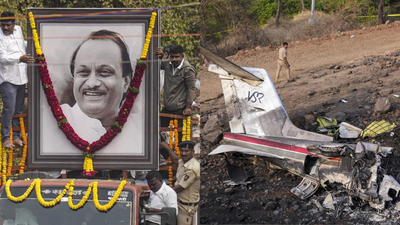
Ajit Pawar’s death reopens uncomfortable questions about political travel, aviation safety and urgency culture
MUMBAI: Ajit Pawar’s death in a charter aircraft crash in Baramati is not only a profound political loss but also a moment of reckoning for India’s aviation safety framework. The tragedy does not sit in isolation; it reopens uneasy questions about the culture of political travel: when urgency, influence, and political schedules dominate, do the margins of aviation safety quietly shrink?Pawar’s final journey has come to symbolize structural tension within India’s aviation landscape.
On one side stands a country whose civil aviation sector is among the fastest-growing in the world; on the other stands a regulatory and infrastructure system struggling to keep pace with this expansion, particularly in aviation segment that ferries business leaders, politicians, and government officials.This crash is therefore not just an accident under investigation — it is a case study in the intersection of power, time pressure, and aviation risk.
The crash: What happened over Baramati
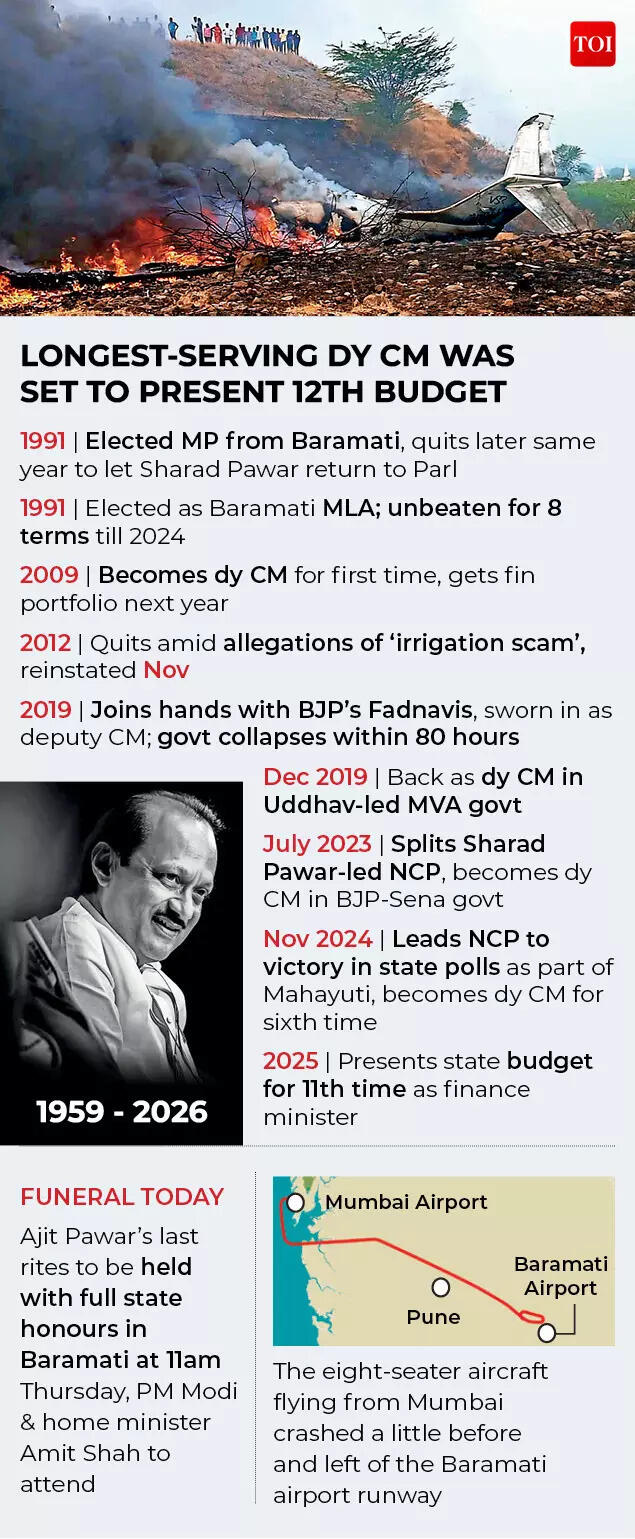
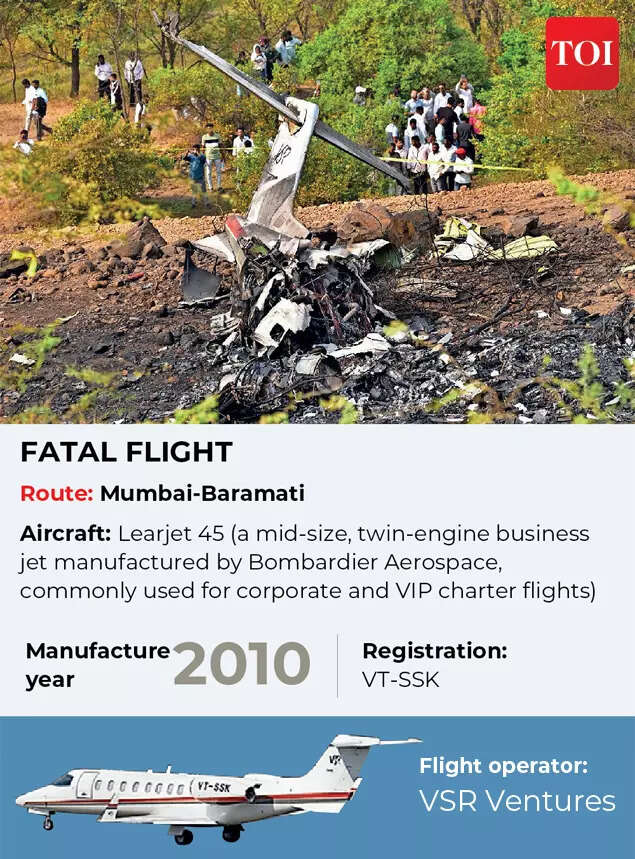
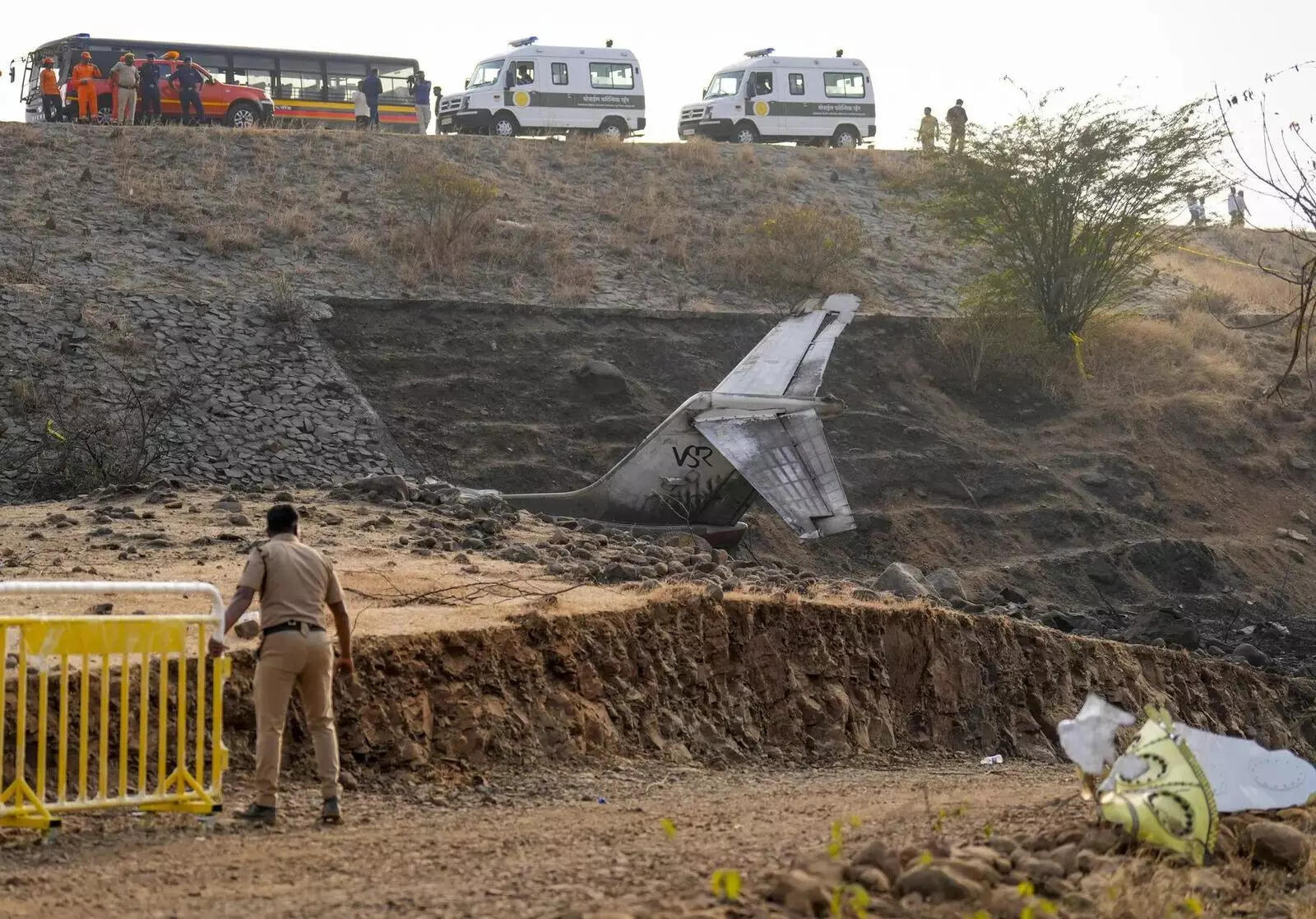
On a Wednesday morning, a Learjet 45 business jet departed Mumbai for a short flight to Baramati, carrying Ajit Pawar and four others. The aircraft contacted Baramati Air Traffic Control at approximately 8:18 am.
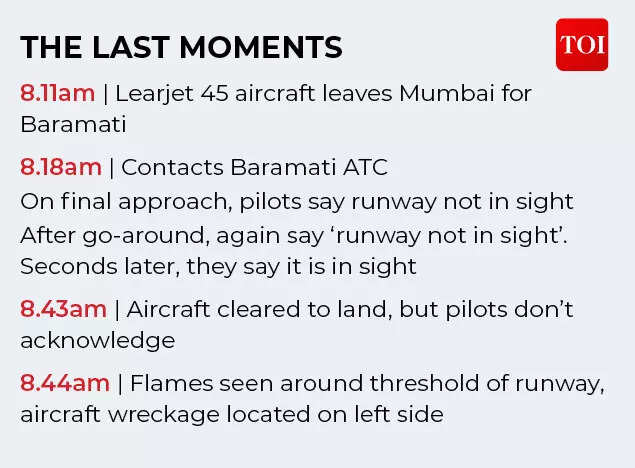
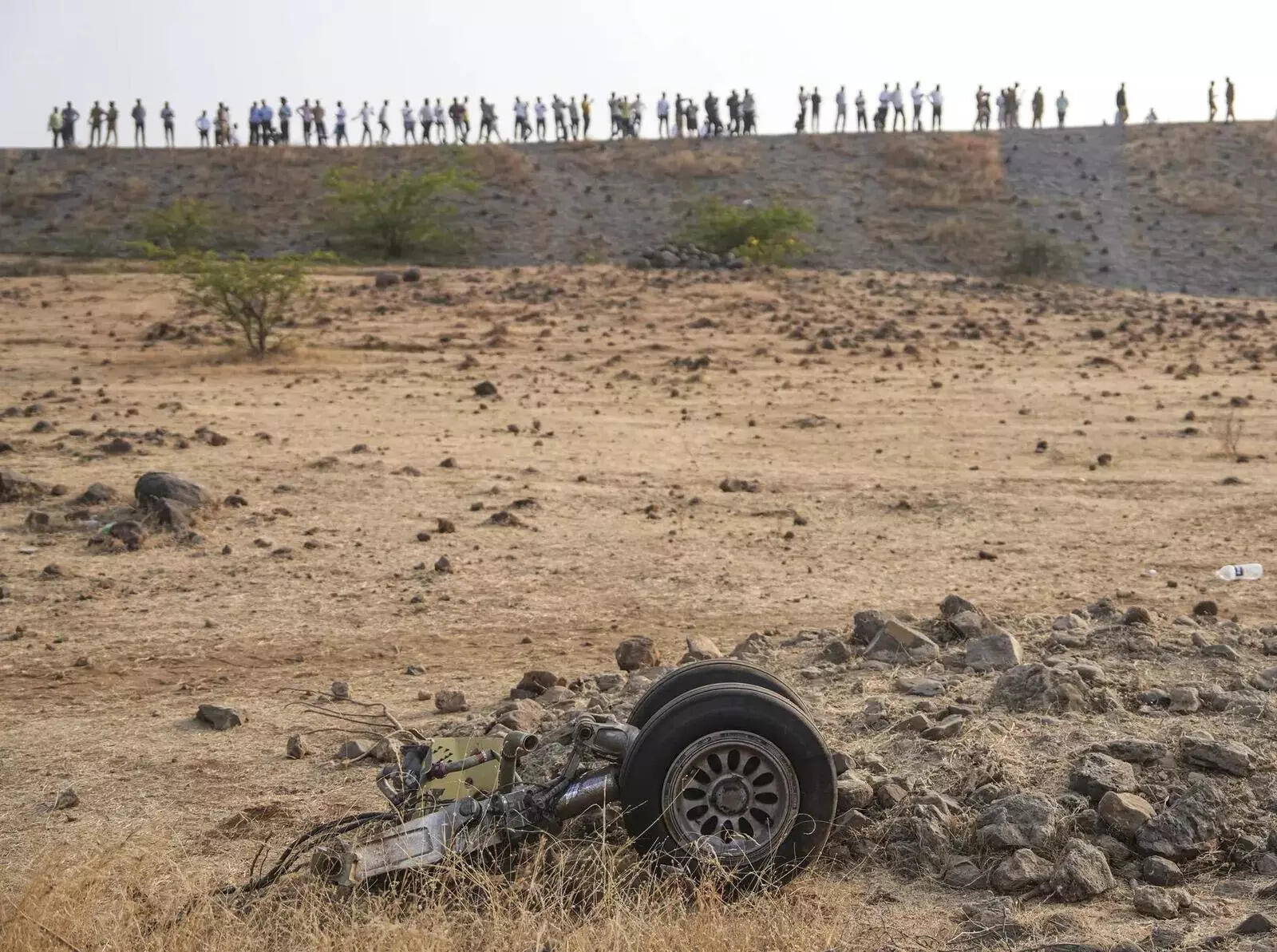
During the first approach, the crew reported the runway was not in sight and executed a go-around. Visibility in the region was reported at around 3,000 metres, but patches of ground fog persisted — conditions that can degrade visual cues during final approach.Shortly afterward, the crew indicated they had the runway in sight and were cleared to land at around 8:43 am. Reports suggest that the landing clearance was not read back — a deviation that investigators will scrutinize closely. Moments later, CCTV footage captured the aircraft banking sharply left before descending and crashing at approximately 8:44 am. No Mayday call was transmitted.
Experts note that such sudden banking could indicate a technical issue, aerodynamic instability, or a loss of situational awareness in marginal visibility.The Aircraft Accident Investigation Bureau will rely on cockpit voice recordings, flight data, radar tracks, and maintenance records to reconstruct the final seconds.Even before technical findings emerge, the context of this flight — a chartered jet, a regional airfield, and a tight political schedule — already highlights systemic risk factors.
Why VIP air travel is inherently riskier than it looks
Scheduled airlines operate within deeply layered systems: dispatch teams, standardized maintenance programs, flight planning units, and continuous oversight. Non-scheduled charter aviation, while regulated, operates with more variability. Operators differ in scale, internal processes, and safety culture. Some maintain airline-equivalent systems; others run leaner operations with fewer redundancies.A Parliamentary Standing Committee in 2025 warned that India’s non-scheduled aviation sector is expanding faster than the supervisory capacity of regulators. Maintenance oversight, implementation of Safety Management Systems, pilot duty monitoring, and operational control structures were highlighted as areas needing strengthening.Small airfields, bigger complexityBaramati represents a category of regional airfields increasingly used for political access but lacking advanced instrument landing systems. Such airstrips rely more on visual flying, particularly during the final approach phase. Elevated terrain, limited navigational aids, and patchy weather monitoring add layers of complexity. In marginal conditions, pilots must make rapid decisions with less technical assistance than at major airports.Smaller airfields — frequently used for political access — often lack the full range of instrument landing systems, advanced ground radar, or precision approach aids found at major airports. Landings there depend more heavily on visual cues and pilot judgment, especially in conditions such as haze, light fog, or shifting winds.Aviation history shows that “marginal” weather — not severe enough to cancel a flight, yet not comfortably clear — is where many accidents occur.
The urgency factor
Political leaders in India are among the heaviest users of chartered aircraft. Election cycles, district tours, crisis visits, and back-to-back public programs require mobility that commercial airlines cannot provide. Chartered jets and helicopters offer flexibility, access to smaller towns, and the ability to complete in hours what would otherwise take days. Over time, this convenience has evolved into dependence.A parallel aviation ecosystem now exists largely to serve political, corporate, and VVIP clients — an ecosystem where aircraft are booked at short notice, routes change rapidly, and operators compete to provide speed and reliability. This demand structure means aircraft are often flying multiple sectors in a single day, crews are working tight rotations, and planning windows are compressed. While none of this automatically implies unsafe operations, it creates an environment where margins are thinner and the system relies heavily on strict procedural discipline to compensate for pace.
The pressure created by political schedules is a defining feature of this ecosystem. Leaders are expected to address rallies in different districts within hours, attend administrative reviews, and return to capital cities the same evening. When such itineraries are built, aviation becomes a tool to “make the programme happen.” That expectation can translate, subtly but powerfully, into operational pressure.In a purely commercial environment, diversions are inconvenient but routine. In political travel, diversion can disrupt an entire day’s chain of events, increasing the psychological weight behind the decision to attempt another approach. No regulation officially permits risk-taking, but culture and context shape how decisions feel inside the cockpit.These operational realities intersect with longstanding concerns about regulatory oversight. India’s Directorate General of Civil Aviation (DGCA) has, in recent years, faced the challenge of supervising a rapidly expanding aviation market that includes commercial airlines, business jets, charter fleets, and helicopter services. Parliamentary reviews have pointed to manpower shortages, uneven audit frequency, and the difficulty of maintaining proactive surveillance across the non-scheduled sector.Scheduled airlines operate within multilayered operational control systems, dispatch units, and standardized safety management structures. Charter operations can vary widely in scale and internal systems. Some maintain rigorous airline-equivalent practices; others function with leaner teams and faster turnaround cycles. The result is not necessarily unsafe aircraft, but variability — and in aviation, variability is itself a risk factor. Oversight agencies must ensure that maintenance records, pilot duty limits, training standards, and safety management systems are not just documented but actively embedded in day-to-day operations.
VSR Ventures: Political connections and VIP charters
Founded in 2014 with a Pilatus and Beechcraft B-200, VSR Ventures has rapidly expanded into one of India’s largest charter operators, now running about 17 aircraft for VIP travel, medical evacuation, and charter services. It is also among the biggest Learjet operators in the country.The company’s success is partly attributed to its strong political connections. Owner Capt V K Singh, a former director of aviation at Bharat Hotels and ex-pilot with Air Charter Services, runs the firm alongside his son. Sources say VSR has become a go-to operator for government and political clients, as it is willing to extend credit, a common requirement given delayed payment cycles in VIP charters.Even during investigations into the Baramati crash, VSR aircraft were used to ferry politicians for funeral-related travel, underscoring the company’s continued role in high-profile political transport.
Charter companies often build long-term relationships with political clients, sometimes extending credit arrangements that strengthen business ties. While not inherently problematic, this commercial reality underscores how deeply political mobility and private aviation have become intertwined.The crash also triggered renewed discussion on the need for closer monitoring of operators engaged in VIP flying. Among the questions raised by charter sector professionals are the recovery status of the cockpit voice recorder (CVR) and flight data recorder. “Whether CVR was on during the flight, the devices are in a condition suitable for data extraction, and whether established procedures for their handling and custody are being followed,” said a source.Others said regulators typically examine flight and duty time compliance, maintenance documentation, and the internal reporting of technical events following serious accidents. “The DGCA should put operators flying VIPs under increased scrutiny, such as cross-checking whether flight hours and aircraft utilization data submitted by an operator align with independent records maintained by airports and air navigation service providers,” suggested a source. “While airlines come under strict scrutiny of the regulator, that is not the case with charter flights. It’s crucial for the flying public, in this case VIPs, to know whether any of the officials from the companies who fly them were suspended for violations involving pilots’ duty/rest norms or for not reporting an incident.”
A pattern of political aviation incidents
Ajit Pawar’s crash has also brought renewed attention to a pattern of past near-misses and accidents involving VVIP travel. India’s political history includes multiple tragedies where leaders lost their lives in aircraft or helicopter crashes, often in challenging weather or terrain. Alongside those are numerous incidents where chief ministers, union ministers, and senior figures survived emergency landings, technical snags, or aborted take-offs.
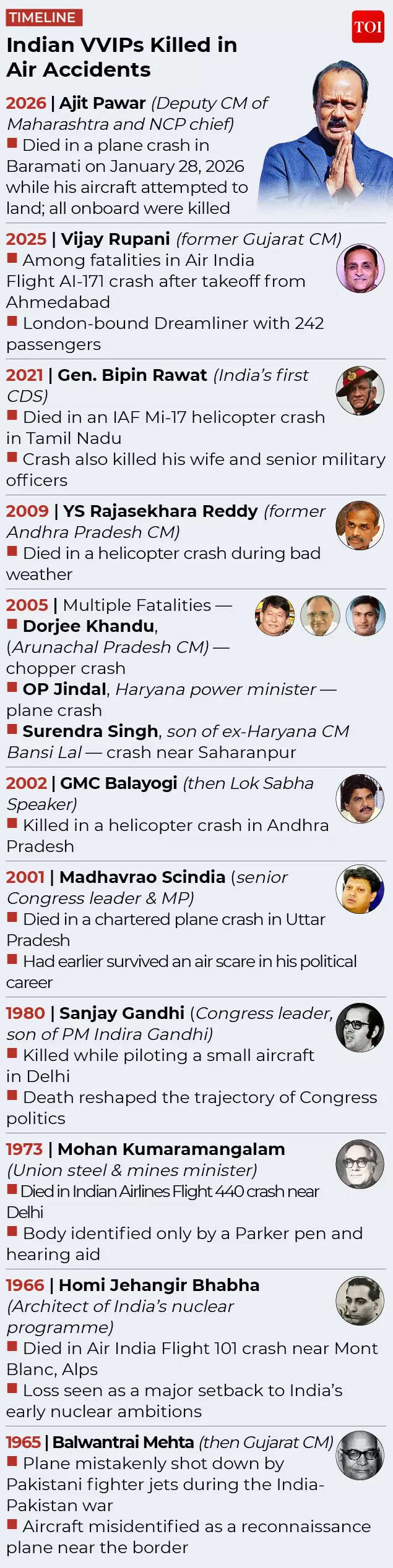
Helicopters forced down by weather, small jets overshooting runways, aircraft turning back due to cockpit warnings — these stories recur across states and years. Each incident is investigated individually, yet collectively they reveal how frequently political travel intersects with higher-risk operating environments such as remote districts, temporary helipads, mountainous terrain, or minimally equipped airstrips. The exposure level of political travellers is simply greater, and exposure is a core element of risk.Historical political aviation near-missesMorarji Desai’s – 1977On November 4, 1977, then Prime Minister Morarji Desai survived a harrowing aircraft accident. While approaching the runway late at night, the plane struck a large tree branch, causing one wing and an engine to be lost mid-air. The aircraft crash-landed over a thick bamboo grove on rain-soaked ground, which cushioned the impact. Despite severe damage to the cockpit, Desai and passengers survived, marking one of the most remarkable political aviation escapes in Indian history.Ahmed Patel, Prithviraj Chavan, and Kumari Selja – 2004In 2004, senior Congress leaders Ahmed Patel, Prithviraj Chavan, and Kumari Selja survived a serious aircraft accident. All three received immediate medical attention and were declared safe, offering relief to colleagues and supporters.Sukhwinder Singh Badal’s Helicopter emergency – 2009Former Punjab CM Sukhwinder Singh Badal encountered a mid-flight helicopter technical fault. Thanks to the pilot’s timely response, a safe landing was executed, and Badal escaped injury.Ashok Gehlot – 2011Former Rajasthan CM Ashok Gehlot survived a helicopter emergency in 2011 when a rotor blade went out of alignment mid-flight. The pilot’s skillful emergency landing averted disaster, raising concerns about helicopter safety standards.Devendra Fadnavis – Multiple escapes in 2017Maharashtra CM Devendra Fadnavis experienced multiple aviation incidents in 2017, including a helicopter crash during takeoff in Latur where the aircraft got entangled in power lines. Quick thinking by pilots in other emergency landings due to engine trouble, weight imbalance, and rotor hazards prevented fatalities, earning him a reputation for extraordinary luck. These events led to stricter safety regulations for VVIP air travel in the state.
DGCA under strain
India’s aviation regulator faces a complex task. Aircraft movements are rising rapidly, new regional routes are opening, and private aviation demand is growing. The tragic Baramati plane crash that claimed the life of Maharashtra Deputy Chief Minister Ajit Pawar has reignited scrutiny over India’s civil aviation safety framework.Months before the accident, a Parliamentary Standing Committee report (tabled in August 2025) had already warned that India’s rapid aviation growth was outpacing regulatory oversight, particularly in the non-scheduled aviation sector that includes private jets and charter aircraft.The report highlighted that, unlike scheduled commercial airlines, private and charter operations often show uneven compliance, increasing safety risks. While commercial airlines operate under highly standardized procedures, charter operators frequently lack robust maintenance and operational oversight, leaving vulnerabilities that could have fatal consequences.
Private and Charter aircraft safety under scrutiny
- Maintenance and operational concerns – The Committee raised alarms over inconsistent maintenance standards, poor documentation, and weak operational controls among non-scheduled operators. Many charter firms operate with small technical and safety teams, limiting effective oversight.
- DGCA oversight needs strengthening – Regulators were urged to conduct surprise inspections and stricter audits to ensure private and charter operators meet safety norms comparable to commercial airlines.
- Operational support gaps – Smaller operators often lack layered control centres to guide pilots during diversions or adverse weather, a vulnerability not present in scheduled airlines.
- Mandatory safety management systems – The report recommended that all private operators implement fully functional Safety Management Systems (SMS) to formalize safety processes and mitigate risk.
- Flight planning and risk assessment – Weaknesses in flight planning, weather evaluation, and pre-departure risk analysis were noted. Alternate planning and real-time operational oversight should be mandatory for non-scheduled flights.
The political charter economy
Private and chartered aircraft owned by corporate houses have increasingly become the preferred mode of travel for political leaders, especially during election seasons. In many cases, politicians have used these flights ahead of Lok Sabha polls, raising questions about compliance with Election Commission (EC) norms.Investigations by Cobrapost, using RTI data from Airports Authority of India (AAI), revealed that several senior leaders frequently rely on private jets and helicopters, sometimes with family, officials, and corporate associates on board. In some cases, the aircraft were not registered with the DGCA, raising safety and regulatory concerns.Demand surges during electionsIndustry experts predict that as political parties gear up for Lok Sabha polls, demand for private planes and helicopters is likely to increase by 30–40% compared to previous elections. Helicopters are expected to see higher demand than fixed-wing aircraft due to their ability to access rural and remote areas quickly.Charter pricing generally ranges from Rs 4.5–5.25 lakh per hour for planes, and around Rs 1.5 lakh per hour for helicopters, with some flights reaching as high as Rs 3.5 lakh per hour.Many operators lease aircraft during elections to meet the surge in demand. Official data shows there were 112 NSOPs as of December 2023, with around 450 planes and helicopters, of which half were helicopters. Most had fewer than 10 seats, suitable for quick political travel.Election spending and political air travel costsIn the 2019 Lok Sabha elections, the BJP spent over Rs 250 crore on aircraft and helicopter travel, while Congress reportedly spent over Rs 126 crore, though the latter did not separately account for aviation expenses. Analysts estimate that 2024 Lok Sabha election expenditure may reach Rs 1.2 lakh crore, with only a fraction spent by the EC itself.Despite high costs, the private charter sector has remained competitive, keeping prices stable since the pandemic, while demand continues to rise due to hygiene, safety, and convenience factors.Election norms and travel discrepanciesOn January 23, 2013, the EC directed parties to submit detailed election expenditure statements, including air travel. Cobrapost documents, however, show that leaders like Andhra CM Chandrababu Naidu, BSP chief Mayawati, and Trinamool secretary Mukul Roy did not fully disclose their travel costs, violating EC rules.For instance, Naidu reportedly flew a Krishnapatnam Port aircraft (call sign VT-NAV) multiple times in April 2014. DGCA records show VT-NAV was not listed as a non-scheduled operator permit (NSOP) holder, implying the aircraft operated without regulatory clearance, yet AAI allowed the flights.What this tragedy may triggerNo regulation formally allows compromise, yet aviation experts acknowledge that operational culture matters. Pilots must be empowered to divert or delay without consequence. However, in high-stakes political travel, the surrounding ecosystem is built on certainty of arrival. The tension between procedural caution and schedule urgency is subtle but real.Ajit Pawar’s death may catalyse reforms: stronger enforcement of Safety Management Systems, increased DGCA audits of charter operators, infrastructure upgrades at regional airfields, expanded ATC staffing, and formal risk-assessment protocols for VVIP flights.



 हिन्दी
  English