 Sipu Jha

NEW DELHI: For decades, India’s fiscal federal system has had one core element that stood out: poorer states would be supported so that growth could be shared.The 16th Finance Commission has not broken that promise on paper. States will still receive 41 percent of the divisible pool of central taxes. But beneath that headline number, the logic of how money moves across the Union is beginning to change.For the first time, economic output shapes transfers. Long-running revenue deficit grants — once a fiscal buffer for states — have been eliminated. Parts of local government funding are now tied to performance benchmarks. Disaster funding is moving towards risk-indexed allocation rather than discretionary relief.The shift is subtle in design but important in consequence. Transfers are no longer only about closing gaps. They are increasingly about shaping behaviour — rewarding growth, nudging fiscal discipline, and linking public money to administrative capacity.“Considering India’s growth imperative, there is a need for at least a small shift in the devolution criteria towards efficiency,” the Commission said, capturing the direction of travel.
What a Finance Commission decides
Under Article 280 of the Constitution, a Finance Commission is appointed roughly every five years to recommend how Union tax revenues are shared with states and how that share is distributed among them.The 16th Commission covers the period from 2026-27 to 2030-31. Its recommendations come at a time when India is expected to remain one of the fastest-growing major economies and set to become world’s third largest economy in the recommendation period.
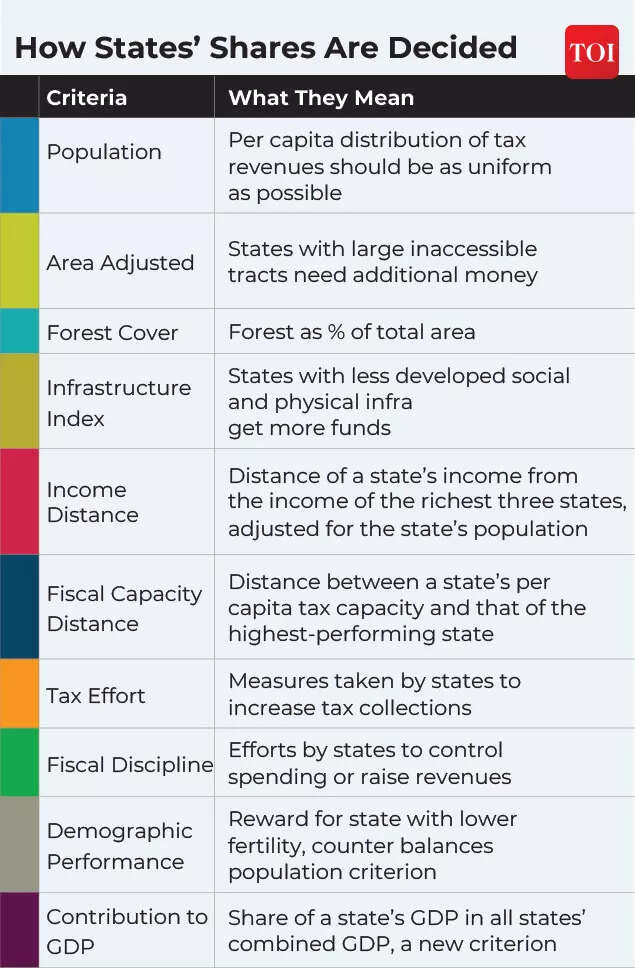
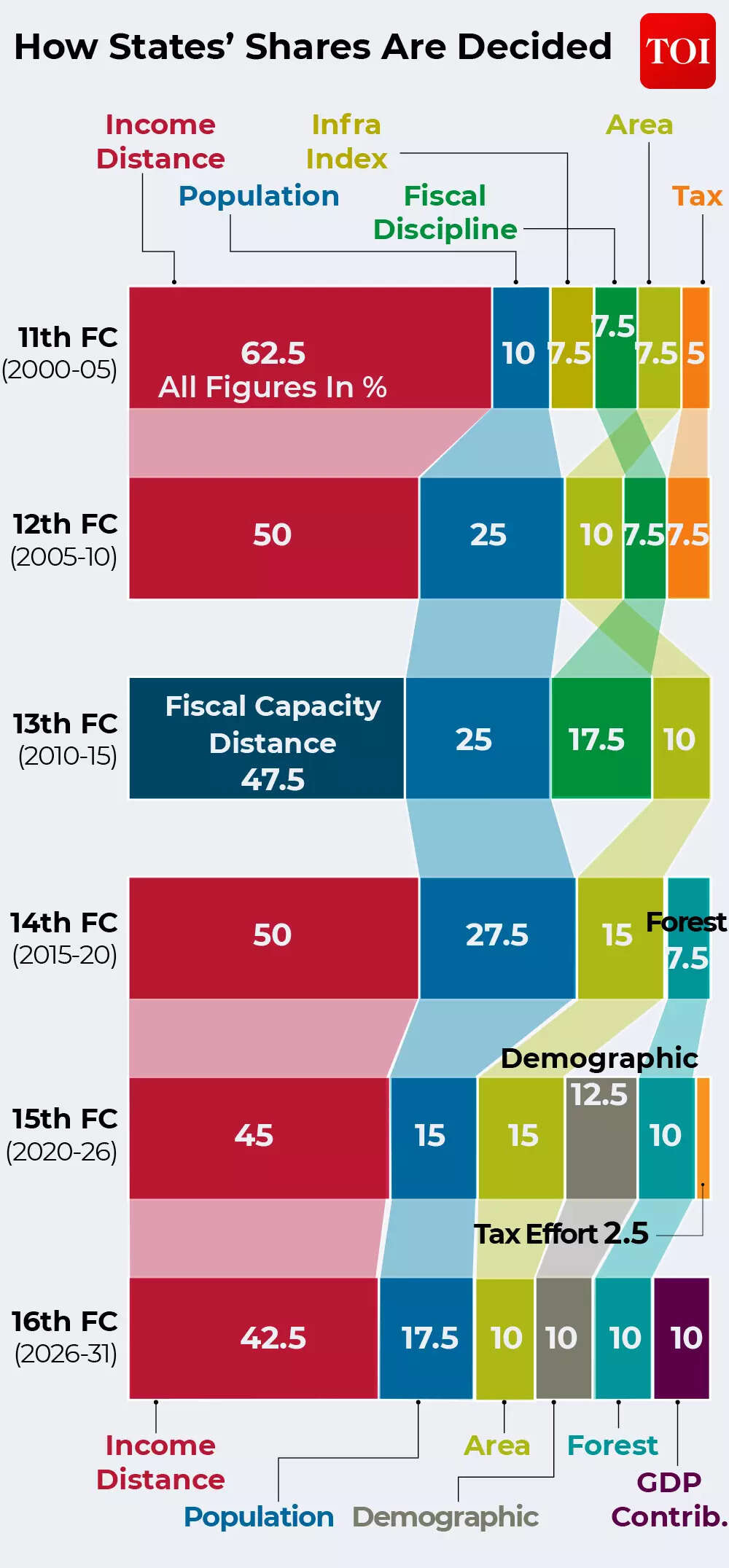
The core decisions are twofold. Vertical devolution determines what share of central taxes goes to states. Horizontal devolution determines how that pool is divided among them. The vertical share remained unchanged. The horizontal framework has changed.
GDP contribution enters the formula
For the first time, contribution to national GDP has been included as a horizontal devolution criterion with a 10 percent weight. Karnataka gains 0.48 percentage points. Kerala gains 0.45 percentage point. Madhya Pradesh loses 0.50 percentage point. Bihar loses 0.11 percentage points . The formula now combines income distance, population, demographic performance, area, forest, GDP contribution. Income distance continues to drive equalisation. GDP contribution introduces an efficiency signal.In response to TOI queries, DK Srivastava, Chief Policy Advisor at EY India, questioned the conceptual basis.“Linking devolution to production efficiency does not appear to be justified,” he said.He said variation in state GDP contribution reflects structural economic factors rather than fiscal management.“It is important to distinguish between efficiency of a production system and efficiency of a fiscal system. GSDPs and GDP are the outcome of the production system in a country which is largely driven by market forces. Inter-state variation in the contribution of the GSDP of an individual state to the overall GDP depends largely on the inter-state concentration of capital stock, inter-state movement of financial and human resources and state level availability of infrastructure,” Srivastava said.He said fiscal rules themselves reinforce divergence.“The differences in inter-state infrastructure depends largely on the limit of fiscal deficit of 3% of GSDP which is by definition higher for higher GSDP states,” he said. “Lowering of the weight attached to the income distance criterion and giving a relatively high weight to the contribution criterion would reduce the degree of equalization.”Ranen Banerjee, Partner and Leader, Economic Advisory, PwC India, said the change sends a policy signal rather than creating an immediate redistribution shock.“The introduction of contribution to GDP as a parameter is a bold step as it clearly puts growth and consequent improvement in the per capita incomes of citizens as an important imperative,” he told TOI.
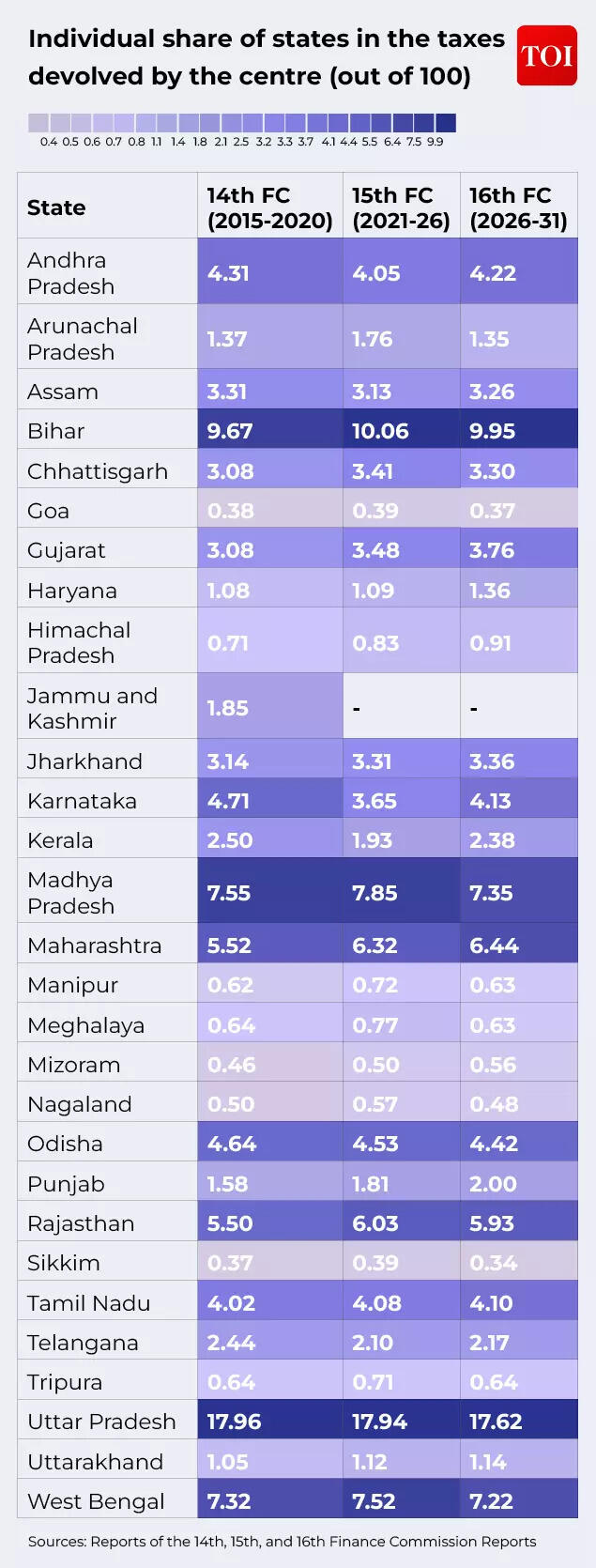
He said states are already competing on growth and investment metrics.“The states have been competing in attracting investments and improving their ease of doing business as well as articulating ambitious growth targets,” Banerjee said. “The signalling through this indicator could possibly work towards restraining populist expenditures and encouraging capital output enhancing expenditures that lead to economic growth.”He added the numerical impact remains modest.“While this may not be counted as a structural shift given the highest negative impact of just 50 basis points in the share of a state with all the changes in the weights and introduction of this parameter, it is a big incentive for states to perform well and provide growth to its population,” he said.Rumki Majumdar, Economist at Deloitte India, said the shift formally introduces performance into federal fiscal thinking.“The introduction of GDP contribution marks an important evolution: for the first time, economic performance finds measured recognition in horizontal devolution,” she said.
Revenue deficit grants end
The Commission has eliminated revenue deficit grants entirely, ending a mechanism historically used to support fiscally weaker states.The Commission’s reasoning is behavioural. It argues that persistent revenue support created ‘adverse incentive structures’ and weakened fiscal reform pressure.Srivastava said stronger design could still have been built around subsidy discipline.“One possible approach could have been to more explicitly exclude excessive or unjustified subsidies in the assessment of states’ expenditure needs during the award period,” he said. “Designing calibrated fiscal incentives or disincentives linked to subsidy discipline may enhance accountability.”
Local body transfers: performance now matters
Local bodies will receive Rs 7.91 lakh crore between 2026 and 2031, with 60 percent going to rural bodies and 40 percent to urban bodies.
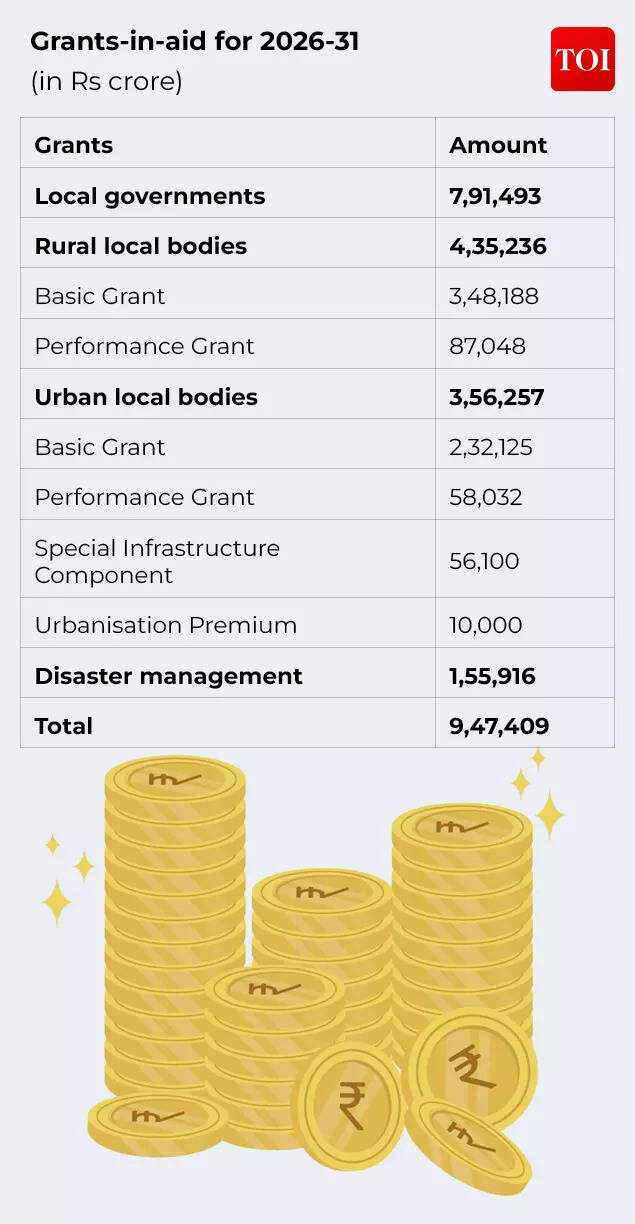
Within this, 80 percent is basic grants and 20 percent is performance-linked.Performance conditions include audited accounts publication, property tax system strengthening, and own revenue growth targets.Majumdar said transparency reform is foundational.“Uniform on-budget reporting becomes the first step toward discipline,” she said.She said transparency alone is insufficient without incentive design.“A shift to uniform, on-budget accounting will ensure states remain committed to the path of fiscal prudence. That said, transparency will have to paired with targeted incentives for efficiency and progressive designs,” she said.
Disaster funding
The Commission has expanded formula-based disaster allocations using a disaster risk index based on hazard, exposure and vulnerability.Banerjee said the framework attempts to balance predictability with flexibility.“The sixteenth finance commission’s disaster relief and mitigation fund related recommendations have built in fiscal flexibility,” he said.He said extreme disaster funding scales with the size of the event.“The risk to extreme tail end disaster events that essentially entails relief has been adequately provided for with a graded contribution from states and centre based on the size of relief,” he said.He said fund stockpiling is controlled while allowing emergency replenishment.“The commission has also recommended capping of accumulation in the SDRF to the extent of past 3 years allocation,” he said.“In the event the fund gets depleted on account of a disaster, it has given provision for its replenishment,” he said.He said mitigation spending remains underused.“The challenge has been utilisation of the State Disaster Mitigation Funds,” he said.“Work on mitigation measures utilising the mitigation funds will be the best way to bring down the risks to be within modelled risk scenarios,” he said.Srivastava said tail-risk disasters remain a central government stabilisation responsibility.“Tail-risk disasters refer to high impact, low probability events such as natural disasters and pandemics,” he said.

(Credit -Sandeep Adhwaryu)
“In the macro-fiscal stabilization framework, dealing with these disasters is largely the responsibility of the central government,” he said.He said fiscal rule flexibility may be necessary in extreme events.“This calls for some flexibility in the fiscal deficit to GDP targets provided in the Centre’s FRBM Act,” he said.He cited pandemic precedent.“For events such as Covid-19 also, it was the central government that increased its fiscal deficit to an inordinately high level of 9.2% of GDP in 2020-21 to cope with the Covid led economic contraction,” he said.He said long-term catastrophic planning remains incomplete.“There is also a case to plan for dealing with disasters like pandemics, nuclear and biological holocausts in advance,” he said.Majumdar framed the shift as systemic resilience building.“When the next black swan arrives, the question is not whether models predicted it, but whether financing can move at the speed of need,” she said.“By modernising risk indices, widening eligibility and introducing market-based risk transfer, the framework somewhat ensures that public finances retain the agility required for a new era of tail-risk volatility,” she said.
Subsidy discipline
The Commission has recommended subsidy rationalisation, improved targeting, sunset clauses and stronger disclosure.Banerjee said fiscal deficit limits already create indirect discipline.“The fiscal federalism structure has an in-built mechanism that penalises fiscal profligacy by states,” he said.“This is through capping of the fiscal deficit that means limiting the borrowing that a state can undertake,” he said.He said adjustment pressures fall on capital spending.“When states are faced with serious fiscal constraints on account of excessive subsidy, the borrowing limit forces it to rationalise expenses,” he said.“Given the rigidity of expenditure for salaries, pension and interest payments, the casualty of such rationalisation is the capital expenditure,” he said.

Representative image
He said transparency can create market pressure.“More transparency on the fiscal condition of a state should upward pressure on the yields of the state development loans raised by the states making borrowing more expensive,” he said.Srivastava said stronger incentive architecture could have been considered.“One possible approach could have been to more explicitly exclude excessive or unjustified subsidies in the assessment of states’ expenditure needs,” he said.“Designing calibrated fiscal incentives or disincentives linked to subsidy discipline may enhance accountability,” he said.
A quieter federal shift
The Commission does not abandon equalisation. Income distance remains the dominant driver.But incentive-linked federalism now sits alongside support-based transfers.Growth versus redistribution, performance versus protection and fiscal discipline versus political economy pressures now operate within the same transfer structure.Over the next five years, states will adjust spending, borrowing and welfare design around this framework.







 हिन्दी
  English