 Sipu Jha
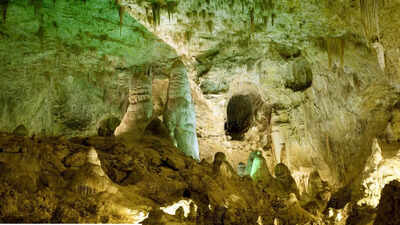
Microbial communities hidden deep inside the caves of New Mexico have fascinated scientists who study extreme environments and search for extraterrestrial life. In 2018, the team of scientists at Carlsbad Caverns came across strange green colonies on the limestone walls, which were very far away from the natural light. Later, these microbes were confirmed to be cyanobacteria, which have the ability to conduct photosynthesis using near-infrared light. According to the study, these bacteria have existed in their present form for the last 4 to 9 million years. This discovery indicates that life is able to exist even under conditions that had been regarded as too dark to support life.The research, which was done by Hazel Barton of the University of Alabama and Lars Behrendt of Uppsala University, has a potential impact on biology and astrobiology. Besides that, it reveals how organisms modify themselves to survive with very low energy supplies in enclosed and low-light environments.
Scientists spot glowing green microbes in a pitch-dark Carlsbad Caverns cave
The discovery was made in an alcove that appeared entirely black to the eye. When researchers shone a torch across the wall, a bright green layer became visible. The colour was striking against the stone. Laboratory testing showed the growth consisted of cyanobacteria, single-celled organisms often linked to surface environments where sunlight is present.What made this colony different was its location. The area receives no direct sunlight. It sits well beyond the cave entrance. Yet the microbes were active and stable.
Cave microbes use near-infrared light to photosynthesise at record low levels
Further analysis revealed that these organisms contain chlorophyll d and chlorophyll f. These pigments allow absorption of near-infrared light, which sits beyond the range visible to humans. This form of light is faint and scattered. In the cave, it appears to reflect and diffuse from limestone surfaces in small amounts.The microbes use that limited energy to photosynthesise. The process works at lower light levels than previously recorded for similar organisms. It is not dramatic, but it is steady.
Research reshapes search for extraterrestrial life
The finding of the study, “Life in the dark: far-red absorbing cyanobacteria extend photic zones deep into terrestrial caves”, has drawn interest from astrobiologists. Understanding the minimum light conditions needed for photosynthesis helps define where life might survive elsewhere. If organisms can adapt to such restricted wavelengths, planets orbiting dimmer stars may remain possible targets.Hazel Barton has said the work aims to identify the longest wavelength and lowest intensity of light that can sustain photosynthesis. That boundary matters. It shapes telescope surveys and guides modelling of exoplanet atmospheres.
Extreme cave environments preserve early adaptations
Carlsbad Caverns provides a controlled setting, with stable temperature and little disturbance. The cyanobacteria appear to have adjusted over long periods to exploit scarce energy. The ecosystem is simple, almost quiet. There is no immediate suggestion of alien microbes waiting in the darkness. But the cave walls offer a reminder that life can persist where expectations narrow. It changes the margins slightly. Sometimes that is enough.








 हिन्दी
  English