 Sipu Jha
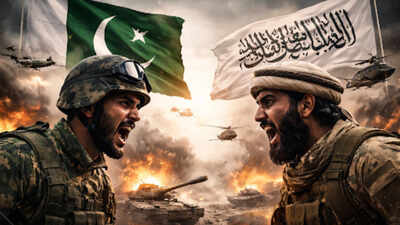
AI image (Picture credit: OpenAI via ChatGPT)
Tensions between Afghanistan and Pakistan have sharply escalated following days of cross-border airstrikes and retaliatory attacks. Both sides have accused each other of heavy losses, with casualty figures varying widely and remaining unverified.Pakistan’s defence minister Khawaja Mohammad Asif on Friday said his country was now in an “open war” with neighbouring Afghanistan, calling it the worst escalation since a Qatar-mediated ceasefire in October.
Afghan authorities said their forces launched retaliatory strikes along the Durand Line after Pakistani air raids on border provinces.As fighting intensifies, the military balance between the two neighbours highlights a stark contrast in capabilities, manpower and firepower.
Overall strength: Pakistan far ahead in global rankings
According to the Global Firepower Index, Pakistan ranks 14th out of 145 countries with a Power Index score of 0.2626. Afghanistan ranks 121st with a score of 2.7342. In this index, a lower score indicates stronger military capability.According to the London-based International Institute for Strategic Studies, Pakistan’s armed forces benefit from strong recruitment and continued investment, including equipment from China. Afghanistan’s military capability, meanwhile, has declined since the Taliban returned to power in 2021, with limited access to modernisation due to a lack of international recognition, reported Reuters.
Personnel: A major gap in troop numbers
Pakistan has around 660,000 active military personnel, according to Global Firepower Index. Of these, roughly 560,000 are in the army, 70,000 in the air force and 30,000 in the navy. It also has about 550,000 reserve personnel and 500,000 paramilitary forces.Afghanistan’s active military strength is significantly smaller. As per Reuters, it has around 172,000 active personnel, with plans announced to expand to 200,000.In terms of population, Pakistan has over 252 million people, compared with Afghanistan’s roughly 40 million, giving Islamabad a much larger manpower pool.
Air power: A decisive advantage for Pakistan
Air capability is one of the clearest differences between the two forces.Pakistan operates 1,397 aircraft in total, including 331 fighter jets, 90 dedicated attack aircraft, 379 helicopters and 55 attack helicopters, according to Global Firepower. Afghanistan, by contrast, has no fighter aircraft. As per estimates, Afghanistan possesses at least six aircraft and 23 helicopters, many dating back to the Soviet era, though their operational status is unclear.This air superiority gives Pakistan a major edge in cross-border operations.
Land forces: Armour and artillery gap
On land, Pakistan also holds a strong advantage.Global Firepower data shows Pakistan has 2,677 tanks, over 59,000 armoured vehicles, 662 self-propelled artillery units, 2,629 towed artillery pieces and 652 mobile rocket projectors.On the other hand, Afghanistan has around 3,902 armoured vehicles. The number of artillery systems is unclear, though Afghan forces possess some Soviet-era tanks and artillery, but exact numbers are unknown, as per Reuters.
Missile systems and air defence
According to Missile Defence Advocacy.org, the Taliban inherited Stinger and SA-24 Igla-S man-portable air defence systems (MANPADS). These include:
Stinger MANPAD (range 8 km, United States origin)- SA-24 Igla-S MANPAD (range 6 km, Soviet origin)
In 2021, the Taliban reportedly discovered Scud B ballistic missiles (range 300 km) and FROG-7 artillery rockets (range 68 km), both of Soviet origin.Pakistan, however, has a far more developed missile programme and a nuclear arsenal.
Nuclear and naval power
Pakistan is a nuclear-armed state with an estimated 170 warheads. Afghanistan has no nuclear capability.Afghanistan is landlocked and has no navy. Pakistan, on the other hand, operates a functional navy with eight submarines, nine frigates, six corvettes and dozens of patrol vessels.
Defence spending: A massive financial gap
Financial resources further underline the imbalance.Pakistan’s defence budget stands at about $9.1 billion, ranking 38th globally.Afghanistan’s defence budget is estimated at just $145 million, ranking 136th.This difference affects procurement, training, maintenance and technological upgrades.
Strategic context
Pakistan has repeatedly accused Afghanistan of “exporting terrorism” and supporting the Pakistani Taliban, allegations Kabul denies. The latest clashes follow months of tension, including deadly incidents in October and a fragile ceasefire that failed to hold.While both sides claim battlefield successes, the numbers show that Pakistan overwhelmingly dwarfs Afghanistan in conventional military strength. However, border conflicts are often shaped by terrain, irregular warfare and political factors, not just raw military statistics.





 हिन्दी
  English