 Sipu Jha
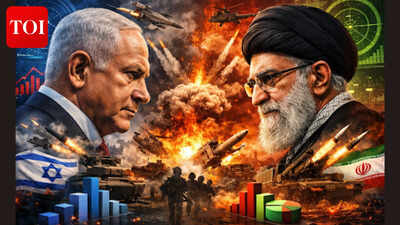
AI image (Picture credit: OpenAI via ChatGPT)
The confrontation between Israel and Iran intensified on Saturday after coordinated US–Israeli strikes targeted Iranian facilities, including sites near Tehran. In response, Iran launched waves of drones and missiles towards Israeli territory and US-linked assets in the Gulf, widening fears of a regional war.Israeli Prime Minister Benjamin Netanyahu said the operation was aimed at removing what he described as an “existential threat”. US President Donald Trump confirmed that “major combat operations” were underway. Tehran, meanwhile, warned it “will not hesitate” to retaliate.Against this backdrop, military data shows two very different models of power — one based on size and missile strength, the other on technology and air superiority.
Global ranking and manpower base
According to the 2026 Global Firepower Index, Israel ranks 15th out of 145 countries with a Power Index score of 0.2707, while Iran is close behind at 16th with 0.3199. The lower the score, the stronger the ranking.Iran’s population of about 88 million provides it with a far larger manpower pool than Israel’s 9.4 million. Tehran maintains around 610,000 active-duty troops and 220,000 paramilitary personnel.Israel has 169,500 active soldiers but relies heavily on compulsory military service and a reserve force of roughly 465,000, enabling rapid mobilisation in wartime.
Geography and strategic depth
Geography shapes strategy. Iran spans more than 1.6 million square kilometres, allowing dispersion of assets and strategic depth. Israel’s territory is under 22,000 square kilometres, making missile defence central to its security doctrine.
Defence spending and nuclear dimension
Israel spends approximately $34.6 billion annually on defence, compared with Iran’s $9.23 billion. The funding gap translates into advanced aircraft, missile defence networks and intelligence systems for Israel.On nuclear capability, Israel is widely believed to possess around 90 nuclear warheads, according to data cited by Statista, although it has never officially confirmed this. Iran insists its nuclear programme is civilian and maintains it does not possess nuclear weapons.
Land systems and rocket forces
On the ground, Iran holds numerical superiority. It operates roughly 2,675 tanks compared with Israel’s 1,300. Iran also deploys around 1,550 mobile rocket launchers, far exceeding Israel’s 228. However, Israel’s domestically produced Merkava tanks are regarded as technologically advanced and combat-proven.
Naval strength and regional posture
Iran operates 109 naval vessels, including 25 submarines, giving it significant capability in the Gulf and Strait of Hormuz.Israel maintains 82 vessels, including six submarines and seven modern corvettes, focusing on coastal security and deterrence.
Air power: Advanced fleet versus ageing platforms
Air capability is a critical dividing line. Israel operates 597 aircraft, including 239 fighter jets. Its fleet includes US-made F-15 and F-16 jets and 39 F-35I “Adir” stealth fighters.It also fields 48 AH-64 Apache attack helicopters and aerial refuelling aircraft, allowing long-range strike missions.Iran operates 551 aircraft, including 188 fighter jets. However, many are older US or Soviet-era models such as the Su-24 and F-7. Years of sanctions have limited upgrades and spare parts. Tehran has instead invested heavily in drones and ballistic missiles as asymmetric tools of warfare.Israel deploys more than 1,000 drones and operates a layered air defence shield, the famous Iron Dome for short-range threats, David’s Sling for medium-range missiles and the Arrow system for long-range ballistic missiles. Iran fields over 2,500 air defence units, including Russian-origin S-300 systems and domestically developed missile defences.
Iran’s vast ballistic missile arsenal
While both sides possess capable air and ground forces, missiles are at the heart of this confrontation.As per various reports, Iran’s ballistic missile inventory is estimated at more than 3,000 missiles, making it one of the largest in the region. The arsenal includes short-range ballistic missiles (300–1,000 km) and medium-range ballistic missiles (1,000–3,000 km).Among short-range systems, Iran operates the Shahab-1 (350 km) and Shahab-2 (750 km), both liquid-fuelled. The Qiam-1, also liquid-fuelled, has a 750 km range and features improved targeting. The solid-fuelled Fateh family includes the Fateh-110 (300 km), Fateh-313 (500 km) and Zolfaghar (750 km). The Hormuz series is designed as an anti-ship ballistic missile with a range of about 300 km.In the medium-range category, Iran fields several Shahab-3 variants with ranges between 1,200 km and 2,100 km. The Haj Qasem (1,400 km) and Qasem Basir (1,200 km) are solid-fuelled systems with improved precision. The Kheybar Shekan can strike targets up to 1,450 km away. Iran has also unveiled the Fattah-1 and Fattah-2, described as hypersonic missiles capable of speeds up to Mach 13, with ranges of 1,400–1,500 km.Other systems include the Ghadr-110 (2,000–3,000 km), Sejjil (2,000 km), Khorramshahr (2,000 km, capable of carrying multiple warheads), Emad (2,000 km) and Etemad (1,700 km).European countries such as Britain, France and Germany fall within range of Iranian medium-range missiles, though major US cities remain out of reach from Iranian territory.
Israel’s strategic missile deterrent
Israel maintains deliberate ambiguity over its missile and nuclear capabilities, but it operates the Jericho series of ballistic missiles. The Jericho 1, developed in the 1960s with French assistance, was Israel’s first nuclear-capable missile and was retired in the 1990s.The Jericho 2, a solid-fuelled medium-range missile, remains operational but is expected to be phased out by 2026. It also forms the basis of the Shavit satellite launch vehicle. The more advanced Jericho 3, first tested in 2008 and operational since 2011, is an intermediate-range ballistic missile believed to provide long-range strategic deterrence.Beyond ballistic missiles, Israel deploys the Delilah missile, a road-mobile, air-to-surface and surface-to-surface precision weapon originally developed as a UAV decoy. The Gabriel family serves as Israel’s primary anti-ship missile system and has been in service since 1972. Israel also operates the LORA (Long Range Artillery), a solid-fuelled ballistic missile with a range of 280 km, developed by Israel Aerospace Industries in cooperation with IMI.
Missile defence and strategic balance
Missiles are only part of the equation. Israel’s layered air defence system, including Iron Dome, David’s Sling and Arrow interceptors, is designed specifically to counter large-scale missile barrages. Iran, meanwhile, relies on dispersal, mobility and volume of fire.In essence, Iran’s strength lies in the scale and diversity of its missile stockpile. Israel’s advantage rests in precision strike capability, long-range deterrence and sophisticated missile defence. In any prolonged conflict, missile exchanges are likely to define both the tempo and intensity of the war.In essence, Iran commands greater manpower, missile stockpiles and geographic depth. Israel compensates with higher defence spending, advanced aircraft, strong reserves and a multi-layered missile defence system. If escalation continues, the balance between scale and sophistication will determine how the conflict unfolds.






 हिन्दी
  English