 Sipu Jha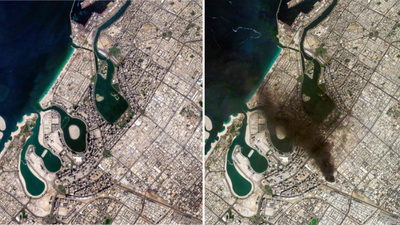
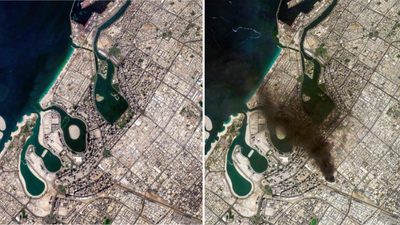
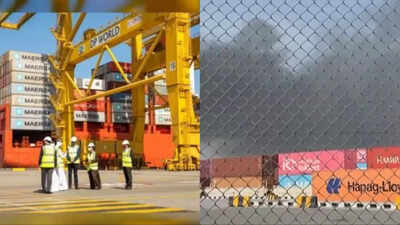
The lavish and ultramodern city of Dubai also came under the radar amid the massive unrest in the Arab world, as grief-stricken Iran unleashed strikes on multiple nations in the Middle East following the killing of its Supreme Leader Ayatollah Ali Khamenei and several other top leaders in a coordinated attack carried out by the United States and Israel.Khamenei’s killing and the large-scale military operation in Iran by the US and Israel pushed Tehran into a state of frenzy. The Khamenei-less Islamic Republic launched heavy retaliatory strikes on American military bases across the Gulf and on Israel, and also targeted the region’s major commercial and tourism hub, Dubai, the city of skyscrapers, along with nearby Sharjah in the United Arab Emirates.Satellite images clearly captured the aftermath of the attacks, comparing pictures taken before and after the strikes launched by Iran.The images showed thick black fumes rising into the sky, turning the city’s iconic skyline grey after heavy explosions and blasts.Over the years, the scenes and skyline of Dubai rarely reflected the unrest often associated with the Arab world, instead symbolising the glamour and opulence of modern city life.The opulent, sail-shaped Burj Al Arab hotel, perched along Dubai’s Gulf coast, has long stood as a symbol of the city’s wealth and ambition. Now, after Iranian missiles set parts of it ablaze, the iconic structure has become an emblem of the crisis engulfing the region.Residents looked on in shock as hundreds of drones and missiles targeted the United Arab Emirates and other Gulf allies of the United States, nations that have long served as relative safe havens from the region’s conflicts, over the weekend.In Dubai, a city that has transformed within decades from a modest desert outpost into a cosmopolitan hub of towering skyscrapers and global finance, many of the targets carried strong symbolic value.Along with the Burj Al Arab, a beloved landmark since its opening in 1999, explosions also struck a five-star hotel on the upscale Palm Jumeirah, the man-made island known as a playground for the global elite.Dubai International Airport, the world’s busiest airport for international passengers, and Jebel Ali Port were also hit in the strikes. Together, the two facilities account for roughly 60 percent of Dubai’s revenues, according to official estimates.Dalia, a 33-year-old Lebanese expatriate, was at the popular Kite Beach near the Burj Al Arab on Saturday when interceptor systems began destroying incoming missiles and drones in the sky.Later, debris from an intercepted drone reportedly ignited a fire near the base of the hotel’s facade.




 हिन्दी
  English