 Sipu Jha
Though he campaigned against the foreign entanglements of past presidents, President Donald Trump has shown little hesitation in deploying American military power during his second term. Since returning to the White House in 2025, Trump has authorised a string of operations stretching from the Middle East and Africa to Latin America.The interventions range from counterterrorism strikes in Somalia and Iraq to a dramatic commando raid that captured Venezuelan leader Nicolás Maduro, and most recently, a major US-Israel military campaign against Iran.While the White House insists its actions align with a narrower definition of national interest, critics argue the growing list of operations suggests a far more interventionist posture.US–Israel war against IranThe most dramatic escalation came on February 28, when the United States and Israel launched coordinated strikes across Iran targeting military installations and senior leadership.One strike hit a compound in Tehran housing the offices of the ayatollah, the Iranian presidency and the national security apparatus. The attack killed Supreme Leader Ali Khamenei, sending shockwaves across the region.Iran retaliated swiftly. Missiles were fired at Israeli targets and US military facilities across the Middle East. One strike on a base in Kuwait killed four American service members.Tehran also widened the battlefield by hitting civilian infrastructure in Gulf states, including the Fairmont hotel in Dubai and Kuwait International Airport, signalling an unprecedented expansion of the conflict.
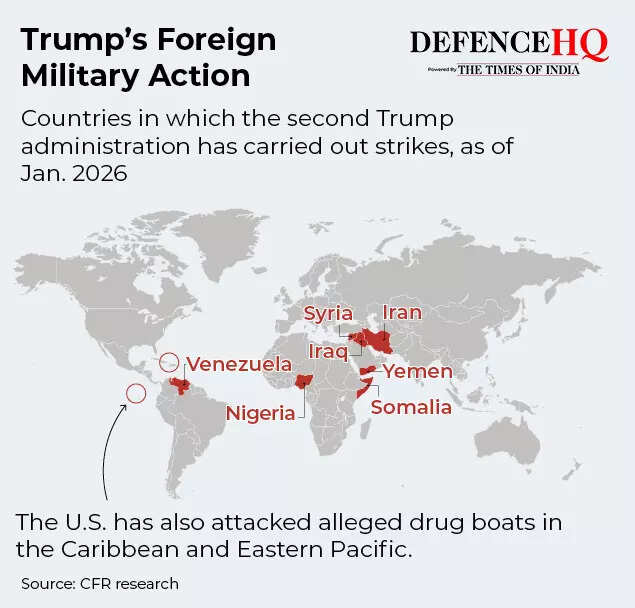
Trump’s foregn military action
Trump has warned the campaign could continue for weeks. According to the president, the operation aims to destroy Iran’s missile arsenal, cripple its naval forces, prevent the country from acquiring nuclear weapons and dismantle its network of regional proxies.Officials in Washington have offered conflicting signals on whether the United States would accept a new Iranian leadership or push for the collapse of the Islamic Republic altogether.Tensions had been rising since January 2026, when the Iranian government violently suppressed widespread protests. Trump initially threatened intervention but later softened his tone while negotiations continued.Talks mediated by Oman in Geneva and Muscat appeared close to a breakthrough on February 26, with mediators claiming Iran was ready to halt uranium enrichment.Just two days later, however, US and Israeli aircraft struck Iran. Trump later said Tehran posed a direct threat to “core [US] national security interests.”Venezuela: The capture of MaduroIn one of the most dramatic episodes of Trump’s second term, US forces launched a daring operation on January 3, 2026, extracting Venezuelan president Nicolás Maduro from Caracas.The mission, dubbed Operation Absolute Resolve, involved US special forces and law enforcement officers storming Maduro’s heavily guarded compound.Roughly seventy-five Venezuelan and Cuban guards were killed during the raid. Maduro and his wife were flown to New York, where he now faces narcoterrorism charges.The long-term US military presence in Venezuela remains uncertain. Secretary of State Marco Rubio has outlined a three-phase plan designed to pressure the remaining regime figures, including interim president Delcy Rodríguez, into complying with US demands.Washington is seeking sweeping reforms to Venezuela’s oil sector, the removal of advisers from China, Cuba, Iran and Russia, and the release of political prisoners.Initially, the White House framed the campaign as a counter-narcotics mission. Beginning in September 2025, US forces targeted suspected drug trafficking vessels in the Caribbean before expanding operations into the Pacific.Throughout the buildup, officials insisted the United States was not pursuing regime change. Yet at a press conference announcing Maduro’s capture, Trump openly linked the mission to Venezuela’s vast oil reserves.Iran: Strikes on Nuclear FacilitiesThe war with Iran did not begin in February. It followed an earlier escalation in June 2025.On June 12, the International Atomic Energy Agency declared Iran was breaching its nuclear commitments and could reach weapons-grade uranium enrichment within two weeks.The following day, Israeli Prime Minister Benjamin Netanyahu launched a sweeping campaign against Iranian nuclear and military targets.Ten days later, the United States joined the offensive.On June 22, US B-2 stealth bombers dropped bunker-busting munitions on underground nuclear facilities at Fordow and Natanz, while a US submarine fired cruise missiles at Isfahan.Trump later declared that Operation Midnight Hammer had “completely and totally obliterated” Iran’s enrichment infrastructure.A subsequent US intelligence assessment offered a more cautious conclusion, suggesting the strikes delayed Iran’s nuclear programme by only a few months rather than eliminating it entirely.Syria: Retaliation after deadly attackIn December 2025, US Central Command launched Operation Hawkeye Strike after an attack near Palmyra killed two American soldiers and a civilian interpreter.The operation targeted more than seventy ISIS sites across central Syria, including weapons depots and infrastructure.Trump blamed ISIS for the attack and vowed “serious retaliation.”Defence Secretary Pete Hegseth described the campaign as “a declaration of vengeance”, promising the United States would continue to “hunt” and “kill” its enemies.US forces later expanded the campaign on January 10, 2026, striking thirty-five additional ISIS positions.Despite the strikes, the episode highlighted the complex security environment in Syria. Syrian officials later revealed the attacker was a member of their own security forces who had been facing dismissal over extremist views.Nigeria: US bombs ISIS targetsThe United States also expanded its counterterrorism operations in Nigeria, where jihadist violence has plagued the country’s northern regions for years.In October 2025, Trump redesignated Nigeria as a Country of Particular Concern under the International Religious Freedom Act, citing attacks against Christian communities.Nigeria’s government rejected the characterisation, arguing militant groups routinely target civilians regardless of religion.On December 25, Trump announced that US forces had struck sixteen ISIS-linked targets in Sokoto state using guided missiles.The strikes were conducted in coordination with the Nigerian government, and both sides signalled the possibility of additional operations.Somalia: Intensified counterterrorism campaignAnother major theatre of operations has been Somalia, where the Trump administration significantly expanded US military activity.Beginning in February 2025, American forces intensified strikes against al-Shabaab, an al-Qaeda affiliate, and ISIS-Somalia, a smaller offshoot operating in the country’s north-east.According to the Washington-based think tank New America, the United States conducted 126 operations in Somalia during 2025, killing nearly two hundred militants.The campaign represents a dramatic escalation. In that single year, the US carried out more operations than during the combined administrations of George W. Bush, Barack Obama and Joe Biden.Trump officials say the objective is to eliminate terrorist groups capable of threatening the United States and its allies.Yet the long-term impact remains uncertain. Al-Shabaab continues to gain ground against Somali government forces and has pushed closer to the capital, Mogadishu.Iraq: Precision strike against ISIS leaderThe Trump administration also maintained pressure on ISIS in Iraq.On March 13, 2025, US Central Command conducted a precision air strike in Al Anbar province, killing Abdallah “Abu Khadijah” Makki Muslih al-Rifai, the group’s second-in-command.The militant was widely regarded as one of the most dangerous ISIS leaders, overseeing global operations and financing.General Michael Kurilla, then commander of CENTCOM, said the strike was part of ongoing efforts to dismantle organisations that “threaten our homeland and US, allied, and partner personnel in the region and beyond.”Trump praised the operation on Truth Social, describing it as another example of his “peace through strength” doctrine.The strikes form part of Operation Inherent Resolve, the anti-ISIS campaign launched in 2014 after the group seized large parts of Iraq, including Mosul.Yemen: Escalation against the houthisUS military operations also intensified in Yemen, where Iran-backed Houthi rebels have targeted shipping in the Red Sea and launched attacks against Israel.Following Trump’s return to office, CENTCOM launched Operation Rough Rider in March 2025, dramatically expanding air strikes against Houthi positions.The campaign deployed two US carrier strike groups and large amounts of airpower.While the strikes degraded the Houthis’ drone and missile capabilities, they did not stop the group’s attacks on shipping lanes.The operation also came at a high cost. Houthi retaliation destroyed several US Reaper drones, and two advanced fighter aircraft were lost at sea while operating from a carrier.Congressional estimates place the cost of the campaign at more than $1 billion before the White House abruptly ended it in May 2025.Houthi attacks later subsided after a Gaza ceasefire was announced in October 2025.A narrower doctrine or expanding power?The Trump administration’s 2025 National Security Strategy argues that previous presidents defined US interests too broadly, leading to overextension abroad.The document states that “the affairs of other countries are our concern only if their activities directly threaten our interests.”Yet Trump’s growing list of military interventions suggests a broader interpretation of what constitutes such a threat.For supporters, the approach reflects the president’s belief in decisive force and deterrence.For critics, it signals a presidency increasingly willing to wield military power across the globe.






 हिन्दी
  English