 Sipu Jha
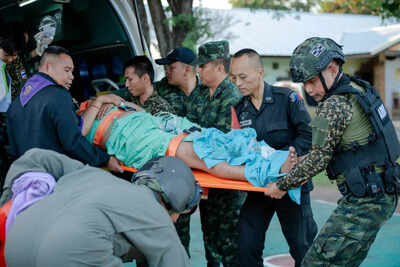
Thailand carried out airstrikes on Cambodia on Monday, marking a fresh escalation in tensions just weeks after US President Donald Trump oversaw a ceasefire agreement between the two neighbours in Malaysia in October.The two sides had engaged in brief fighting last month as well.Both countries blamed each other for the latest burst of fighting along their disputed border, which left a Thai soldier dead.As tensions escalate, here’s how the rivals stack up militarily:Ground forces and defence budgetCambodia’s army — the largest branch of its post-1993 armed forces formed through a merger of the former Communist military and two resistance groups — fields roughly 75,000 soldiers. It is supported by more than 200 battle tanks and about 480 artillery systems, according to Reuters.Cambodia’s defence stood at $1.3 billion in 2024.Thailand, designated by the US as a major non-NATO ally, spent far more — $5.73 billion last year. Its army alone comprises about 245,000 personnel, including an estimated 115,000 conscripts, and is equipped with roughly 400 battle tanks, more than 1,200 armoured personnel carriers and around 2,600 artillery pieces.The Thai army also operates its own aviation fleet, including passenger aircraft, dozens of US-made Black Hawk helicopters and a range of unmanned aerial vehicles.Air forcesIn terms of air power, Bangkok fields one of Southeast Asia’s best-equipped and best-trained forces, with roughly 46,000 personnel and a fleet that includes 112 combat aircraft — among them 28 F-16s and 11 Swedish Gripen fighter jets — along with dozens of helicopters.Cambodia’s air force, with just 1,500 personnel, is vastly outnumbered. Its fleet is also limited, consisting of about 10 transport planes and 10 transport helicopters.The country has no fighter aircraft. Instead, it operates 16 multi-role helicopters — six Soviet-era Mi-17s and 10 Chinese Z-9s.NaviesThailand holds a commanding lead at sea as well, with nearly 70,000 naval personnel compared with Cambodia’s 2,800. The Thai navy includes naval aviation, marines, coastal defence forces and conscripts. Its fleet features an aircraft carrier, seven frigates, 68 patrol and coastal combat vessels, and a small number of amphibious and landing ships capable of carrying hundreds of troops, along with 14 smaller landing craft. Thailand’s naval aviation wing operates its own aircraft, including helicopters and UAVs, while its marine corps fields around 23,000 personnel supported by dozens of armoured fighting vehicles. Cambodia’s navy, by contrast, consists of roughly 1,500 naval infantry and a fleet limited to 13 patrol and coastal combat vessels and a single amphibious landing craft.








 English
  हिन्दी